How to Fix a Drawer That Sticks
Empty the sticking drawer and pull it out gently only as far as its manufacturer allows. Check for objects trapped behind it, loose screws, a warped drawer box and misaligned runners.
Quick answer: Empty the sticking drawer and pull it out gently only as far as its manufacturer allows. Check for objects trapped behind it, loose screws, a warped drawer box and misaligned runners. Clean reachable track surfaces with a dry soft cloth and reinstall correctly. Apply wax only to compatible untreated wood-on-wood runners, never indiscriminately to metal ball-bearing or soft-close slides.
A drawer that jams at the same point each time often has a snag, alignment fault or damaged glide; a drawer that binds only in humid weather may have swollen wood. Wood runners, exposed metal slides and concealed soft-close slides are not interchangeable. First find out whether the drawer should lift out, release via side levers, or unlock from underneath.
Check applicability and set up safely
You will need:
- Flashlight and dry microfiber cloth or soft brush
- Screwdriver matched to visible mounting screws
- Small container for removed contents
- Model-specific release instructions; compatible wax only for maker-approved wood glides
Step-by-step procedure
Step 1: Check the load and the sticking point
Remove heavy items and pull the drawer slowly without forcing it. If the drawer now works, overloading or a tall item contacting the underside of the next shelf is likely. Watch whether one corner tilts or one side stops first.
Step 2: Look behind and beneath the drawer
Use a light to inspect the accessible cabinet interior for a pen, utensil, screw or fallen item jamming travel. Do not reach blindly into a spring-loaded closing device or sharp rail. Remove obstructions only when safely reachable.
Step 3: Identify the slide system before removing the drawer
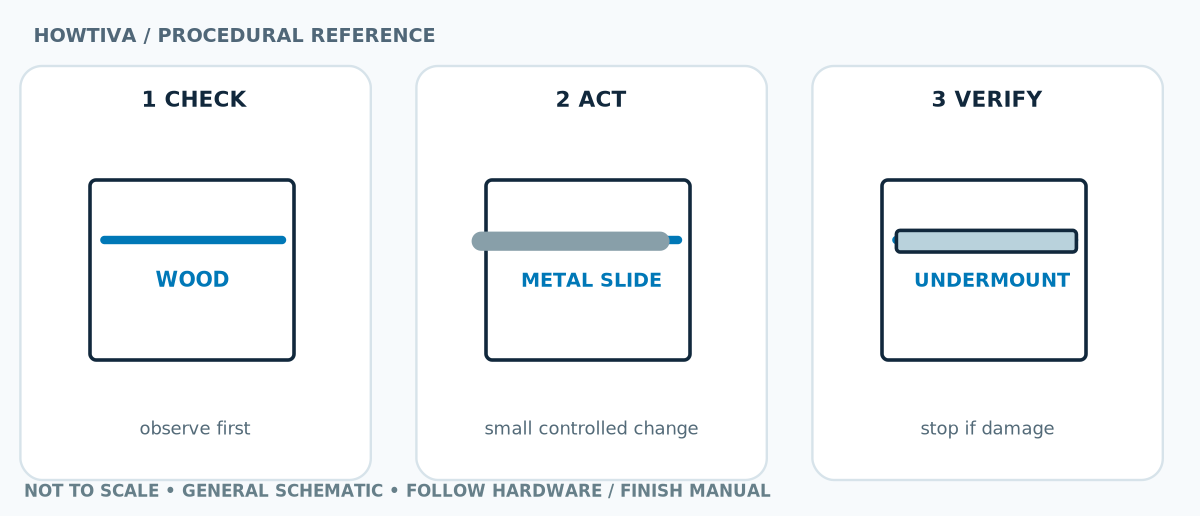
Wood-on-wood runners slide along wood rails; common side-mounted slides may use paired release levers; concealed runners can use front locking clips. Do not pull a drawer hard past its stop. Follow its maker’s removal instructions, preferably with a helper for large drawers.
Step 4: Clean and inspect the runners
Brush away dry grit from accessible surfaces and wipe the runner rails. Check for protruding fasteners, bent metal, missing rollers, swollen wood, and screws backing out. If both sides have a metal mechanism, keep lubricant off it unless its manufacturer specifically requires a product.
Step 5: Correct simple visible fastener or seating issues
With the drawer supported, snug a clearly loose mounting screw without shifting the rail from its required hole pattern. IKEA notes that drawer fronts and rails positioned in the wrong holes can cause a visibly offset installation. Follow the exact assembly diagram if the rail looks displaced.
Step 6: Use a material-specific alternative if appropriate
On a traditional bare wood runner, a tiny amount of manufacturer-compatible wood wax can sometimes reduce friction. Keep it off drawer contents and sealed food contact surfaces. Do not sand finished cabinetry, apply oil to ball bearings or spray silicone inside soft-close dampers.
Step 7: Reseat and test without a heavy load
Reinstall using the maker’s rails and clips, confirm the drawer is retained on both sides, and test a short open/close motion. Add ordinary contents gradually only after it moves correctly.
Two real-world situations to compare before repeating a step
Drawer sticks after you move house
A furniture cabinet may have racked or a rail may have shifted. Check squareness, level and loose fixtures rather than automatically lubricating. A metal glide whose screws loosened in transit may bind when loaded.
Antique wooden drawer stiff on rainy days
The wood may be absorbing moisture and swelling. Avoid carving or sanding it down while wet; inspect humidity and the existing finish and apply wax only if the maker and surface allow it.
Troubleshooting: when the first check does not solve it
Stops sharply at the same point. Likely an obstruction, mis-mounted rail or damaged carriage; investigate before forcing.
One side travels farther. Check both release clips and runner attachment; a detached side can cause the drawer to fall.
Soft-close drawer bounces or refuses to latch. The damper or locking clip may not be reset or aligned. Use its manual; do not oil the damper.
Wood drawer gets tighter in damp weather. Humidity can swell unfinished wood. Resolve indoor moisture conditions; do not remove large amounts of wood while it is temporarily swollen.
Alternative paths and brand-specific differences
For a heavy filing drawer, full-extension commercial mechanism or an antique with delicate veneer, seek maker service or cabinet help. Replace bent runners as matched pairs if specified; mismatched slides can bind and fail.
When to stop and ask for help
Stop at bent tracks, damaged locking clips, a drawer that could fall, a failed spring/soft-close unit or distorted frame. Heavy and specialized drawers need maker support.
Frequently asked questions
Should I use WD-40 on a stuck drawer?
Do not spray lubricant blindly. Product compatibility differs sharply between plain wood rails, plastic guides and precision slide assemblies.
Can I fix a drawer without removing it?
Yes: unloading, removing an accessible obstruction and tightening a visibly loose safe screw may be enough. Stop if the rails cannot be inspected without disassembly.
Sources & further reading
-
IKEA: Why do all my drawer fronts have a difference of about 1 cm?
-
IKEA: Why does my kitchen drawer end up too high or too low?
-
Howard Products via The Home Depot: Howard Paste Wax — manufacturer answer
Use the checklists as you go, and confirm the result before moving on to a more involved repair.