How to Fix a Loose Cabinet Hinge
Open the cabinet and support its door. Find which part moves: the hinge-to-door attachment, the mounting plate attached to the cabinet, or the hinge arm itself.
Quick answer: Open the cabinet and support its door. Find which part moves: the hinge-to-door attachment, the mounting plate attached to the cabinet, or the hinge arm itself. If an ordinary mounting screw is simply loose in sound material, snug it by hand with the correct screwdriver and recheck the door. Do not treat a hinge adjustment cam or clip-release button as a mounting screw.
Loose hinges often look like misaligned doors, but those are different faults. The first decision is whether the hardware attachment itself is moving or the door is securely attached but needs alignment. Concealed European-style hinges, face-frame hinges and exposed surface hinges use different fasteners. Some IKEA UTRUSTA hinges even use screwless expansion fittings at the door.
Check applicability and set up safely
You will need:
- Correct-size Phillips, Pozidriv or other driver for the actual head
- A helper or temporary support under the door
- Flashlight, camera or phone for identifying the hinge
- Replacement parts only when positively matched to hinge and cabinet material
Step-by-step procedure
Step 1: Support the weight and inspect the hinge
Open the door slowly and place a supporting hand or padded block beneath it. Avoid working alone with a large or glass-fronted door. Look at each hinge with the door slightly open, while lightly checking for movement. Note any split wood, swollen particleboard, cracked mounting plate or loose hinge cup.
Step 2: Distinguish mounting points from adjustments
For a typical concealed hinge the cup sits in the back of the door, its arm connects to a mounting plate on the cabinet, and separate screws or cams may change alignment. Compare against your hinge model guide. Older surface-mounted hinges generally expose ordinary mounting screws.
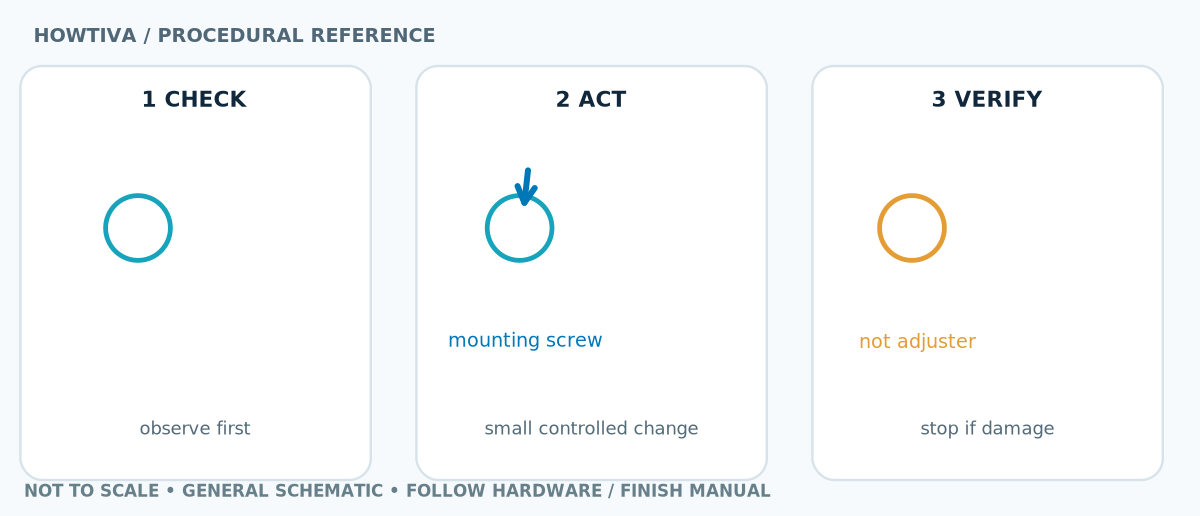
Step 3: Snug a truly loose mounting screw by hand
Hold the door in its normal position. Fit a correctly sized hand screwdriver squarely into the fastener and turn only until firmly seated; stop before the head strips or the board crushes. Tighten one accessible mounting fastener at a time, keeping the hinge supported. A power drill can strip small screws rapidly.
Step 4: Check the other hinge and the door gap
Repeat inspection on the other hinge without changing adjustment screws. Open and close the door gently. Look at the gap above and beside neighboring doors. If hinges are now firmly mounted but gaps are still uneven, perform the model-specific alignment process instead of continuing to tighten.
Step 5: Deal with a stripped hole conservatively
If a screw spins without gripping, stop. The correct repair differs between solid wood, plywood, MDF and particleboard. A compatible repair insert or correctly sized repair method may be possible, but drilling or stuffing random material into a thin cabinet wall can destroy it. Seek the cabinet maker’s approved solution.
Two real-world situations to compare before repeating a step
One lower hinge is wobbling
Support the door before touching it. If the cabinet-side plate moves but the hinge cup on the door remains firm, inspect the cabinet-side attachment. A screw spinning in particleboard is not repaired by simply tightening harder.
A screwless cabinet hinge
Some expansion-style systems intentionally have no loose screws at the door. Do not drill a pilot hole into the hinge cup or door because another kitchen uses screws; find the specific fastening mechanism.
Troubleshooting: when the first check does not solve it
The hinge plate slides when the door moves. The mounting screw or an expansion anchor may not grip, or the plate may be broken. Do not force it; assess cabinet substrate and replacement compatibility.
The screw head looks intact but keeps turning. Likely damaged threads or substrate. Further tightening will not restore holding power and may enlarge the damage.
One door corner drops. Support the door; check both hinge attachments first, then adjust height on a hinge design that permits it.
A clip-on hinge will not latch. A hinge arm may not be fully seated on its plate. Follow the exact manufacturer’s clipping procedure; do not substitute an improvised clip.
Alternative paths and brand-specific differences
If the hinge is cracked, sprung, heavily corroded or broken, source a compatible replacement using its number, overlay and mounting pattern. Do not replace only by appearance. For rented, built-in or warranty-covered cabinets, contact the responsible installer.
When to stop and ask for help
Stop at cracked substrate, a detached hinge cup, a glass or exceptionally heavy door or any joint that cannot carry the door securely. A failed attachment is a falling-door risk.
Frequently asked questions
Can I use a cordless drill to tighten it?
A hand screwdriver gives better feedback around small cabinet screws. Avoid powered tightening unless the hinge maker specifies controlled torque.
Is the front screw always the one to tighten?
No. On many concealed hinges the front cam adjusts the door side-to-side and is not a structural mounting fastener.
Sources & further reading
Use the checklists as you go, and confirm the result before moving on to a more involved repair.