How to Create Sinking Funds for Future Expenses
Create sinking funds for annual bills and planned purchases with clear pay-period formulas, sample fund allocations and review tips.
Quick answer: Identify a predictable future cost, write down how much you need and when you need it, subtract any money already reserved, then divide the shortfall by the number of deposits remaining before the bill is due. Save that amount each payday in a labeled pot or ledger category, and adjust the estimate if the cost or deadline changes.
What you will finish: A practical sinking-fund schedule for annual renewals, repairs, school costs, gifts or other known upcoming spending. All numerical examples are fictional US dollars; they are not product pricing, recommended savings rates or interest forecasts.
Understand sinking funds versus emergency savings
A sinking fund accumulates money for a cost you expect, even if the exact amount is approximate: annual vehicle insurance, replacement tires, holiday gifts, planned device replacement or school costs. An emergency fund holds accessible cash for unforeseen shocks such as sudden loss of income or urgent repairs. Canada’s FCAC specifically distinguishes occasional predictable expenses from emergencies. UK MoneyHelper’s 2026 guide describes using separate savings pots and planned periodic deposits.
This method is particularly useful when a monthly budget looks healthy until several annual costs arrive together. Setting aside a portion monthly does not make an expense cheaper, but it distributes its impact across pay periods and helps you see what cash is already committed.
Before you begin
Collect last year’s renewal notices, bills, and actual receipts; note each expected payment date and amount. For costs not yet quoted, use a conservative estimate informed by your own records rather than presenting an assumed price as a verified current offer. Choose whether each goal is essential or optional, and make sure urgent bills and mandatory debt payments can be funded before scheduling transfers. Pick a monthly or payday-based contribution frequency that matches income.
Step 1 — List every known future expense
Scan twelve months of statements and your calendar for quarterly, semiannual and yearly payments. Examples include vehicle registration, school uniforms, professional membership renewals, insurance premiums, planned family travel, periodic home maintenance and certain gifts. Record what each fund is for, the best estimated due date and whether the cost is fixed or variable.
Avoid creating 20 overlapping funds that are impossible to manage. You can combine several small household items under “annual household costs” so long as the ledger still records individual due dates. Don’t use sinking funds to conceal a current month that cannot cover essential living costs.
Step 2 — Calculate your deposit amount precisely
Use the formula:
Contribution per deposit = max(0, target cost − current fund balance) ÷ number of deposits before the deadline.
Count only deposits you can make before the bill must be paid. The number depends on today’s date, payday frequency and due date; “due in nine months” does not automatically imply nine deposits if a due date falls before your next payday. For monthly contribution plans, round up to the nearest cent or currency unit to avoid a small shortfall. If the cost can rise, add a clearly labeled discretionary margin and explain that it is an assumption.
These hypothetical goals assume exactly the following numbers of available monthly contributions and zero interest/fees:
| Fund | Target | Already saved | Deposits remaining | Monthly contribution |
|---|---|---|---|---|
| Insurance renewal | $900 | $0 | 9 | $100 |
| Year-end gifts | $480 | $0 | 12 | $40 |
| Planned appliance replacement | $360 | $0 | 6 | $60 |
| Total monthly allocation today | $200 |
Check: $100 × 9 = $900; $40 × 12 = $480; $60 × 6 = $360. The $200 total applies to the overlapping months while all three funds are active; once the replacement is purchased after six contributions, that $60 allocation can be redirected by an explicit budget decision.
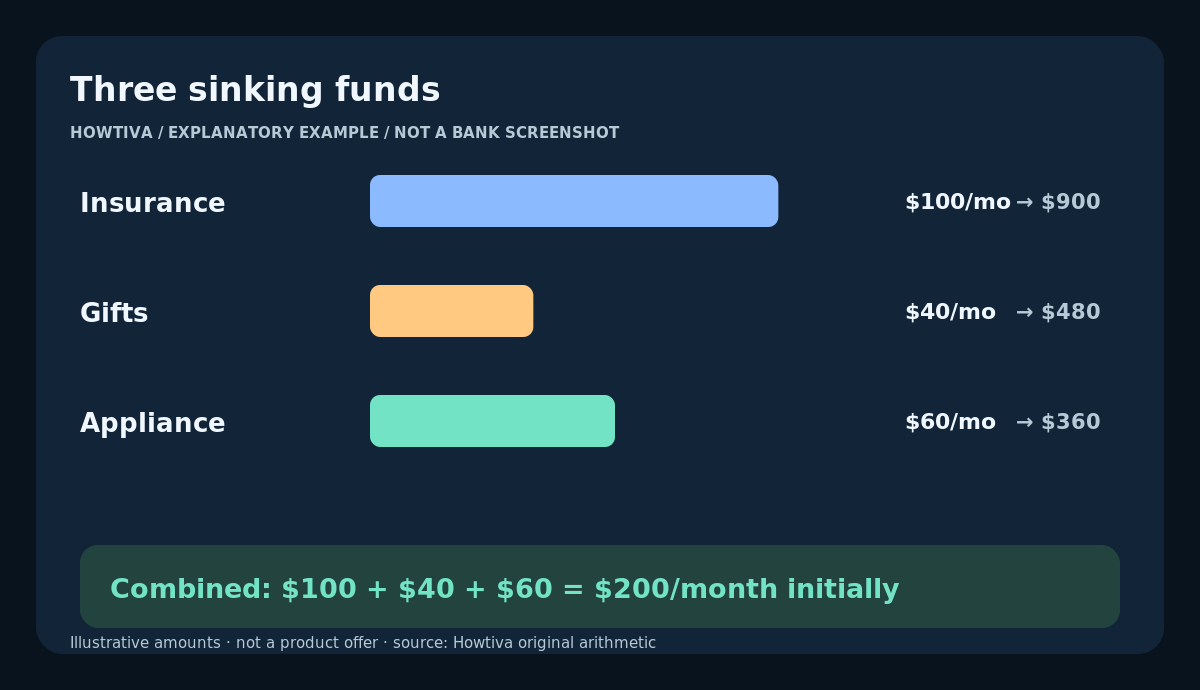
Figure: Nine insurance contributions of $100, twelve gifts contributions of $40 and six appliance contributions of $60 sum to $200 in overlapping months.
Step 3 — Account for money already saved or a new deadline
Suppose the insurance goal is still $900 due after exactly nine monthly deposits, but you already have $150 designated for it. The remaining gap is $750. Divide $750 by 9 = $83.333…, so set aside $83.34 per month. Nine such deposits total $750.06; together with the starting $150, the fund will hold $900.06, ignoring interest and fees. Rounding down to $83.33 would provide only $899.97 and leave a three-cent gap.
If the due date moves to four deposits away with the same $150 already saved, the required monthly amount becomes $187.50 ($750 ÷ 4). If the amount is not affordable, consider revising the underlying expense, checking for legitimate payment options or changing an optional goal—not assuming a magical return on savings.
Step 4 — Decide where to keep and label the money
Options include a dedicated easy-access savings account, bank-provided subaccounts/pots, or one account with a reliable spreadsheet subledger. Compare accessibility, fees and the terms of any transfer or withdrawal restriction before using an account. Some banks offer labeled savings spaces, but features and deposit safeguards are provider- and country-specific; do not invent a product or promise eligibility. For expenses due very soon, instant or predictable access matters more than a speculative future return.
If using a single account, label each fund’s allocated balance in a ledger and ensure their sum equals the corresponding earmarked amount within the account. Unassigned cash is not automatically available for discretionary spending if it has already been allocated to bills.
Step 5 — Put deposits on the calendar and verify them
Schedule an affordable transfer after you are paid, or use a calendar reminder and transfer manually. Do not automatically debit an account if cash availability is uncertain; check pending withdrawals and essential bill due dates first. Every month, record each fund’s opening balance + deposits − payments made from the fund + any verified interest/adjustments = closing balance.
When you pay an insurance renewal, record the original bill expense against its category and use the accumulated savings to fund it. Avoid counting the savings transfer and the final purchase as two unrelated consumption expenses. One is moving cash; the other is the actual cost.
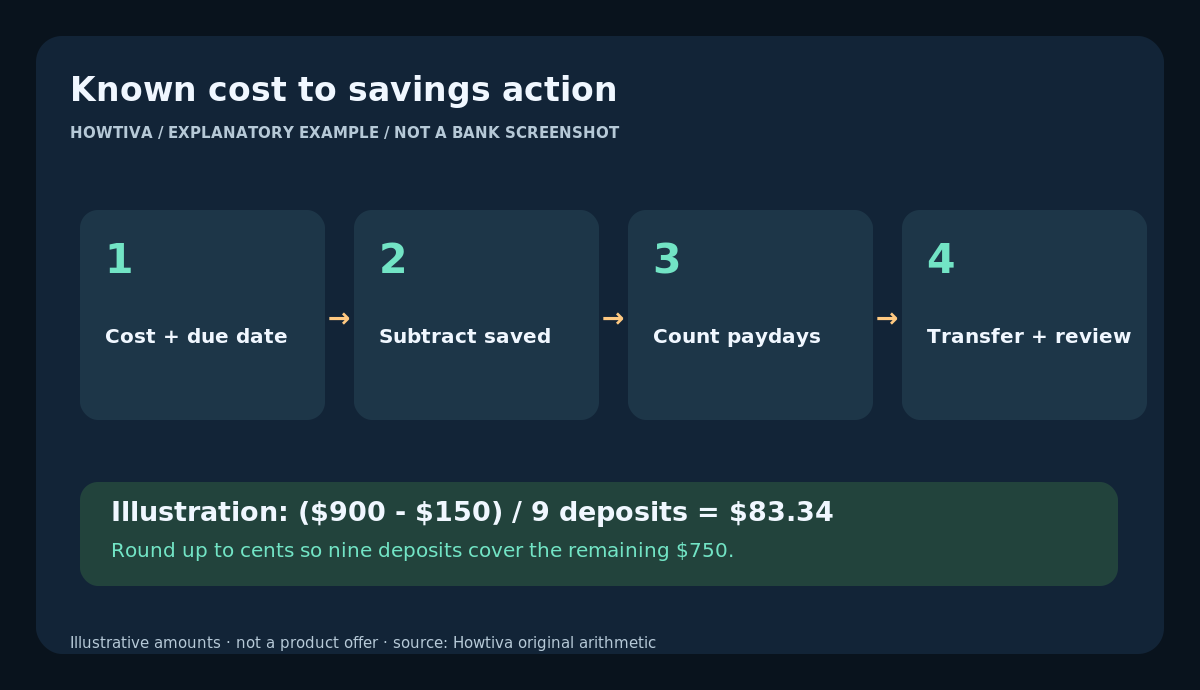
Figure: Write down estimated cost and due date, subtract balance, divide by remaining deposits, transfer and review.
Step 6 — Review price changes and shortfalls ahead of the deadline
At least monthly, compare the target with newly received official bills or quotes. If the cost estimate increases from $900 to a hypothetical $990 while nine deposits remain and nothing is saved, the deposit must rise from $100 to $110. If the first few deposits already happened, recalculate using remaining balance needed ÷ remaining deposits, not the original number of months.
If an annual bill is due next week and the fund is empty, do not misrepresent the shortage as solvable by dividing by twelve. Address the real near-term cash need using available funds, biller arrangements where offered or appropriate debt advice; then establish contributions toward the following renewal. Do not drain emergency savings for predictable bills unless real circumstances require prioritization.
Common mistakes and troubleshooting
- I assumed I had 12 months before an annual bill. Count deposits actually available before the next payment date. A renewal in three months needs a three-payment calculation, not a twelve-payment one.
- The fund balances add up to more than my savings account. Reconcile transfers, purchases and any pot-to-pot movements; you may have counted allocated money twice.
- I add interest that has not been earned. Plan on zero interest unless explicitly modeling a clearly dated, non-guaranteed assumption; rates and conditions can change.
- I budget the savings transfer as a purchase and count the bill again. A transfer is a movement of money. Record the actual bill once as consumption in the relevant reporting view.
- I use a holiday fund for an emergency and forget it. A genuine crisis may justify reallocating funds, but update the holiday target and remaining deposits transparently.
- The due date changed. Recalculate the shortfall using the new count of deposits, not the old monthly amount.
- There are too many pots. Combine them into 3–5 meaningful buckets with a written subledger and due-date list.
Alternative methods and special cases
With weekly pay, count actual weekly paydays before the cost is due; an estimated annual $520 bill with 52 scheduled contributions requires $10 per contribution when starting from zero, whereas a 26-paycheck schedule needs $20 per payday. Both assume no missed payments and no interest. With uncertain income, make the essential portions part of a conservative baseline, then top up optional pots in strong months. Some bills offer monthly direct payments rather than annual renewal; compare the total fees, discounts and contractual terms before choosing—not just the apparent monthly price.
Country notes
UK: MoneyHelper’s May 2026 sinking-fund guidance explicitly addresses planned recurring expenses, deposit counts and savings pots. Canada: FCAC distinguishes predictable occasional bills from emergency savings. US: CFPB’s cash-flow guidance supports preparing for less-frequent expenses and mapping savings to bill timing. Australia: Moneysmart describes separate accounts and budgets that include annual and irregular costs. Bank pot features, insurance/consumer protections, cancellation rights and deposit schemes differ by jurisdiction and provider. References reviewed 27 October 2026; this article does not assert current institutional interest rates, fees or protection limits.
Frequently asked questions
Do I need a separate bank account for every sinking fund?
No. A single safe account with a clearly maintained subledger can work. Keep totals reconciled and make sure the funds remain accessible when needed.
Is a sinking fund only for big purchases?
No. Small predictable annual or quarterly bills can also be easier to manage when funded a little at a time.
What if a planned cost disappears?
Review and deliberately reassign the remaining pot balance to another goal, an emergency reserve or current priorities rather than losing track of it.
What if I miss a contribution?
Calculate the updated unfunded amount and divide by the deposits still possible. Reduce or reschedule optional goals if the revised amount is not affordable.
Can I earn interest on the pot?
Possibly, depending on the product, but actual rates, fees, access rules and tax treatment change. Do not rely on an assumed return to make an imminent bill affordable.
Final checklist
- Identify known costs, estimated amounts and real due dates.
- Distinguish sinking funds from emergency savings.
- Count actual deposit opportunities before each payment.
- Subtract money already set aside and round contributions up appropriately.
- Confirm the combined contribution fits a realistic budget.
- Keep clear fund labels, accessible money and reconciled totals.
- Review deadlines, quotes and balances every month.
Sources & Further Reading
- MoneyHelper — Sinking funds explained (updated 29 May 2026)
- MoneyHelper — Managing your money using savings pots
- FCAC — Setting up an emergency fund
- CFPB — An essential guide to building an emergency fund
- ASIC Moneysmart — How to do a budget
Editorial note: Checked against official financial-literacy guidance on 27 October 2026. Cost numbers, deadlines and examples are illustrative. No account transfer or provider functionality was tested.
Use the checklists as you go, and confirm the result before moving on to a more involved repair.