How to Calculate Credit Card Interest
Learn credit card daily interest, APR, average daily balances and grace periods with precise illustrated calculations.
Quick answer: Find the APR that applies to the relevant credit card balance and the issuer’s interest method. For a common non-compounding average-daily-balance illustration, approximate interest by sum of each day’s balance × (APR ÷ 365). Use your statement’s exact billing dates and distinguish purchases, cash advances, balance transfers and any grace period.
What you will achieve: This guide helps reproduce an estimated purchase-interest line, check why an amount changes after a payment and understand why APR divided by 12 is only a rough shortcut. It is not a substitute for the specific card agreement or a guarantee of the issuer’s bill.
Before you begin
Collect the statement dates, transaction posting dates, purchase APR, cash-advance APR if relevant, daily-balance definition, payments and credits, opening balance and whether your card has a grace period. Some contracts use 365 days or another disclosed divisor; compounding, billing cutoffs and rounding rules also vary.
Credit-card interest follows the issuer’s agreement: purchase balances, cash advances, grace periods and promotional rates may have different rules. Use the actual balance and billing dates, not a generic monthly percentage.
Step-by-step instructions
-
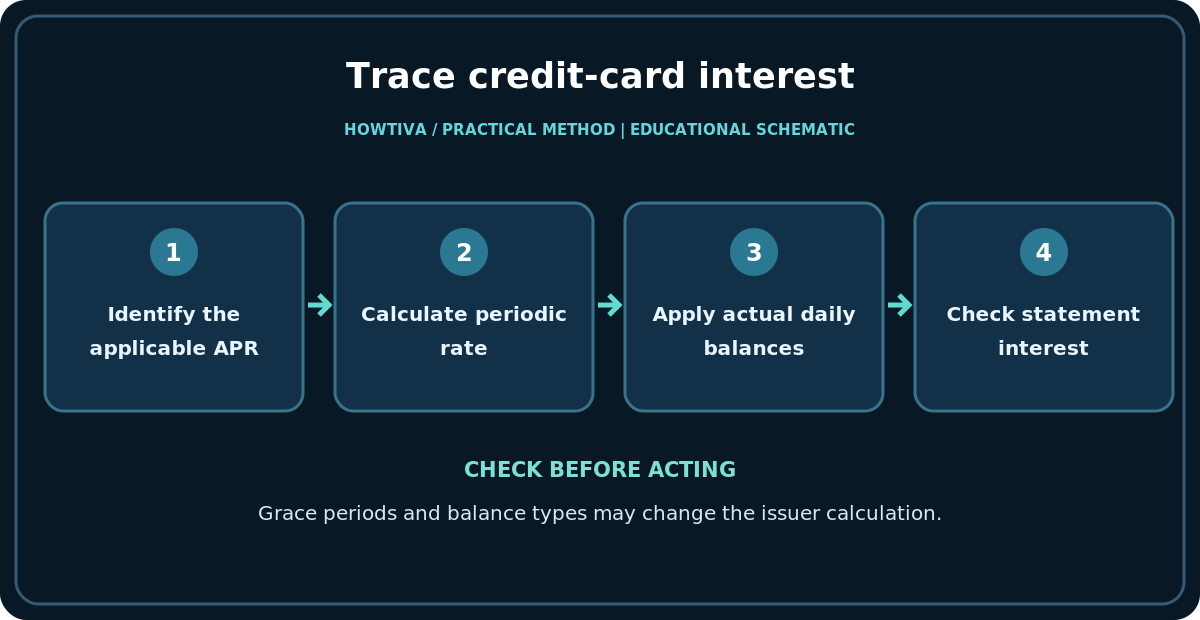
Locate the balance category: Use the rate for the type of balance being calculated. Purchases and cash advances can accrue differently. If a promotional purchase rate applies, check its expiration and what transactions qualify.
-
Check whether interest is owed: When an eligible purchase grace period remains in effect and the required statement balance is paid in full by its due date, purchase interest may be avoided. A grace period generally does not apply in the same way to cash advances.
-
Mark every day in the cycle: From opening date through closing date, note balance changes after posted purchases, payments, refunds or adjustments. A payment halfway through a cycle affects fewer days than a payment on the first day.
-
Apply the daily rate: For the illustrative agreement in this article, daily periodic rate = annual APR as decimal / 365. At 24% APR it is 0.24/365 = about 0.000657534 per day; do not round this rate to two decimals.
-
Multiply before rounding: Calculate balance × daily rate for each day or multiply the common balance by days in that group. Sum all daily charges and round only when the card’s contract requires rounding.
-
Review the average-daily-balance equivalent: For simple non-compounded treatment, interest = average daily balance × APR/365 × days. This produces the same result as summing each day’s non-compounded interest.
-
Reconcile posted interest: Separate foreign transaction, late and annual fees from interest. Consider issuer-specific balance calculations, a lost grace period, promotional balances and any daily compounding before assuming a billing error.
-
Reduce avoidable future interest: If interest is accruing daily and no grace period applies, earlier payments generally reduce the outstanding balance sooner; continue paying at least the required amount by the due date.
Worked financial example
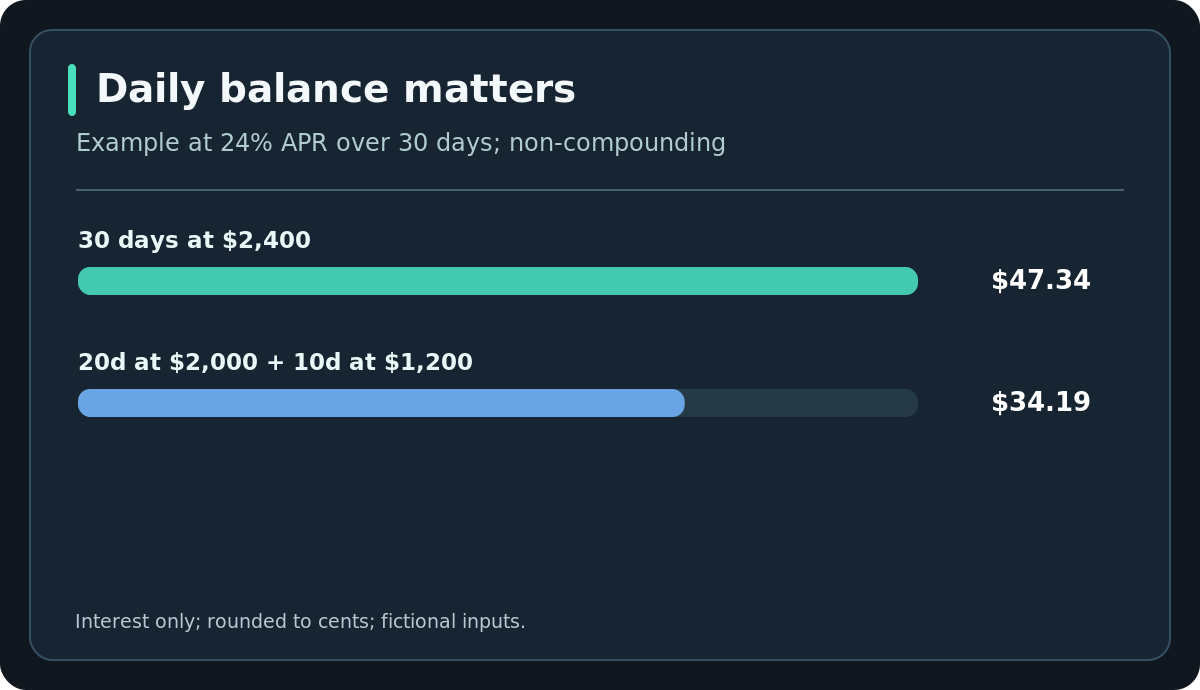
Purely illustrative: a $2,400 constant balance for 30 days at 24% APR without compounding or a grace period gives $2,400 × 0.24/365 × 30 = $47.34 after rounding to cents. It is not a prediction of a specific bank’s monthly charge.
Second worked scenario and interpretation
If the balance is $2,000 for 20 days and $1,200 for the next 10 days at 24%, the sum of daily balances is ($2,000 × 20) + ($1,200 × 10) = $52,000 balance-days. Interest = $52,000 × 0.24/365 = $34.19. The average daily balance is $52,000/30 = $1,733.33 repeating, giving the same amount using full precision.
Common mistakes and troubleshooting
- Using APR divided by twelve as an exact bill: Billing periods have different day counts; issuer conventions vary.
- Forgetting the grace period: Interest on eligible purchases may be zero when the full-pay conditions are met.
- Mixing rate buckets: Cash advances, purchase transactions and promotions may have different rates.
- Assuming payments post at midnight: Posting and effective times depend on issuer rules; use the statement and contract.
If the estimate disagrees with the statement, reconcile transaction dates, daily balances, promotional expiration and any newly posted fees before disputing a charge.
Alternative methods and exceptions
- Simple planning estimate: APR/12 × average balance is a rough monthly scale, not an exact reconciliation.
- Daily compounding: Where the agreement compounds daily, calculate a day-by-day changing balance or use the bank’s disclosed formula.
- Grace period uncertainty: Ask the issuer when a grace period is restored rather than assuming a single full payment immediately changes all interest rules.
Country-specific considerations (checked 2026-10-27)
- US: CFPB explanations describe common average-daily-balance and grace-period methods; check the US card agreement and statement for actual APR categories.
- UK: Cards also disclose an annual rate and a payment calculation, but repayment, interest and annual-rate conventions can differ from US disclosures.
- Canada: Card terms, grace periods and disclosures follow applicable Canadian rules and contract details; do not assume US 365-day calculations.
- Australia: Australian card issuers may use distinct rate types and interest-free period conditions; check product terms and your bank’s daily-interest explanation.
Frequently asked questions
Does a 24% APR always mean 2% each month?
No. It is a useful rough mental estimate; many issuers assess daily balances over the actual cycle.
Can paying earlier help?
When an interest-bearing balance accrues interest daily, reducing it earlier usually lowers future interest.
Why do I see interest after paying in full?
Accrued or residual interest may post after payment when a balance previously bore interest. Ask the issuer to explain.
Is a cash advance treated like a purchase?
Often no. A separate rate and immediate interest accrual may apply.
Final checklist
- [ ] Find relevant APR and transaction category
- [ ] Check grace-period eligibility
- [ ] Count actual statement days
- [ ] Track daily balance changes
- [ ] Carry unrounded daily rates
- [ ] Compare estimate against issuer disclosure
Sources & Further Reading
- Consumer Financial Protection Bureau — How does my credit card company calculate interest? — Average daily balance and periodic rate method.
- Consumer Financial Protection Bureau — What is a grace period for a credit card? — Grace-period limitations and new purchase charges.
Use the checklists as you go, and confirm the result before moving on to a more involved repair.