How to Create a Monthly Budget
Create a practical monthly budget using take-home income, real expense categories, annual bills and a worked $4,200 allocation.
Quick answer: Calculate your dependable monthly take-home income, list every monthly and less-frequent expense, assign a realistic amount to essentials, flexible spending, debt payments and savings, then check that planned uses of money equal or stay below available money. Track actual spending during the month and revise your plan; a budget is a working decision tool, not a test of willpower.
What you will finish: A one-page monthly spending plan with line-item amounts, bill dates, space for irregular costs and a review routine. This is general financial education, not individualized financial, tax or debt advice. All amounts below are hypothetical US-dollar examples, not national averages or recommended spending levels; use your own currency and figures.
Before you start: gather accurate numbers
Set aside 30–60 minutes and collect two or three recent bank/card statements, payslips, cash receipts, recurring bills, debt minimum payment notices and a calendar of annual renewals. Include income you can genuinely use after deductions; do not treat withholding or money owed to a tax authority as spendable. If you share costs with someone, agree whether this covers one person or an entire household to avoid counting the same amount twice. Store statements securely rather than uploading them to an unknown budgeting service.
Write down the month you are planning for and the currency. If you have irregular pay, use the conservative method in How to Budget with Irregular Income (separate Howtiva guide; URL pending approval), rather than assuming your best month will repeat. A budget cannot solve a structural shortage by itself; where essential bills already exceed dependable income, prioritize immediate assistance and negotiating realistic due dates instead of inventing savings amounts.
Step 1 — Convert income to one monthly basis
List net, accessible income by source. A monthly salary is already monthly; if you are paid biweekly (every two weeks), multiply each take-home payment by 26 ÷ 12 to estimate the annual average monthly amount. For weekly pay, use 52 ÷ 12. If you are paid twice monthly (24 paydays a year), multiply by 2. Do not confuse biweekly pay with twice monthly. Average monthly pay is useful for annual planning, but a two-paycheck month may have less cash than the average: also mark actual paydays and cash availability.
For example, an illustrative $1,800 take-home paycheck every two weeks gives $1,800 × 26 ÷ 12 = $3,900 average per month, although a typical two-paycheck month brings $3,600. Do not promise to pay $3,900 in bills during a $3,600-cash month unless you already have an appropriate buffer.
Step 2 — Separate essential bills from variable spending
Start with rent or mortgage, utilities, basic groceries, essential transport, essential insurance and required minimum debt payments. Next list controllable expenses such as dining out, streaming, hobbies and discretionary shopping. Estimate from actual statements, not from what you wish you spent. Include household costs paid in cash and automatic charges on more than one card.
When an amount varies, look at three or more months, identify seasonal peaks and plan an amount you can actually sustain. Write due dates beside bills; a mathematically balanced budget may still fail if several payments fall before payday. If a bill is annual, set aside a portion monthly in a sinking fund instead of pretending it will never arrive.
Step 3 — Convert occasional costs into monthly savings targets
List insurance renewals, vehicle maintenance, school expenses, gifts and other foreseeable bills. For a cost evenly spread across a full year, monthly contribution = expected annual expense ÷ 12. For example, an illustrative $600 annual insurance renewal suggests setting aside $50 per month if you have 12 contributions before it is due. If only four months remain, $600 ÷ 4 = $150 per month instead. Check whether your savings account or bank offers optional separated pots; do not assume every bank provides them.
Keep a sinking fund (planned expense) separate from an emergency fund (genuinely unplanned loss or shock). If you are saving toward debt reduction, make sure mandatory minimum payments remain in the essentials section; extra debt repayment is a distinct line.
Step 4 — Make a zero-based plan (not a zero bank balance)
The equation is available monthly income − allocated monthly expenses − savings − extra debt payments = unassigned amount. Aim to allocate the unassigned amount purposefully; this does not mean spending all cash or emptying your checking account. Include a small contingency or carry-forward buffer where cash flow requires it.
Here is a fully illustrative monthly plan for one household with $4,200 in net income:
| Planned category | Amount | Explanation |
|---|---|---|
| Housing | $1,400 | Required housing payment |
| Utilities | $260 | Expected monthly bills |
| Groceries | $500 | Food bought for home |
| Transport | $320 | Necessary travel |
| Insurance | $180 | Monthly premiums |
| Minimum debt payments | $240 | Contractual minimums |
| Flexible spending | $650 | Entertainment, dining, nonessentials |
| Sinking funds | $250 | Known future bills |
| Emergency savings | $300 | Financial-shock buffer |
| Extra debt repayment | $100 | Optional beyond minimums |
| Total planned | $4,200 | Matches income; unassigned $0 |
The first six categories total $2,900. The remaining $1,300 consists of flexible spending ($650), sinking funds ($250), emergency savings ($300) and extra repayment ($100). This is not a universal ideal allocation; rent, childcare, debt and income vary widely.
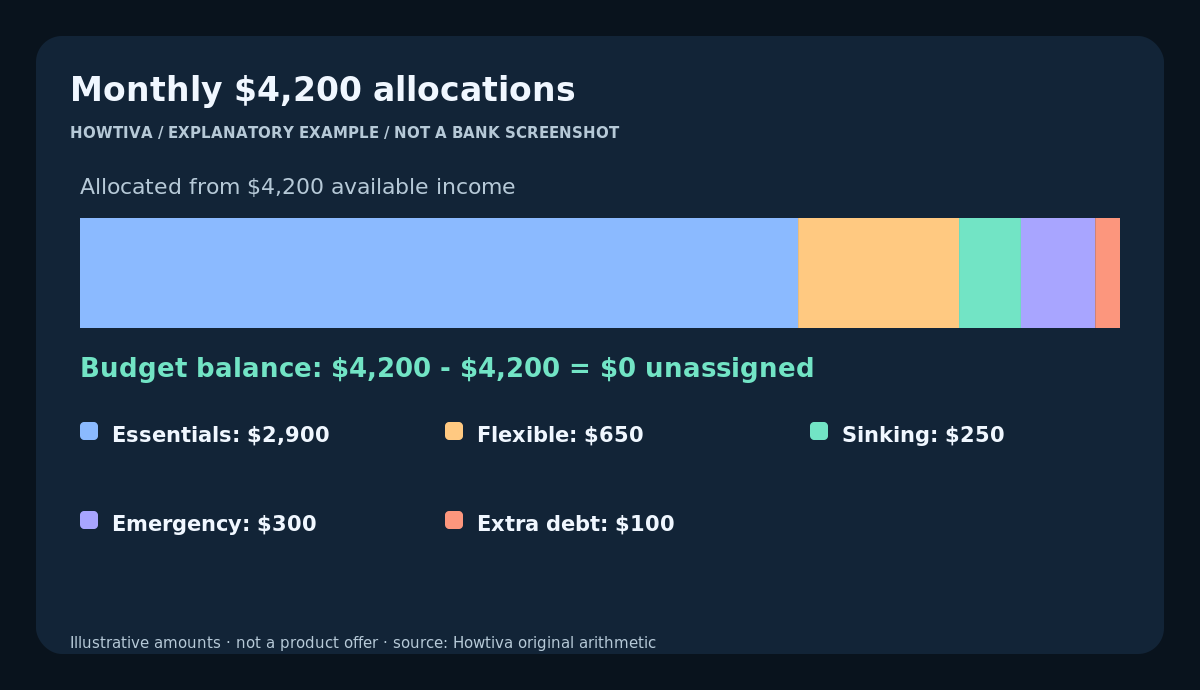
Figure: Illustrative $4,200 monthly income allocated across essential bills, flexible spending, sinking funds, emergency savings and extra debt payments.
Step 5 — Check cash timing before you automate anything
Draw a simple calendar showing the day each paycheck arrives and the date each large bill clears. Ensure the account will have enough cleared funds on that date, not merely that the month ends positive. If a rent payment falls before the first paycheck, carry an opening balance or contact the biller about changing the due date where possible. Account transfer and overdraft rules vary by institution and jurisdiction.
If you automate savings, choose a transfer date after reliable income arrives and monitor the account. Automating a transfer that leaves too little for essential payments can create fees, missed payments or overdrafts. Check pending card transactions before assuming a displayed account balance is fully available.
Step 6 — Compare actual spending to the plan weekly
During the first month, record transactions at least weekly using a spreadsheet, paper ledger or reputable banking export. Compare actual spending with the allocation for each category. If groceries exceed the plan by $45, either reduce a different flexible category by $45 or revise the plan openly; don’t hide the difference. Separate account transfers from purchases so moving money to savings is not double-counted as a new expense.
At month end, calculate actual net income − actual spending − planned transfers to savings and reconcile against opening/closing balances after adjusting for transfers and uncleared transactions. If it doesn’t match, investigate missing cash spending, pending charges, refunds and duplicate transactions. Record what changed and set next month’s numbers based on actual data.
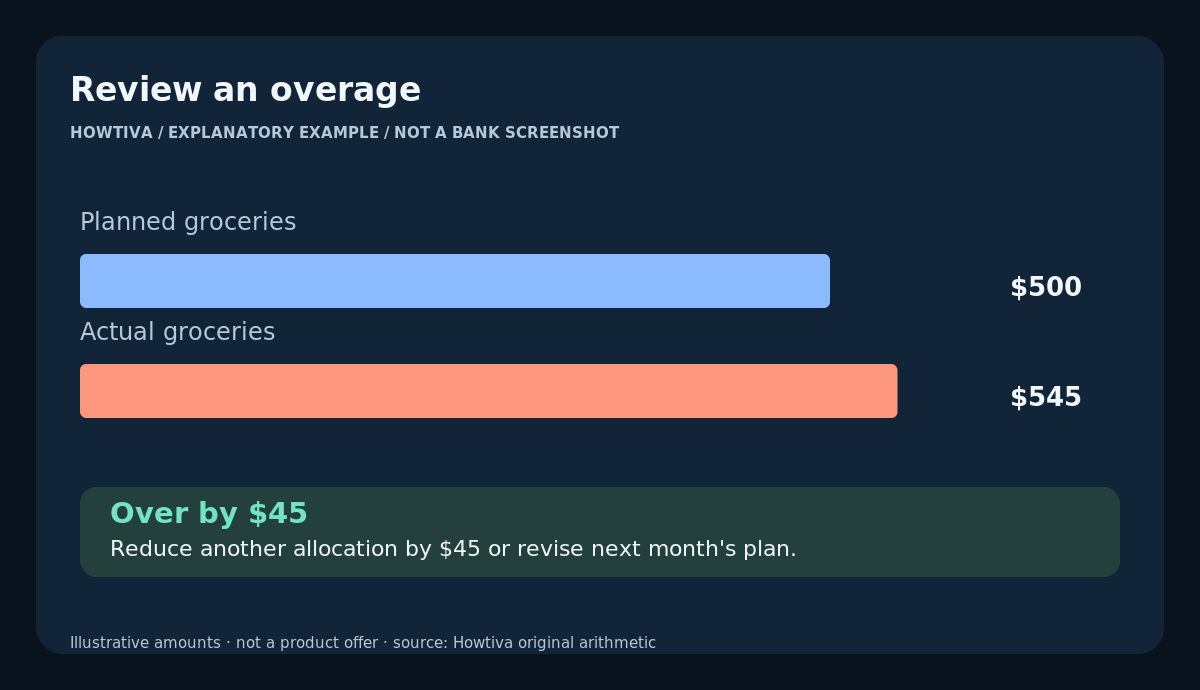
Figure: Illustrative grocery spending of $545 exceeds a $500 plan by $45; adjust another category or revise the plan.
Common mistakes and troubleshooting
- The budget says I have money but the account is empty. Check due dates, outstanding payments and whether you used an annual average for a low-cash month. Build a payment-date view beside the monthly total.
- I keep forgetting yearly bills. Scan twelve months of statements and a renewal calendar. Start a sinking fund for known future costs rather than treating them as emergencies.
- Everything fits only if I spend nothing on food or transport. The plan is unrealistic. Price essential needs honestly, reduce flexible costs first and seek help early with essential bills or debt if a shortfall persists.
- A refund appears as income. Refunds usually reverse the category of an earlier purchase; otherwise your income and spending totals can be distorted.
- I count card purchases and card repayments as two expenses. Track purchases when they occur; treat later card-balance repayment as a transfer or liability payment appropriately, while recording interest/fees as actual costs.
- I copied a 50/30/20 rule and failed. Percentage rules are optional planning shortcuts, not legal rules or evidence that your local housing and debt costs must fit a fixed ratio.
Alternatives and exceptions
An envelope system assigns cash or digital pots to categories; a pay-yourself-first plan moves an affordable amount into savings when money arrives; a paycheck-by-paycheck plan maps each bill to the deposit that will fund it. Households with income shocks, costly overdraft use or arrears may need a weekly cash-flow schedule before a conventional monthly budget. Joint household budgets should document which expenses are shared and which are personal.
Country notes: United States, United Kingdom, Canada and Australia
The core arithmetic is the same worldwide; bank product features, debt-help services, taxes and pay cycles are not. In the US, CFPB provides income, spending and cash-flow worksheets. In the UK, MoneyHelper’s Budget Planner accommodates varied payment frequencies and annual costs. In Canada, the Financial Consumer Agency of Canada provides a Budget Planner. In Australia, ASIC Moneysmart offers a budget planner with selectable payment frequency. Confirm your own provider’s account rules before setting up pots, direct debits or transfers. Sources verified 27 October 2026; we do not assert particular current fees or tax thresholds.
Frequently asked questions
Does a budget have to be perfectly balanced every month?
No. The goal is to make an actionable plan that avoids committing more than you can fund. A planned surplus can become savings or a cash cushion. A deficit is a signal to revisit commitments, income and support options.
Should I use gross or net income?
Use take-home/after-tax money for a household spending plan. If self-employed, reserve for tax obligations before calculating spendable income; the applicable tax treatment depends on location and circumstances.
What if I get paid every two weeks?
Use 26 payments per year for long-run averages, but schedule bills against actual paycheck dates. Two three-paycheck months in some calendars do not justify spending money before it arrives.
Is my monthly savings transfer a bill?
It is an allocation of cash, not consumption spending. Include it in the budget so total uses match income; avoid counting it again as an expense when reconciling transactions.
How often should I rebuild my budget?
Review briefly each week, close the numbers each month and redo assumptions when income, housing, dependents, debt or major bills change.
Final checklist
- Define the household, currency and month.
- Use dependable, net monthly income and mark real payday dates.
- List fixed, variable, debt and less-frequent costs.
- Budget annual expenses with correct remaining contribution count.
- Allocate no more cash than is available; leave a buffer where needed.
- Verify the balance before scheduling automatic transfers.
- Reconcile weekly transactions and review at month end.
Sources & Further Reading
- CFPB — Get your money situation in order
- CFPB — Your Money, Your Goals companion tools
- MoneyHelper — Budget planner
- FCAC — Making a budget
- ASIC Moneysmart — How to do a budget
Editorial note: Reviewed against the linked official resources on 27 October 2026. Examples and figures are illustrative; calculation checks are documented separately. No live bank, paid application or WordPress workflow was tested.
Use the checklists as you go, and confirm the result before moving on to a more involved repair.