How to Compare Employee and Independent Contractor Expenses
Compare employee salary, contractor costs, payroll taxes, benefits and billable hours without mixing cash and noncash value.
Quick answer: Compare the full annual economic picture, not just an employee salary with a contractor’s headline day rate. Normalize both options to the same time period; record reliable income, business overhead, unpaid time, insurance, retirement support, payroll taxes and cash-flow risk separately. Then assess whether the proposed contractor arrangement is legally a contracting relationship in your country. A contract that calls you independent does not, by itself, make you independent.
What you will finish: A side-by-side worksheet for an employee offer and a hypothetical self-employed work arrangement, a billable-hours price floor and a list of legal questions to verify. Financial examples below are fictional US-dollar calculations, not market salaries, typical benefits, tax advice or a recommendation to change employment status.
Gather the offers and keep assumptions aligned
Obtain the employee offer letter and written benefits summary, the contractor statement of work, expected invoice timing, liability or professional insurance quotes if relevant, estimated equipment/software charges, planned time off and a realistic number of billable hours. Identify who pays for employer benefits and who reimburses expenses. Separate payments you certainly receive from optional bonuses and business revenue that depends on winning work.
A salary is generally compensation for an employment arrangement that may include paid leave; contractor revenue often comes only from approved, billable work actually invoiced and collected. When comparing, do not count holiday pay twice: if paid vacation is already included in the employee’s annual salary, it is part of that annual figure, not an extra identical salary payment.
Step-by-step: compare like with like
Step 1 — Establish the correct work classification
Before running spreadsheets, document who directs the work, who supplies tools, whether the person has multiple customers, who bears business risk, and whether the relationship is ongoing. In the US, the IRS assesses behavioral control, financial control and the type of relationship, among other facts. It is a multi-factor test; a signed invoice agreement or a Form 1099 cannot decide the issue alone. The legal classification may affect overtime, wage, tax and other entitlements.
In the UK, employment-law and tax classifications can differ, and agency, worker and off-payroll arrangements need separate scrutiny. Australia and Canada use their own legal tests and employment protections. Never relabel a genuine job as contracting solely because a spreadsheet makes the invoice amount look larger.
Step 2 — Convert income to a realistic annual amount
For employee compensation, start with the annual salary (or hourly wage × paid hours, allowing for overtime arrangements). Add employer-paid contributions and benefits as separately valued benefits, not take-home cash. For contractors, use realistic client fees for work expected to be sold and paid for, not 52 weeks at an advertised maximum rate. Subtract anticipated non-billable days from time that could otherwise generate invoices when making the forecast.
Imagine an illustrative employee salary of $70,000/year, with employer-provided health benefits valued at $6,000 and employer retirement contributions of $2,800. The total illustrative nominal package value is $78,800, but only $70,000 is cash salary before taxes; health and retirement values cannot automatically pay next month’s rent. A second fictional offer anticipates $92,000 of collected annual contractor invoices. These offers are not yet directly comparable.
Step 3 — Separate contractor costs and taxes from gross billings
Build cost lines for equipment, computer subscriptions, mandatory licenses, professional insurance, bookkeeping, unpaid administrative time and travel that will not be reimbursed. In the example, assume $5,000 in substantiated business operating costs and $6,000 of personally paid health coverage. These figures are illustrative; the US deductibility of particular premiums is not established by the example.
The contractor’s assumed business profit before self-employment tax is $92,000 − $5,000 = $87,000; personal health cover is displayed as a separate personal cash outflow rather than automatically reducing Schedule C profit. Under a conventional, below-ceiling US 2026 self-employment calculation with no W-2 wages, estimated regular SE tax is $87,000 × 92.35% × 15.3% = $12,292.71. This excludes federal income tax, state taxes, any additional Medicare tax and business-specific adjustments. A particular health-insurance income-tax deduction may exist, but has not been assumed in this cash comparison.
Step 4 — Calculate an employee cash comparator separately
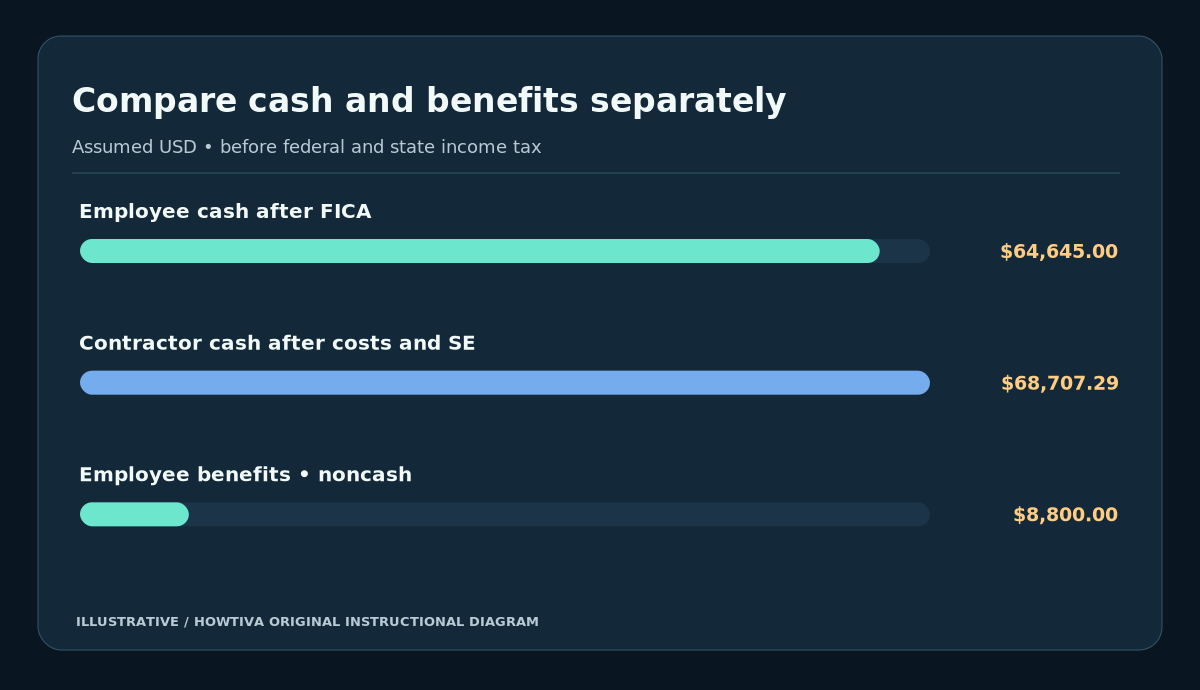
A simplified US employee with the fictional $70,000 salary would have ordinary employee Social Security and Medicare withholding of 7.65% if fully below the wage base, or $70,000 × 0.0765 = $5,355.00. Salary after those two payroll taxes (but before income taxes and any employee benefit premiums) would be $64,645.00. Employer health and retirement benefits remain a separate $8,800 non-cash nominal package value, not deposits into the employee’s personal checking account.
The contractor’s simplified annual cash after the $5,000 business costs, $6,000 personally paid health premium, and $12,292.71 ordinary SE tax would be $68,707.29, also before federal/state income tax and any other coverage or retirement contributions. A raw cash gap is $4,062.29 in favor of this assumed contractor scenario, but it is not an after-tax pay difference. Income taxes, benefit value, risk, timing and additional costs might reverse the result. It does not mean contracting is better.
Step 5 — Price non-billable time rather than assuming 2,080 invoices
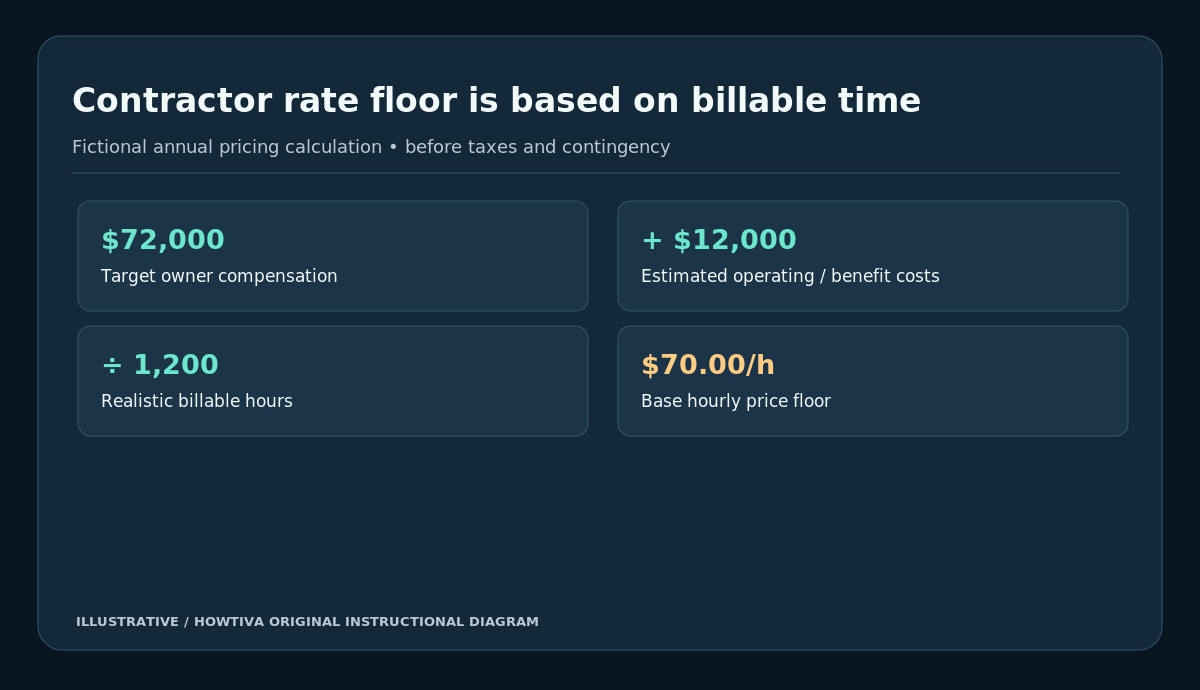
A contractor pays for time spent pitching clients, preparing proposals, bookkeeping, unpaid training, sick days, holidays and gaps between engagements. If your expected annual contractor target is $72,000 for owner compensation plus $12,000 estimated business and personally funded benefits costs and you can realistically invoice 1,200 hours, the simple pre-tax floor is ($72,000 + $12,000) ÷ 1,200 = $70 per billable hour. An advertised $70/hour for 2,080 hours would be misleading if only 1,200 can be billed. Add contingency and taxes separately; the simple price floor is not a market quote or a guarantee that clients will buy every hour.
Step 6 — Compare cash timing and risk
An employee paycheck may arrive on a regular schedule. Contractor invoices can be delayed, disputed, canceled or only partially paid. Build a month-by-month cash forecast: opening cash + receipts − due bills − tax reserve − essential expenses = closing cash. Identify the largest expected low-cash gap and the contract terms for deposits, termination, late payment and reimbursements. Do not treat an unpaid invoice as immediately spendable cash.
Factor in workers’ compensation rules, liability exposure, customer concentration, replacement equipment and the ability to obtain insurance where you live. Contract terms may allocate risk unexpectedly; do not assume that a verbal promise of an annual amount is enforceable.
Step 7 — Put the offer comparison in three separate columns
Column A: cash available under your assumptions, with taxes carefully scoped. Column B: non-cash compensation and protection, including paid leave and employer-sponsored benefits. Column C: uncertainty and legal constraints, including collection risk, work classification and client demand. Only after examining all three should you ask a relevant professional whether the arrangement is valid and financially viable.
Worked annual comparison: illustrative USD only
| Line | Employee job | Contractor work |
|---|---|---|
| Salary or collected invoices | $70,000.00 | $92,000.00 |
| Business costs | Assumed employer-paid | −$5,000.00 |
| Self-paid health premium | Not assumed | −$6,000.00 |
| Ordinary employee FICA / estimated SE tax | −$5,355.00 | −$12,292.71 |
| Illustrative cash subtotal before income tax | $64,645.00 | $68,707.29 |
| Separately stated employer health/retirement value | $8,800.00 (non-cash) | Not assumed |
The comparison does not include income taxes or contractor retirement funding and makes different health-cost assumptions explicit rather than hiding them. It is a decision worksheet, not a precise personal payroll projection.
Common mistakes and troubleshooting
Compare hourly figures without billable-hours reality: Calculate collectible annual invoices from actual likely billable hours, subtract downtime and overhead, and rerun a weak-demand scenario.
Treat employer-paid benefits as spendable income: Track benefits separately. A retirement contribution may matter enormously over time but does not pay today’s electricity bill.
Double-count holiday pay: If employee salary includes paid leave, do not add a second full salary for vacation. If contractor invoice forecasts already exclude time off, do not deduct the same missed billings twice.
Call all contractor expenses tax-deductible: Legal deductibility is jurisdiction- and fact-specific. Distinguish a cash expense from an allowable tax deduction.
Forget self-employment tax or employer-side contributions: In the US, ordinary SE tax covers both sides of Social Security and Medicare, subject to limits. Other countries’ systems differ significantly.
Ignore classification risk: The real day-to-day working relationship may conflict with a contractor label. Obtain status guidance before proceeding.
Country-specific considerations (checked 27 October 2026)
United States: IRS status tests consider control, financial independence and relationship. Federal employment tax treatment differs for employees and independent contractors; state worker protection, unemployment coverage and workers’ compensation require local checks.
United Kingdom: GOV.UK distinguishes employees, workers and genuinely self-employed people. Employment rights and tax-law status can differ; contractors operating through companies may need to examine off-payroll working rules. Do not transplant the US FICA example.
Canada: CRA classification and Canada Pension Plan/Employment Insurance obligations depend on the working relationship and context. Reimbursement and paid-leave rules also require provincial verification.
Australia: Fair Work explains that contractors generally lack employee-paid-leave entitlements, but certain workers have protections. Superannuation, sham contracting and particular industry requirements need separate checks.
Alternatives and exceptions
If you are already employed, consider negotiating paid salary, hours and benefits rather than converting to contract work. A part-time employee may have different benefit eligibility; a sole trader with several clients and a limited company with an owner-director do not necessarily face the same taxes. Temporary agency work may introduce a third party and different rights. Compare the exact arrangement, not a generic label.
Frequently asked questions
Is a $100 contractor hourly rate always better than a $60 employee rate?
No. Hours paid, taxes, non-billable work, expenses, benefits and risk differ. Compare credible annual scenarios using actual offer terms.
Can I choose to be a contractor to pay less tax?
You generally cannot choose classification merely to obtain a tax result; it depends on the true legal relationship. Seek guidance on your specific facts.
Should I put paid vacation in both columns?
Record whether the salary covers paid time off; when it does, leave it within annual salary. Reduce contractor expected billed revenue for non-billable time rather than subtracting it twice.
Does the contractor pay 15.3% on invoices in the United States?
Not ordinarily. Under a typical 2026 case, calculate appropriate business profit, apply the 92.35% factor and consider the Social Security wage cap, W-2 wages and Medicare exceptions.
Does client reimbursement count as free extra earnings?
Not necessarily. Track reimbursed costs and their tax treatment separately so business revenue and expenses are not inflated or double-counted.
Final comparison checklist
- [ ] Both offers are for the same annual period and realistic hours.
- [ ] Status and rights are checked under local law, not contract labels.
- [ ] Salary, cash, benefits, billings, expenses and taxes are separate.
- [ ] Holidays, sickness and client downtime are counted only once.
- [ ] Contractor income is expected collected revenue, not maximum advertised revenue.
- [ ] Taxes, insurance, retirement and bad-debt risk are explicitly scoped.
- [ ] A weak-workload scenario and a delayed-payment scenario have been tested.
Sources & Further Reading
- IRS: Independent contractor (self-employed) or employee?
- IRS: Topic 762 — Independent contractor vs employee
- IRS: Topic 751 — Employment tax rates
- IRS: Topic 554 — Self-employment tax
- GOV.UK: Employee status
- GOV.UK: Self-employed and contractors
- Fair Work Ombudsman (Australia): Contractor entitlements
Public status and tax sources verified 27 October 2026. All financial values are artificial and are not a pay quote, legal classification or individualized recommendation.
Use the checklists as you go, and confirm the result before moving on to a more involved repair.