How to Estimate the Cost of Making Minimum Credit Card Payments
Estimate how minimum-only credit card payments extend debt payoff, using an honest monthly model and a fixed-payment comparison.
Quick answer: To estimate the cost of minimum-only credit card payments, model each statement month: interest first, then the required payment, then the remaining balance. Apply the issuer’s actual minimum-payment formula, any minimum dollar floor, fee rules and changing APR. Compare that schedule with a fixed payment that is larger than the minimum.
What you will achieve: You will understand the payoff time, total interest and why a low minimum can keep a balance outstanding for years. US card statements typically include a minimum-payment warning and a three-year comparison; that estimate is often better than a generic formula for your real card.
Before you begin
Get the current balance, APR by balance category, statement minimum-payment rule, minimum-dollar floor, due date, promotional expiry date and any penalty/annual fees. Make the model assumption “no new spending.” If you will keep using the card or have multiple rate buckets, a simple single-rate simulation will not reproduce the statement.
A minimum payment is a contractual requirement, not an optimal payoff plan. The actual minimum formula, late fees, penalty APR and purchases can change the total cost materially.
Step-by-step instructions
-
Read rather than assume the minimum rule: Some cards use a fixed minimum, a percentage of balance, or an interest-plus-principal calculation, subject to other requirements. The fictional 3% rule below is a teaching device only.
-
Select the interest approximation: For a planning model with constant APR and no grace period, this lesson uses APR/12 on each month’s opening balance. A real issuer may use average daily balance, fees and varying statement periods.
-
Set a month-by-month ledger: Create columns: opening balance, interest, minimum due, actual payment, principal reduction, ending balance. The ending balance is next month’s opening balance.
-
Pay enough to avoid increasing the debt: If the minimum barely exceeds interest, almost none reduces principal. If an estimate shows negative amortization, investigate whether your model omitted a contractual minimum rule or added new charges.
-
Stop at the actual final payoff: Never pay more than balance plus accrued interest in a simulated final month. The final minimum is simply what remains due if below the rule’s usual floor.
-
Model a higher fixed payment: A payment of $90 per month is compared to the fictional changing minimum. In all scenarios, meet actual contractual minimums, which can be higher than your model assumption.
-
Add real-world differences: Include any new purchase, fee, variable rate, payment pause or balance transfer separately; otherwise label the result idealized.
-
Use the statement repayment box: For a real US account, compare your model to the statement’s minimum-only total and 36-month-payment box, then ask the issuer about discrepancies.

Worked financial example
Illustrative $1,500 balance and fixed 22% APR, using monthly 22%/12 simple interest; fictional minimum due is 3% of opening balance or $35, whichever is higher, limited to total due. Month 1: interest = $1,500 × 0.22/12 = $27.50; minimum = max($45, $35) = $45.00; principal reduced = $17.50; closing balance = $1,482.50. The issuer is not assumed to use this formula.
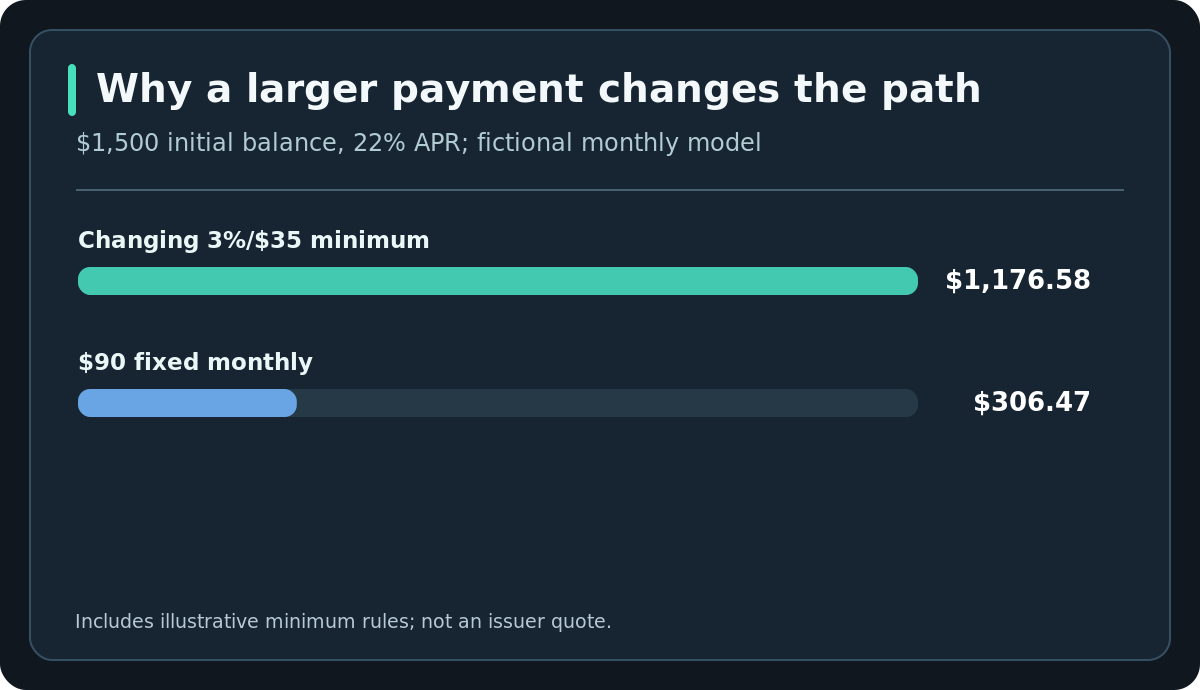
Second worked scenario and interpretation
A larger fixed $90 monthly payment reduces the first month’s principal by $62.50. The production worksheet reports the independently simulated payoff months and total paid under both hypothetical methods. Those totals exclude new purchases, fees, APR changes and actual daily compounding. The simulated results are 74 months and $1,176.58 interest at changing minimums, versus 21 months and $306.47 interest at $90/month. Only the hypothetical planning formula is being modeled.
Common mistakes and troubleshooting
- Using “2% minimum” for every bank: The actual rule is found in the card agreement and statement.
- Charging interest after a zero balance: Stop monthly accrual when the hypothetical balance has been paid.
- Assuming a 0% offer lasts indefinitely: Add the expiry and post-promotion rate or keep that scenario out of the estimate.
- Ignoring statement fees: Annual, late, cash-advance or balance-transfer fees can change the result.
Check that the model applies payment first to fees and interest where required by the contract and does not allow a negative remaining balance. Additional borrowing invalidates a static payoff forecast.
Alternative methods and exceptions
- Ask for hardship assistance: Contact your creditor before missed payments; a payment plan or nonprofit credit counselor may help.
- Accelerated fixed-dollar repayment: Set an affordable amount larger than the required minimum and reconsider it if your finances change.
- Multiple cards: Build one ledger per card and then coordinate payments with the avalanche or snowball guides.
Country-specific considerations (checked 2026-10-27)
- US: US periodic statements generally include a minimum-only repayment warning and 36-month comparison; rely on your individual statement for contract-specific inputs.
- UK: Monthly minimum formulas and persistent-debt interventions differ; check your issuer’s latest terms.
- Canada: Use Canadian issuer disclosures and cardholder agreement; do not import US statement-warning rules as universal.
- Australia: Review the statement minimum repayment warning or comparison tools provided by your issuer and local regulator.
Frequently asked questions
Why does the minimum fall over time?
Percentage-based minimums shrink as the statement balance decreases, subject to floors.
Does paying the minimum avoid all fees?
Timely payment may avoid a late-payment fee, but interest and other charges can remain.
Can I trust a payoff calculator?
Only if its rate, posting convention, floor, future payments and fees match your agreement.
What if I cannot afford the minimum?
Contact the issuer promptly and consider free independent debt counseling available locally.
Final checklist
- [ ] Use your actual statement minimum formula
- [ ] Identify rates for all balance categories
- [ ] Assume no new purchases unless modeled
- [ ] Record each month of interest and principal
- [ ] Compare minimum with an affordable fixed payment
- [ ] Read your statement payoff warning
Sources & Further Reading
- Consumer Financial Protection Bureau — How to read the 36-month payoff box on your credit card bill — US statement payoff warning and assumptions.
- Consumer Financial Protection Bureau — Regulation Z §1026.7 periodic statements — US minimum payment warning disclosures.
- Consumer Financial Protection Bureau — What should I do if I cannot pay credit card bills? — Contact lender and hardship options.
- Consumer Financial Protection Bureau — How does my credit card company calculate interest? — Average daily balance and periodic rate method.
Use the checklists as you go, and confirm the result before moving on to a more involved repair.