How to Dispute an Error on Your Credit Report
Dispute errors on US credit reports with a clear evidence log, separate bureau and furnisher notices and realistic investigation timelines.
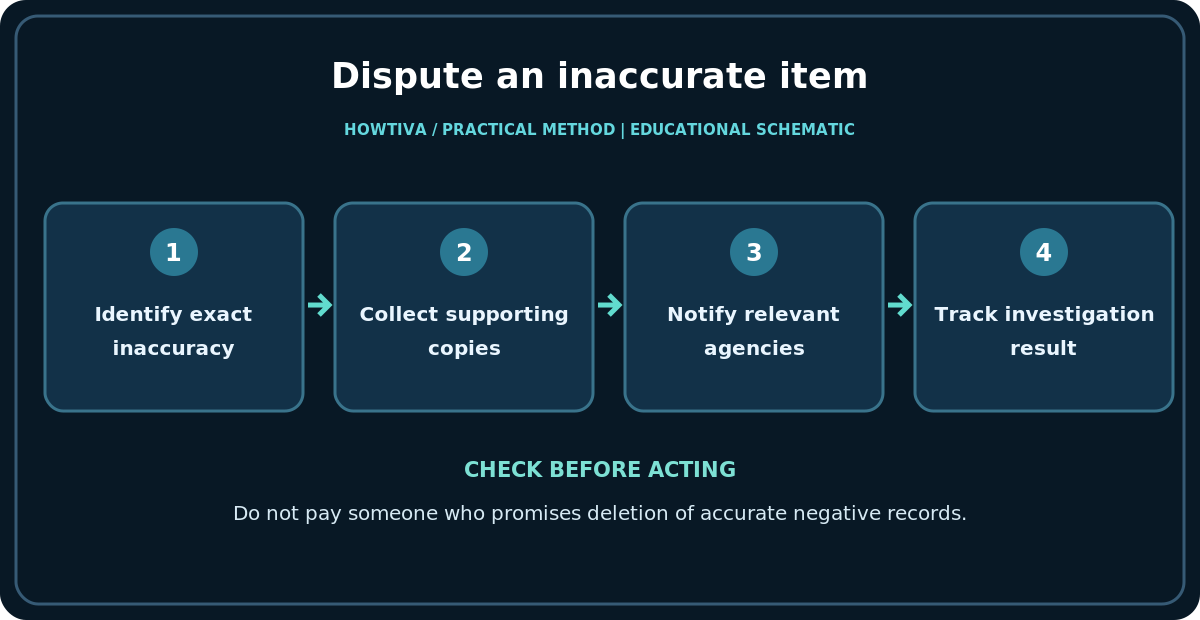
Quick answer: If you find inaccurate information on a US credit report, dispute it with the credit reporting company that displays it and generally also with the business that supplied it. State the exact error, why it is incorrect and what correction you request. Include copies of supporting documents, keep a dated record and check the investigation result.
What you will achieve: You will build an evidence-backed correction request rather than paying a third party promising to remove accurate negative information. The process applies to genuine inaccuracies; a dispute does not guarantee a change when the reported information is accurate.
Before you begin
Have the relevant report, bureau name, report date, affected creditor, error description, bank statements or payment evidence and private copies of correspondence. Protect full account numbers and identity information. If a problem appears to involve identity theft, consider IdentityTheft.gov and the additional procedures associated with fraudulent accounts.
A dispute should identify each specific incorrect item and include copies of relevant evidence, not unnecessary originals or sensitive documents. Use verified bureau and furnisher channels.
Step-by-step instructions
-
Verify the alleged inaccuracy: Compare entries with dated source documents. Check account numbers, reported status and reporting dates; a recent payment may not have reached the bureau yet.
-
Identify every affected report: An error may appear on only one bureau report or across several. Make a separate targeted dispute for each bureau that shows the inaccurate information.
-
State exactly what is wrong: Instead of “my score is unfair,” write “Account X was marked 30 days late for March; the attached issuer statement and bank confirmation show timely payment.” Do not include irrelevant or unverified accusations.
-
Request a specific correction: Ask that the wrong late mark, duplicate account, balance or identity field be corrected or removed as appropriate. Do not request removal of accurate negative data merely because it affects your score.
-
Submit through an authorized channel: Use the credit bureau’s official dispute channel or mail process. The CFPB explains how to send a written dispute and supporting copies; retain a submission confirmation or mailing evidence.
-
Contact the information furnisher: Also dispute the inaccuracy directly with the lender, collector or other furnisher when applicable, using the dispute address it designates. Describe the same error and preserve evidence.
-
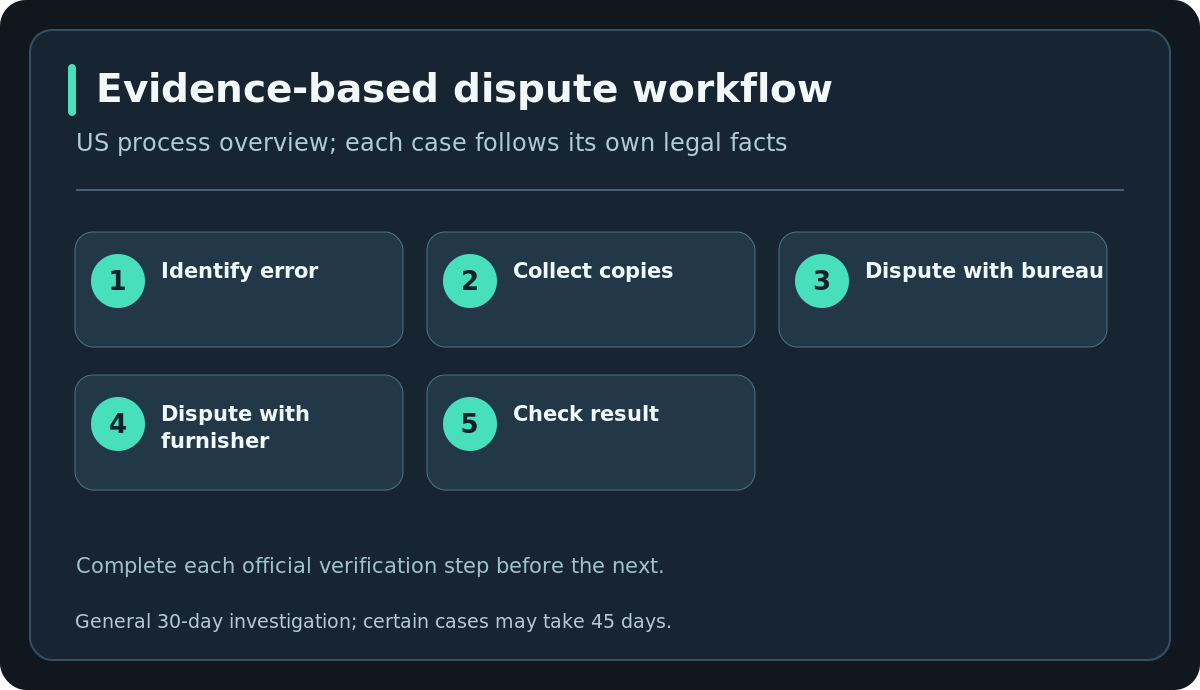
Track the investigation window: The CFPB says a bureau generally investigates within 30 days, with certain circumstances allowing up to 45 days. It generally must notify you within five business days after investigation completion. Measure from documented receipt, not from when you drafted your letter.
-
Review the outcome and escalate accurately: Check the new report, not just an email headline. If still wrong, provide any new relevant evidence, request a statement of dispute where appropriate or submit a complaint to the CFPB after pursuing the companies’ correction processes.
Worked financial example
Illustrative dispute: A $450 card payment due April 12 was credited April 10, but a bureau displays April as “30 days late.” Keep the issuer statement, transaction confirmation, relevant bank record and dated report. Your request identifies the exact creditor, month, incorrect late status and requested correction. $450 is a fictional illustration, not a threshold or legal amount.
Second worked scenario and interpretation
Illustrative timeline: dispute received November 2. A typical 30-calendar-day investigation window points to approximately December 2, but specific counting and exceptions matter, so do not promise that exact resolution date. The five-business-day results notification period follows completion. Keep the provider’s actual receipt and response dates in your log.
Common mistakes and troubleshooting
- Disputing a credit score instead of an entry: Identify the underlying incorrect data that may be driving the score.
- Sending originals: Send copies, retain originals and proof of submission.
- Applying a 30-day rule as universal: The CFPB describes some 45-day investigations and different procedures.
- Assuming “removed” is permanent without verifying: Check subsequent reports and preserve the official results.
Track the acknowledgment, investigation outcome and any corrected reports. Accurate negative information generally cannot be removed simply by paying a third party.
Alternative methods and exceptions
- Identity-theft path: When the account is not yours, use IdentityTheft.gov and explore fraud alert, block and security freeze options.
- Dispute statement: For unresolved disagreements, ask whether the bureau can add a statement describing the dispute.
- Complaint route: Use the CFPB’s official complaint mechanism for unresolved procedural or reporting issues.
Country-specific considerations (checked 2026-10-27)
- US: Detailed guidance is US-specific and was checked against CFPB public explanations on October 27, 2026. The 30-day investigation is general, not a guaranteed end date.
- UK: Use UK credit reference agency correction and complaint procedures, not the US Fair Credit Reporting Act timeline.
- Canada: Canadian credit-bureau dispute processes and provincial/federal oversight differ; use local agency and consumer regulator guidance.
- Australia: Australian credit reporting corrections and complaint routes differ; contact the reporting body and the applicable dispute-resolution service.
Frequently asked questions
Can I pay to delete an accurate negative item?
Do not assume legitimate accurate entries are removable on demand. Focus on mistakes.
How long can investigation take?
CFPB says generally 30 days with some permitted 45-day cases and a results-notice period.
Should I send a dispute to both bureau and creditor?
CFPB recommends contacting both the bureau reporting the error and the information furnisher.
What if I suspect identity theft?
Use government identity-theft resources and protect accounts before ordinary correction follow-up.
Final checklist
- [ ] Identify specific inaccurate entry
- [ ] Collect dated supporting copies
- [ ] Submit to every affected bureau
- [ ] Contact the furnisher as appropriate
- [ ] Preserve receipts and deadlines
- [ ] Review updated report and escalation options
Sources & Further Reading
- Consumer Financial Protection Bureau — How do I dispute an error on my credit report? — CRA and furnisher dispute procedures.
- Consumer Financial Protection Bureau — How long does it take to repair an error on a credit report? — Typical 30 days and some 45-day cases.
- US Federal Trade Commission — Free Credit Reports — Authorized site and phishing avoidance.
Use the checklists as you go, and confirm the result before moving on to a more involved repair.