How to Check Your Credit Report in the United States
Check your free US Equifax, Experian and TransUnion credit reports using the authorized site, then review entries and protect your records.
Quick answer: In the United States, request your free credit reports through AnnualCreditReport.com, the federally authorized central website for Equifax, Experian and TransUnion reports. Review each report for incorrect addresses, unfamiliar accounts, payment history errors, balances, collections and duplicate entries; save a secure copy.
What you will achieve: The aim is to inspect your underlying credit-report information, not to buy a credit score or sign up for paid monitoring. Current major-bureau online reports are available free weekly; your own request does not hurt your credit score. Availability and interfaces can change.
Before you begin
Use a private device and secure connection; have your name, current and previous addresses and relevant identifying information available only on the authentic site. Do not share passwords, full credit report or government identification documents with unknown third parties. If you have a credit freeze, learn the rules for your chosen request method.
Free US credit reports and credit scores are different products. Read each bureau report separately, confirm the reporting date and save a private error log without publishing account numbers.
Step-by-step instructions
-
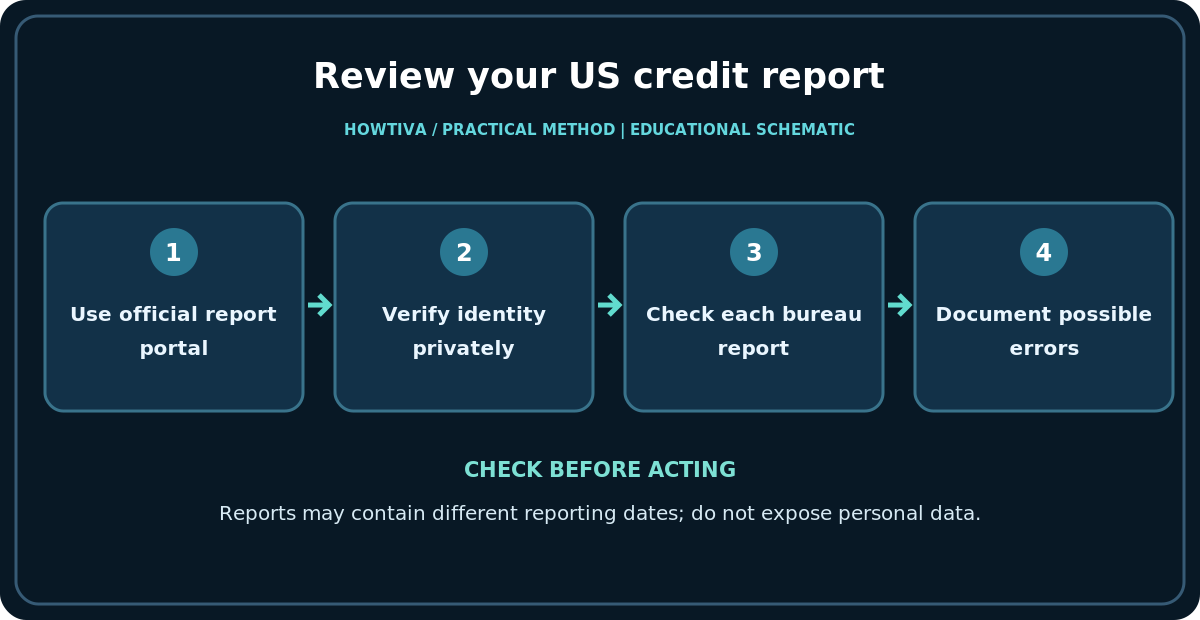
Navigate independently to the authorized service: Type AnnualCreditReport.com yourself or use the verified URL from CFPB/FTC. Avoid advertising links, lookalike sites and calls that solicit your Social Security number.
-
Choose the reports you need: Request a report from one, two or all three national credit reporting companies. Each can contain different data because not all creditors report to all three.
-
Verify your identity through the actual service: Follow the site’s current identity steps and answer only questions legitimately requested there. If online verification fails, use the official phone or mail options; never invent a workaround or guess answers.
-
Download and protect the records: If access is granted, save the document in encrypted or otherwise controlled storage. Record the bureau and report date. A credit report includes highly sensitive information.
-
Review identity and account ownership: Check name, address history, birthdate entries where shown, accounts and creditors. An account you do not recognize may be a reporting error or identity-theft warning sign.
-
Check each account’s payment history: Compare late-payment flags, opening dates, balances, credit limits and closed-account status to your own records. One bureau may show something different from another.
-
Review inquiries and adverse items: Identify unfamiliar hard inquiries, collections and public-record information. A report may not include the same details as a credit-score service.
-
Create a correction log: Write a private list of each potential inaccuracy with bureau, report date, account identifier truncated for privacy, evidence needed and next action. Use the dispute guide for corrections.
Worked financial example
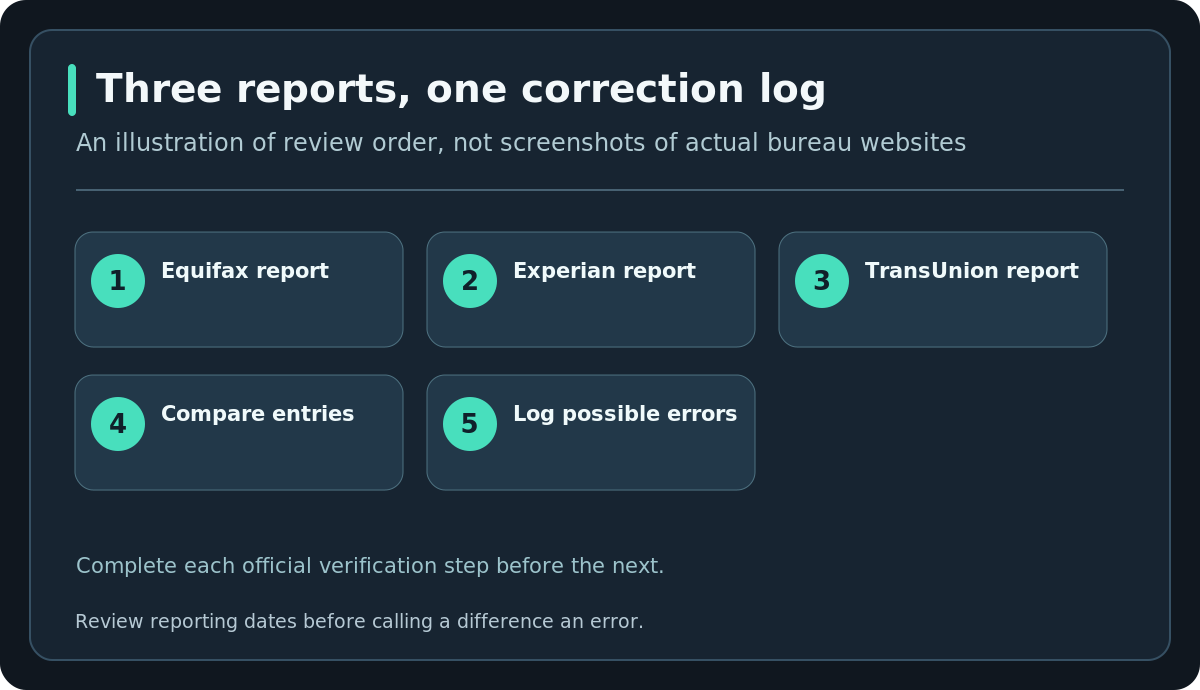
Fictional three-report review: Equifax shows a card balance of $1,050, Experian $1,050, and TransUnion $1,500. A difference is a review flag, not proof of an error: creditors can report on different days. Look at reporting dates, payments and available documents before disputing.
Second worked scenario and interpretation
A person reviewing one report each week could keep a simple record: Week 1—Equifax, Week 2—Experian, Week 3—TransUnion. This is only an example workflow; current online access may permit checking all three in the same sitting. Reading your own report is a soft inquiry and does not lower your credit score.
Common mistakes and troubleshooting
- Using a fee-based lookalike service: The FTC identifies one authorized free report portal; verify the exact domain.
- Assuming the credit report includes a free numerical score: A report and a score are different products.
- Treating every timing difference as fraud: Statements and bureaus may have different reporting dates.
- Downloading reports to a public computer: Private financial files can remain available to later users.
For identity-related surprises, follow the official identity-theft recovery process instead of relying only on a credit-report dispute.
Alternative methods and exceptions
- Official telephone request: The CFPB lists the authorized phone route as 877-322-8228; check the current agency page before placing a call.
- Official mail request: Use the Annual Credit Report Request form linked by the CFPB/FTC and the current mail address from the agency site.
- If identity theft is suspected: Use the official US IdentityTheft.gov reporting resources and consider a fraud alert or security freeze.
Country-specific considerations (checked 2026-10-27)
- US: The detailed procedure applies to US national credit reports. CFPB currently states free weekly online access at AnnualCreditReport.com, confirmed October 27, 2026.
- UK: UK credit agencies and access rights differ; US AnnualCreditReport.com is not a UK credit report portal.
- Canada: Canadian bureaus and request processes differ; consult the Financial Consumer Agency of Canada and the bureau’s official site.
- Australia: Australian access routes operate under Australian credit reporting rules; consult ASIC Moneysmart and relevant credit reporting bodies.
Frequently asked questions
Will requesting my own credit report hurt my score?
No. The CFPB treats your own review as a soft inquiry.
Is checking reports the same as checking credit scores?
No. A report details the underlying file; a scoring model generates a separate number.
Why are bureau reports different?
Lenders may not report to every bureau, and report dates vary.
How often can I check for free?
As reviewed October 27, 2026, current US major-bureau online access is free weekly through the authorized site; confirm any updated terms.
Final checklist
- [ ] Use only the authorized US portal
- [ ] Keep identity verification private
- [ ] Review all three bureaus if needed
- [ ] Inspect account and payment dates
- [ ] Note discrepancies and evidence
- [ ] Store reports securely and start disputes for actual errors
Sources & Further Reading
- Consumer Financial Protection Bureau — How do I get a free copy of my credit reports? — US official report website and availability.
- US Federal Trade Commission — Free Credit Reports — Authorized site and phishing avoidance.
- Consumer Financial Protection Bureau — Does requesting my credit report hurt my credit score? — Personal report request does not affect credit score.
Use the checklists as you go, and confirm the result before moving on to a more involved repair.