How to Compare Currency Exchange Rates and Transfer Fees
Compare overseas money transfers using real delivered amounts, exchange-rate direction, fees, and safe verification with worked calculations.
Quick answer: Compare international money transfers by the amount that the recipient will actually receive, not by the headline exchange rate alone. Quote the same source amount, destination currency, funding method and delivery speed from two or more providers; deduct sender and recipient fees, account for the exact quoted exchange rate, and retain the final receipt.
What you will achieve: You will leave with a like-for-like comparison sheet for overseas transfers. A rate that appears attractive may be offset by a flat fee or an extra charge at the receiving bank. This method is an educational comparison; not a recommendation to use any specific remittance company.
Before you begin
Have the total amount you can spend, sending and receiving currencies, recipient country, legitimate recipient details, funding method, expected delivery date and provider fee disclosures. Quotes can expire. Avoid guessing at intermediary-bank charges; mark unknown deductions separately. For business transfers, corporate FX contracts may work differently.
Do not compare a headline exchange rate in isolation. Confirm the exact currency pair, exchange-rate direction, payer fees, intermediary charges and recipient amount before confirming a transfer.
Step-by-step instructions
-
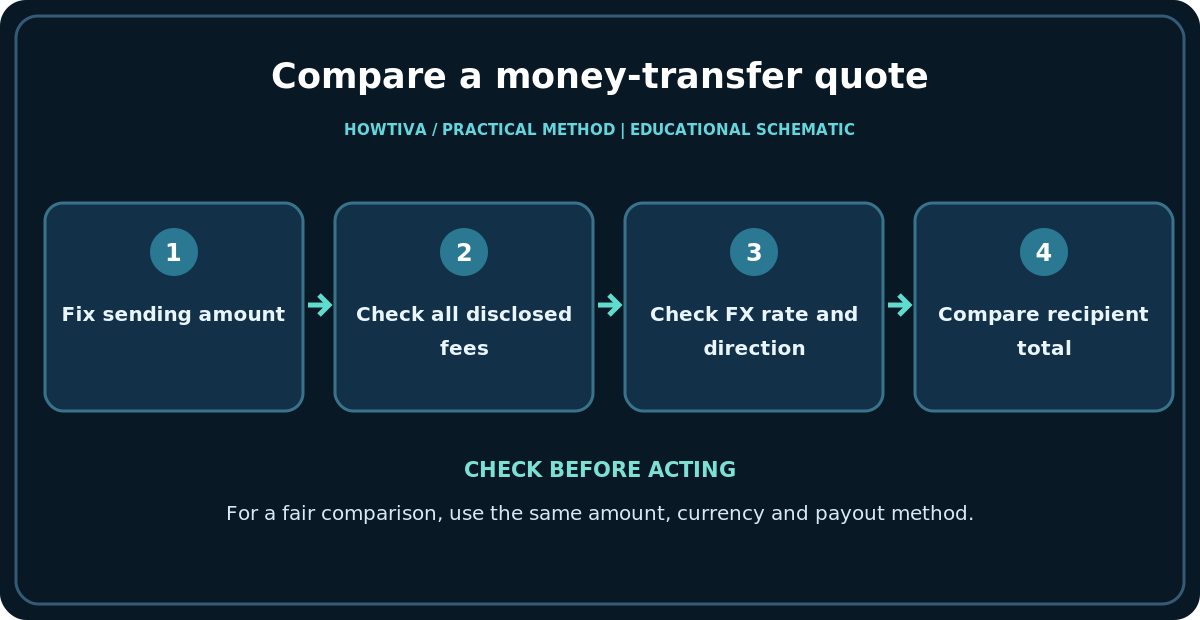
Set the comparison constraint: Choose either a fixed total sender budget or a fixed amount that must reach the recipient. Do not compare a $1,000 transfer plus fees at one provider with a $1,000 all-in transfer at another. Note the time each quote is valid.
-
Record exact rate direction: Write whether the quote means destination currency per unit of source currency or the reverse. If a quote reads 0.92 EUR per USD, multiplication by USD gives EUR; a EUR-per-USD number must not be inverted accidentally.
-
List all disclosed costs: Write the sender fee, card funding surcharge, transfer tax where applicable, destination agent deduction, possible correspondent/intermediary deduction and cancellation conditions. If a fee is charged in the receiving currency, subtract it after conversion.
-
Compute the all-in conversion: For a sender budget that includes the fee: recipient amount = (sender budget − source-currency fees) × destination currency/source currency rate − destination-currency fees. Some products deduct differently, so follow their displayed funding and delivery amounts.
-
Compare delivery and access: Check whether this is a bank deposit, wallet payout or cash pickup; a higher payout is not equivalent if the recipient cannot access it in time. Check the payout provider independently, especially for first transfers.
-
Check the final screen again: The estimate may change when a card funding method or payout country is selected. Confirm the beneficiary details and fee-inclusive amount shown in the final pre-authorization screen. Save the timestamp and receipt.
-
Watch for deceptive requests: Never send a transfer to a supposedly safe account because a caller impersonating a bank demands it. End the call and use the provider’s official channel. A test transfer, if chosen, is not a guarantee against fraud.
-
Reconcile the result: Confirm the recipient’s actual deposited amount and any final charge. Compare actual to the disclosed amount and keep evidence if you need the provider’s correction or complaint process.
Worked financial example
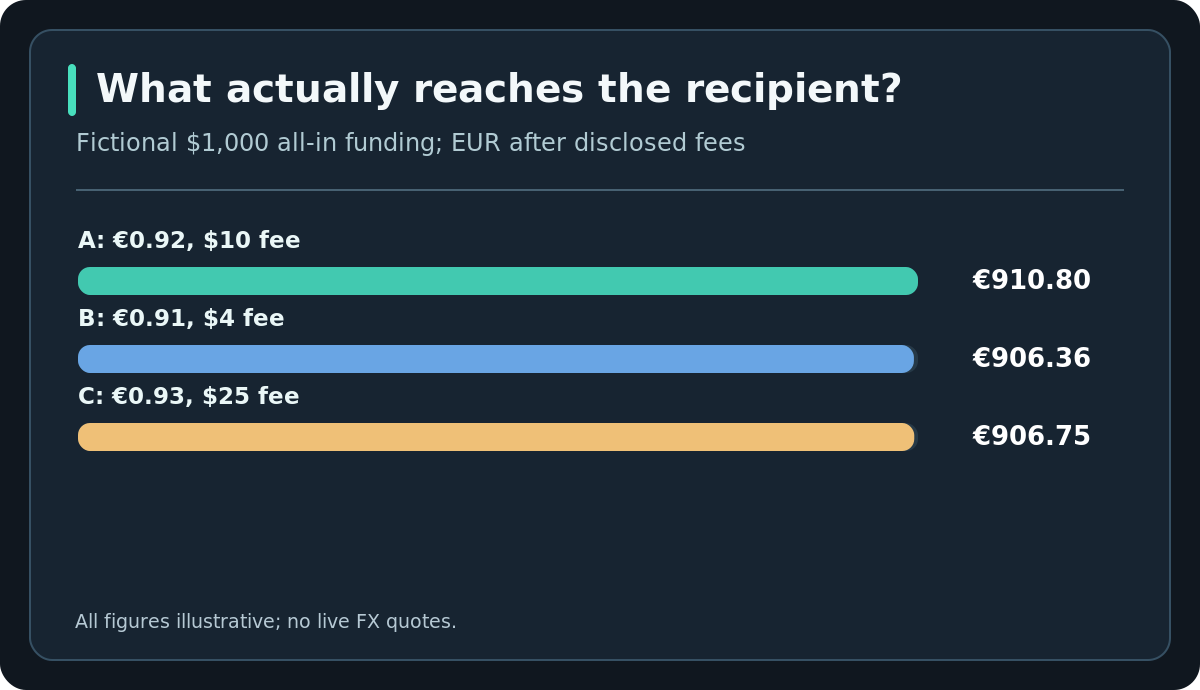
Illustrative only, not live rates. With an all-in USD budget of $1,000, Provider A charges a $10 sender fee and quotes €0.92 per $1: ($1,000 − $10) × 0.92 = €910.80. Provider B charges $4 and quotes €0.91 per $1: ($1,000 − $4) × 0.91 = €906.36. With no destination fees, A delivers €4.44 more despite its higher sender fee.
Second worked scenario and interpretation
A third fictional offer advertises €0.93 per $1 but charges a $25 fee: ($1,000 − $25) × 0.93 = €906.75. That falls below A. If a €3 destination deduction applies, it becomes €903.75. Make a separate column for unknown third-party deductions; never write zero unless confirmed.
Common mistakes and troubleshooting
- Comparing quoted rate alone: The recipient may receive less after the fixed sender fee or a deduction abroad.
- Mixing total budget with send amount: A $1,000 funding budget and a $1,000 pre-fee transfer are not the same transaction.
- Treating a spot reference rate as a retail guarantee: Retail providers can quote a different rate and charges; use the actionable pre-transfer disclosure.
- Trusting urgent payment instructions: Verify with the intended recipient using a previously known channel.
Compare quotes taken close together for the same sending amount and delivery method. A provider that appears cheaper at one transfer amount may be more expensive at another.
Alternative methods and exceptions
- Recipient-first comparison: For a fixed €900 target, calculate the source funding needed from each quote and round according to the provider’s disclosed rules.
- Repeat or scheduled transfer: Compare recurring-plan fees and what happens if the FX rate changes before execution.
- No online access: Ask the institution for a written pre-transfer fee and delivery disclosure rather than relying on a verbally quoted rate.
Country-specific considerations (checked 2026-10-27)
- US: Federal remittance rules cover many consumer transfers sent abroad and typically require specific cost, exchange-rate and delivery disclosures; scope/exemptions vary. Refer to CFPB and recheck the contract as of October 27, 2026.
- UK: Providers operate under UK regulatory and payment rules; use the FCA register and the firm’s current customer disclosure rather than assuming US remittance rights apply.
- Canada: Compare posted CAD funding cost, FX rate and destination deductions; protections and complaints depend on the provider and province/federal jurisdiction.
- Australia: Compare AUD conversion, payment method, transfer method and disclosed beneficiary deductions; review the provider’s applicable disclosures.
Frequently asked questions
Can a provider with a worse FX rate be cheaper?
Yes. Lower fees can more than offset the weaker conversion rate.
What if the recipient bank takes an unknown fee?
Show an estimated range if you can substantiate it; otherwise mark that component “unknown” and ask both institutions.
Should I exchange the quote direction?
Only when both offers are consistently stated in the same base/destination direction. A EUR/USD quote is not the same as USD/EUR.
Can I cancel after sending?
Rights depend on the country, type of remittance, provider and timing; read the specific terms and applicable law.
Final checklist
- [ ] Same all-in sender budget
- [ ] Rate direction confirmed
- [ ] Every disclosed fee captured
- [ ] Actual recipient amount compared
- [ ] Delivery window and payout channel compared
- [ ] Receipt and beneficiary independently verified
Sources & Further Reading
- Consumer Financial Protection Bureau — Sending money overseas: transfer information and comparison — US consumer remittance disclosures, fees, FX rates and delivered amount.
- Consumer Financial Protection Bureau — What is a remittance transfer and what are my rights? — US remittance rights and estimates.
Use the checklists as you go, and confirm the result before moving on to a more involved repair.