How to Clear a Slow Bathroom Sink Drain Safely
Identify the basin stopper, remove accessible hair, and test the drain before attempting plumbing disassembly.
Quick answer: A bathroom sink that drains slowly is often restricted by hair and soap residue around its pop-up stopper. Check whether the stopper lifts or twists out without force, remove reachable debris, rinse with warm tap water and test. If the sink is still slow and no drain-opening chemicals have been used, a flat-cup sink plunger is the next low-risk option. Stop before dismantling an unfamiliar drain mechanism or fragile piping.
This guide is specific to a slow bathroom basin, not an entirely blocked kitchen sink, a bath, or a backed-up building line. An increasingly slow basin is different from water that suddenly comes up through another drain. The latter needs more urgent plumbing attention. Never mix household cleaning chemicals or plunge a drain that could contain commercial opener.
Check the symptom in less than a minute
- Run a modest trickle of water for a few seconds, then turn it off. Does the basin pool water and slowly empty, or does it fail to empty at all?
- Check whether the stopper is stuck partly closed. A lift rod behind the faucet may leave a pop-up plug too low, obstructing flow even without much debris.
- Look inside the sink and under the cabinet for water around the basin, stopper assembly and drain. Do not disassemble if a fitting is already wet, badly corroded or cracked.
- Ask whether someone has already poured drain cleaner into the sink. If the answer is yes or unknown and chemical exposure is possible, stop hands-on cleaning and follow the product safety guidance.
Step 1: identify the stopper type
Lift-out or twist-and-lift: Some modern plugs can be raised and rotated gently by hand. Push-button/click-clack: Some have a cap or center piece that unthreads, while others do not. Lift-rod pop-up: Often connects to a horizontal pivot rod under the basin, attached to a vertical strap behind the faucet. These assemblies differ substantially by manufacturer, so never assume all stopper caps unscrew.
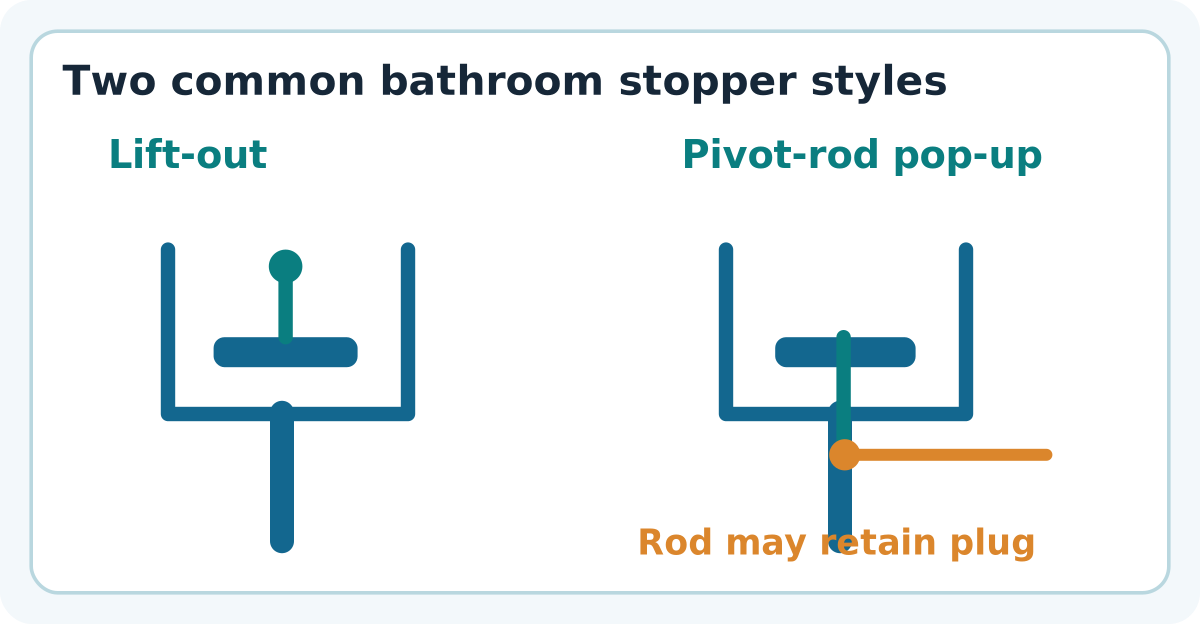
Test the part with light finger pressure only. If it does not move easily, find its brand/model instruction sheet. Do not use pliers on plated surfaces or pull on a pivot-connected stopper from above; that can damage the linkage or seal.
Step 2: remove hair and soap buildup
- Cover the drain opening area with a towel so tiny screws or a removable cap cannot fall down the drain. Put on household cleaning gloves.
- For a stopper that releases without tools, lift it out and note which way it faces. Photograph the orientation if there is a locating tab.
- Pull hair and film from the underside of the stopper with tissue, a soft brush or a flexible plastic drain-cleaning strip designed for basin drains. Work shallowly and gently; do not ram the strip past an obstruction.
- Wash the removed stopper with mild dish soap and warm water separately, rinse it, and reinstall it in the same position. Do not soak special finishes or seals in stronger cleaners unless the manufacturer permits it.
- Run warm—not boiling—tap water for a short time. Check whether the pool drains more quickly and whether anything leaks beneath the bowl.
For a lift-rod pop-up that will not release from above, the manufacturer may require releasing the horizontal pivot rod under the sink. That step risks a leak around the pivot-rod seal if incorrectly reassembled. If you cannot identify the retaining nut and linkage confidently, stop and ask a plumber or building maintenance. Removal is optional, not a prerequisite for an initial cleaning attempt.
Step 3: use a plunger if cleaning the stopper was not enough
Remove or open the stopper so the plunger cup can seal against the basin floor. Block the overflow hole with a damp cloth. Add just enough clean water to cover the cup rim and make several controlled strokes without splashing. Check progress after about 15–30 seconds. Use a sink-only plunger and avoid vigorous action on loose fittings.
Do not work on the pop-up linkage and plunge at the same time: a half-removed pivot rod creates an open leak path. Restore the mechanism fully, check it with a small water test, and only then consider the plunger.
What to do when the stopper is not the problem
One possibility is a buildup inside the P-trap—the U-shaped section of drainpipe visible below many basins. Cleaning a sound removable trap may be a reasonable separate project, but avoid it if the fittings are glued, corroded, cracked or difficult to access. A second possibility is a restriction farther inside the wall drain or a ventilation problem; neither is diagnosed by visible hair alone. In those cases, arranging maintenance can prevent damage.
Problem-solving by symptom
The stopper will not lift out
Look for a lift rod, horizontal rod and clevis strap under the basin. If present, your stopper may be pivot-retained. Do not yank it upward. Identify the fixture instructions before touching that joint; if unsure, leave it assembled.
The stopper is clean, but water drains only with the plug held up
The linkage height or plug alignment may limit the opening. Check that the lift rod can travel freely; do not force or bend the metal strap. Model-specific adjustment may be needed.
There is a bad odor as well as slow flow
Remove accessible organic debris and check for a leak. A persistent sewer-like smell, gurgling or dry/incorrectly fitted trap calls for plumbing inspection rather than masking the smell with fragrance or bleach.
There are two slow sinks or another fixture backs up
Stop local DIY attempts. Shared drain issues can make one sink seem to be the problem even when the blockage is farther away.
Keep the bathroom sink running freely
Catch loose hair before it enters the basin, keep dental floss and wipes out of the drain, and wipe away thick product residue when cleaning the sink. Clean an accessible stopper occasionally rather than waiting for a complete blockage. If the slowdown returns quickly, get the downstream pipe checked.
Frequently asked questions
Can I use baking soda and vinegar to clear hair?
Fizzing does not reliably pull out a hair mat. Physical removal of accessible hair is a more targeted first step. Do not add homemade mixtures to a sink where a chemical opener may be present.
Does the sink overflow hole need cleaning?
You may wipe only the reachable rim with mild soap and water. Do not push tools or products into the hidden overflow passage or seal it permanently; its design varies with the basin.
Will a small drain snake fit every bathroom sink?
No. Stopper rods and narrow, curved pipes can trap or snag tools. A shallow plastic strip may work for reachable hair, but an auger for a deeper obstruction is better left to someone who can identify the drain assembly.
Sources and further reading
- Lowe’s: How to Unclog a Sink: 7 Easy Tips to Try (checked 2026-10-27).
- Lowe’s: How to Remove a Sink Drain Stopper (checked 2026-10-27).
- U.S. CDC: Cleaning and Disinfecting with Bleach (checked 2026-10-27).
Use the checklists as you go, and confirm the result before moving on to a more involved repair.