How to Fix a Door That Rubs Against the Frame
Close the interior door slowly and find exactly where it rubs. Check whether hinge screws have loosened and gently snug them with a hand screwdriver while supporting the door.
Quick answer: Close the interior door slowly and find exactly where it rubs. Check whether hinge screws have loosened and gently snug them with a hand screwdriver while supporting the door. Re-test. Do not immediately plane or sand the door: rubbing can come from a displaced hinge, damp swollen wood, a misaligned latch or a warped frame.
A door that dragged in summer but cleared in winter may respond to humidity, while one that suddenly scrapes at its top latch corner may have sagged on the hinge side. Door repairs are most reliable when diagnosis comes before removing material. Stop at cracked framing, a fire-rated assembly, glass-panel instability or a door that may be a required exit.
Check applicability and set up safely
You will need:
- Flashlight, pencil and removable low-tack tape
- Hand screwdriver fitting the hinge screws
- A helper for heavy doors
- Small level or ruler to compare door-edge gaps
Step-by-step procedure
Step 1: Map the contact without forcing the door
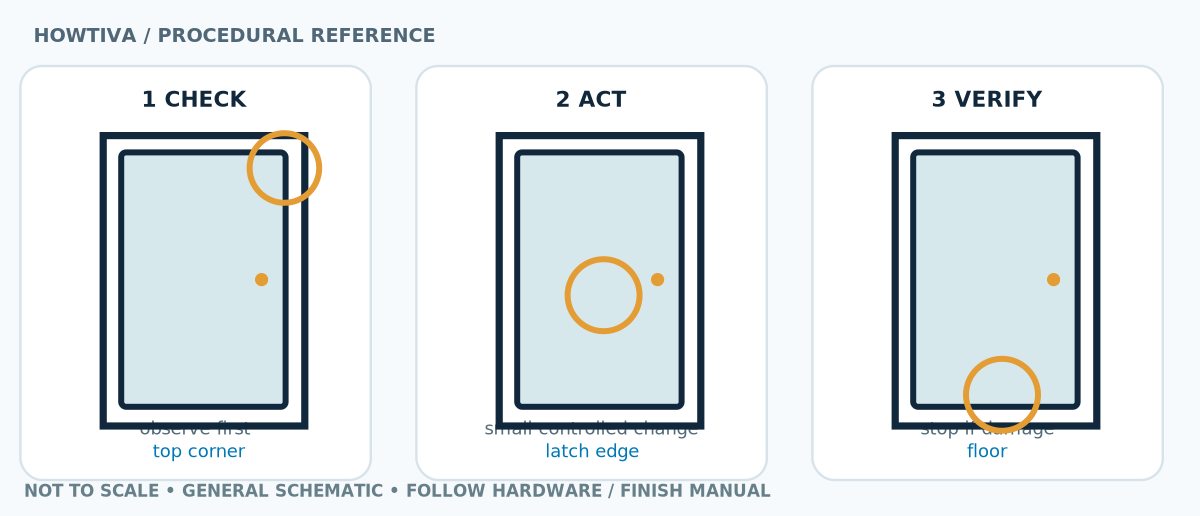
Close very slowly and watch the top, latch and bottom gaps. If safe, slip a thin piece of paper at suspected points to identify friction; do not wedge near pinch points. Mark the rubbing location temporarily with low-tack tape on the frame, not a permanent cut into the finish.
Step 2: Inspect the hinge-side gaps
A wide top gap on one side and pinched top latch corner may indicate sag. Check each hinge leaf and screw for looseness; visually confirm the hinge is not bent and the jamb is sound. A hinge must be secure before you adjust the strike.
Step 3: Snug loose hinge mounting screws by hand
Support the weight of the door; tighten only screws that are loose and still hold properly. Work one screw at a time. Stop if wood threads are stripped, the jamb shifts, or the hinge leaf is deforming. Do not force oversized replacement screws without knowing concealed services and framing details.
Step 4: Check the latch strike separately
If the door closes without scraping but the latch does not line up with its plate, the issue is latching, not necessarily an oversized door. Do not enlarge the strike opening until hinge alignment is corrected and the actual contact has been measured.
Step 5: Assess moisture, seal and frame issues
If the face or edge swells in humid conditions, check for leaks and dampness. A damaged weatherstrip can also drag. Do not sand swollen wood aggressively because it may later shrink, leaving an excessive gap.
Step 6: Verify clearance and safety
Open and close gently several times and confirm the latch operates without lifting, kicking or slamming the door. If the frame is out of square, the door is heavy or a fire door, ask a qualified carpenter/door technician for assessment.
Two real-world situations to compare before repeating a step
Top corner hits when you close the door
The top hinge can loosen and change the hanging angle. Support the door, inspect gaps and hand-tighten sound loose hinge screws. If a screw does not grip, stop rather than forcing the wood.
Bathroom door sticks in humid weather
The swollen door edge might return to normal with moisture control. Look for water intrusion or a missing finish; sanding it immediately may create a permanent gap in dry weather.
Troubleshooting: when the first check does not solve it
Rubs only at the upper latch-side corner. Often associated with top-hinge or frame alignment; inspect hinge attachments and vertical gaps first.
Scrapes the floor along the full bottom edge. Check flooring changes, threshold, bottom sweep and door sag. Do not shave the door without confirming clearance and fire-rating requirements.
Stops before the latch engages. Check strike, weatherstripping and frame contact separately.
Door suddenly binds after water damage. Investigate moisture and structural damage rather than cutting the door smaller.
Alternative paths and brand-specific differences
A door slab that is demonstrably warped, a frame that has moved, or a hinge screw hole that no longer holds requires a repair beyond basic tightening. For aluminum, composite, uPVC or multi-point exterior doors, refer to the door system’s adjustment instructions.
When to stop and ask for help
Stop if screws spin, frame shifts, the door is fire-rated, the opening is a critical exit, or swelling suggests structural moisture damage.
Frequently asked questions
Can I just sand the edge until it closes?
Not before finding the cause; removing material can create draught, security, fit and fire-resistance problems.
Should I move the strike plate first?
Not if the door is sagging. Correct mounting and alignment before adjusting latch engagement.
Sources & further reading
-
The Home Depot: How to Fix an Interior Door
Use the checklists as you go, and confirm the result before moving on to a more involved repair.