How to Calculate Compound Interest
Calculate compound interest with principal, rate, compounding frequency and time; verify every step and avoid APY conversion errors.
Quick answer: Calculate compound interest with A = P(1 + r/n)nt for a fixed annual stated rate r, n equal compounding periods per year, and t years. Subtract the original principal P to find interest earned in a no-contribution, no-fee example. If you contribute periodically, use the contribution schedule in a separate formula or calculator.
What you will achieve: You can reproduce a simple compound-growth table, see why compounding frequency matters, and avoid treating a hypothetical return as a guaranteed result. The calculation is relevant to certain savings products and growth illustrations, but actual investment values can fall.
Before you begin
Gather your initial balance, annual rate convention, compounding frequency, exact period and any deposit/withdrawal schedule. Check whether the quote is an annual effective rate (APY/AER) or a nominal stated rate. For a deposit, rates may change and interest may be taxed; for market assets, modeled constant returns are not promises.
Specify the compounding frequency, nominal annual rate and whether contributions occur at the beginning or end of each period. Changing any of these assumptions changes the projected balance.
Step-by-step instructions
Step 1: Specify starting principal P
Record the initial sum available to earn interest, excluding planned later contributions. For the worked example, P = $1,500. Avoid confusing principal with the ending balance or with the total amount contributed over multiple years.
Step 2: Check the rate type
If a product discloses an APY, its effective one-year yield already reflects compounding. In the basic formula, r is the stated annual rate with its corresponding compounding frequency. Do not enter a quoted APY as a nominal r and compound it again.
Step 3: Convert percentages to decimals
Use r = 0.04 for 4%. The monthly periodic rate for nominal 4% compounded 12 times annually is 0.04/12. The formula is an illustrative model with unchanged rate; actual bank daily-balance calculations may differ.
Step 4: Match compounding frequency and duration
For monthly compounding over three years, n = 12 and nt = 36. For annual compounding, n = 1. If the interval is measured in months instead of full years, count periods explicitly and avoid rounding a partial year to a full one.
Step 5: Raise the growth factor to the period count
Compute (1 + 0.04/12)^36 before multiplying by principal. Spreadsheet functions such as POWER or ^ can do the exponent; check parentheses: 1+ r/n is inside the exponent.
Step 6: Calculate ending value and interest separately
Multiply the accumulation factor by $1,500. The future value includes the original principal, while interest is future value minus principal. Round currency at the report stage unless product-specific rules require earlier rounding.
Step 7: Add regular contributions only with a matching schedule
For end-of-month deposits, each deposit earns fewer periods than the initial principal. Use FV with rate 0.04/12, 36 months, a negative monthly payment in conventional spreadsheet cash-flow sign syntax, and specify end-of-period timing. Do not simply compound the sum of all contributions for 36 months.
Step 8: Stress-test rather than predict
Model a lower rate, additional fees and skipped contributions. Market investments can lose value, and taxes or inflation reduce real outcomes. Use the SEC investor calculator as a cross-check, not a promise.
Formula and assumptions
No-contribution future value A = P(1 + r/n)^(nt). Interest = A−P. Effective annual yield implied by a nominal stated r = (1 + r/n)^n − 1, before fees and taxes.
Fully worked example
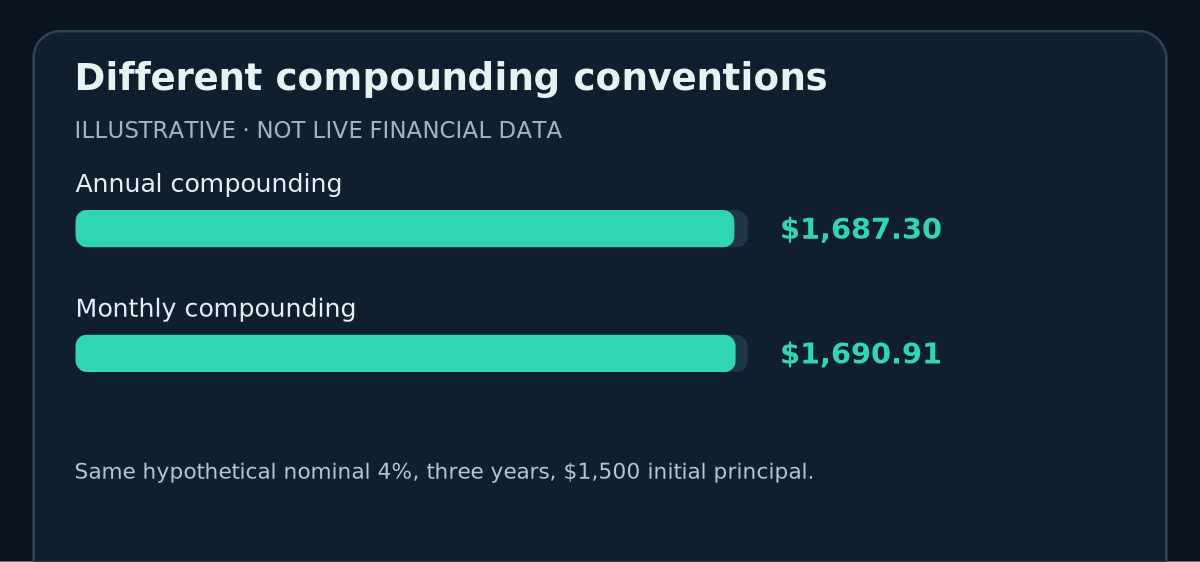
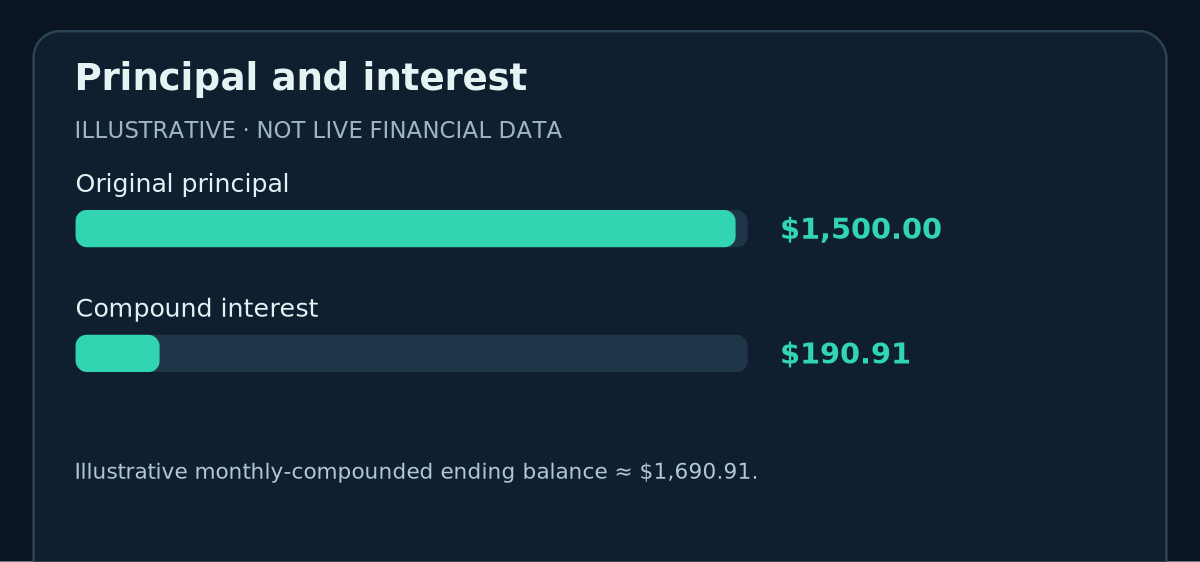
All values are fictional: $1,500 principal, fixed stated 4% yearly rate compounded monthly for 3 years, no additions, fees or taxes. A = 1500 × (1 + 0.04/12)^36 = $1,690.91 (rounded). Interest above principal is $190.91. Use full precision while calculating.
Second scenario and interpretation
With the same nominal 4% rate compounded annually, A = 1500 × 1.04³ = $1,687.30. The monthly schedule gives a slightly higher hypothetical balance because interest is added more often, not because the stated annual nominal rate changed. Compare APY to APY when making real banking choices.
Common mistakes and troubleshooting
Entering 4 instead of 0.04
A percent is divided by 100 before arithmetic; 4 is 400%, not 4%.
Double-compounding APY
Treating disclosed effective yield as a nominal rate can exaggerate growth.
Compounding all later deposits for the full term
Each deposit begins earning on its actual contribution date.
Labeling projected values as guaranteed
Rates may change; investments are risky and inflation/tax/fees affect outcomes.
Alternatives and special cases
Simple fixed-rate deposit
Use the appropriate bank’s disclosed calculation method and account terms.
Monthly additions
Use a period-based future-value calculation with clear timing for contributions.
Variable rate or irregular deposits
Build a dated ledger and apply each period’s applicable rate to the then-current balance instead of one constant-rate shortcut.
Differences by country
United States
US deposit accounts often state APY for comparable yields; read account rate tiers and requirements. SEC’s calculator models assumed growth, not insured returns on investments.
United Kingdom
AER helps compare UK savings products; distinguish it from a stated gross nominal rate and read conditional-bonus terms.
Canada
Check compounding schedule, payment date and disclosed effective interest method for the Canadian account.
Australia
Compare actual deposit terms and conditions; do not assume a rate is compounded monthly unless the institution specifies that convention.
This how to calculate compound interest procedure is general education. Confirm current official rules and product or employment details where relevant.
Frequently asked questions
Does interest compound on previous interest?
Yes, when credited interest remains in the earning balance.
Is monthly compounding always better?
For the same positive nominal stated rate with no fees, it generally produces a larger ending balance; real products differ in rate and terms.
What if I withdraw early?
Recalculate the smaller balance and check account penalties or lost bonus conditions.
Can I apply this directly to stocks?
Only as an explicitly hypothetical constant-return illustration; stock returns are volatile and losses are possible.
Final checklist
-
[ ] Identify principal and annual rate convention
-
[ ] Record compounding frequency
-
[ ] Convert rate to decimal
-
[ ] Count periods correctly
-
[ ] Calculate accumulation factor
-
[ ] Subtract initial principal for interest
-
[ ] Model fees, inflation and changes separately
Sources & Further Reading
-
US Securities and Exchange Commission / Investor.gov: Compound Interest Calculator — Compounding, frequency, starting balance and contributions. Checked 27 October 2026.
-
Federal Reserve Education: Getting Real about Interest Rates — Distinction between nominal and real interest and approximate subtraction. Checked 27 October 2026.
Use the checklists as you go, and confirm the result before moving on to a more involved repair.