How to Compare Simple and Compound Interest
Compare simple and compound interest with identical inputs, step-by-step formulas and realistic hypothetical year-by-year balances.
Quick answer: For the same principal P, annual rate r and time t, compare simple interest: I = P × r × t with annual compounding: A = P(1+r)t. Subtract principal from the compound balance to measure compound interest. Confirm that both calculations use equivalent rates and periods.
What you will achieve: You will understand exactly where interest-on-interest appears and when a quick simple-interest estimate misstates a longer-term accumulation. These examples assume positive, unchanged rates and no transaction costs; they do not replace loan disclosures.
Before you begin
You need a principal, annual rate, time period and a clear compounding frequency. Check whether interest is paid out instead of added to the balance, and whether a quoted rate is an APR, APY/AER or flat add-on rate. The same numbers are not automatically comparable if products use different definitions.
Compare simple and compound interest over the same initial principal, rate convention and horizon. The worked example assumes no fees, taxes, missed payments or rate changes.
Step-by-step instructions
Step 1: Write a common scenario
Take a hypothetical $2,000 balance, 5% yearly nominal rate and 3 full years. Keep principal, time and rate the same when comparing formulas. No fees, tax, withdrawals or extra deposits are included.
Step 2: Calculate simple interest
Multiply principal by annual decimal rate and years: 2000 × 0.05 × 3 = $300. Add back original principal for the $2,300 ending simple-interest balance. In a pure simple-interest model the interest charge is not itself interest-bearing.
Step 3: Calculate the first compound year
With annual compounding, $2,000 grows to $2,100 after year one. At the end of year two, the 5% applies to $2,100, not only the $2,000 principal. Write down each annual end balance to see the mechanism.
Step 4: Calculate the full compound period
After year three, $2,000 × (1.05)^3 gives $2,315.25. Subtract original principal to get $315.25 compound interest. The $15.25 additional interest compared with the simple model arises from growth on earlier credited interest.
Step 5: Check compounding frequency
Monthly or daily compounding requires n in the exponent formula. If you hold the quoted nominal rate fixed, more frequent compounding usually changes the effective rate. If you hold the disclosed APY/AER fixed instead, a frequency comparison is different.
Step 6: For loans, investigate amortization
Typical instalment loans may apply interest to an outstanding declining balance and require periodic principal payments. The simple-versus-compound end balance of an untouched principal is usually not a valid estimate of an actual amortising loan’s monthly repayment total.
Step 7: Identify what gets credited or withdrawn
If interest is paid into another account each year and not reinvested, the original balance may continue earning only on principal. Contract terms, capitalization, nonpayment and fees determine the actual accrual, not the label in a guide.
Step 8: Test a shorter or longer horizon
Repeat the calculation for one year; annual simple and compound amounts agree for a single period. Extend to five years to observe a widening gap when the positive rate and untouched balance are unchanged.
Formula and assumptions
Simple ending balance = P(1+rt). Annual compound ending balance = P(1+r)^t. Extra interest attributable to annual compounding = P[(1+r)^t − (1+rt)].
Fully worked example
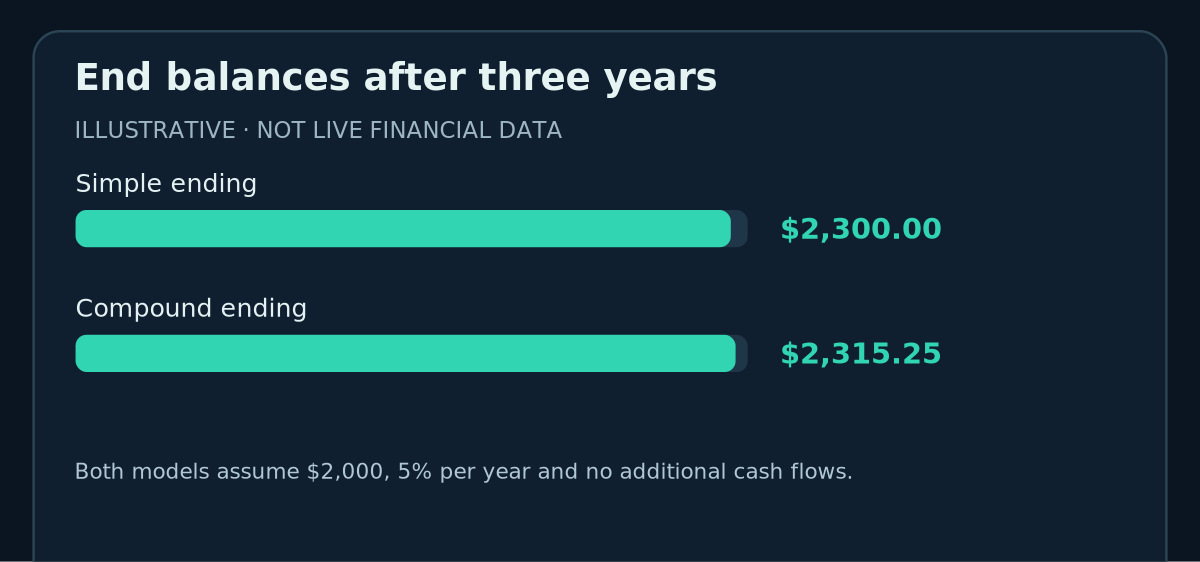
Assumed: P=$2,000, r=5% a year, t=3 years, no costs. Simple interest = 2000×0.05×3 = $300.00 and ending balance $2,300.00. Annual compound balance = 2000×1.05³ = $2,315.25, compound interest $315.25. The extra is $15.25.
Second scenario and interpretation
For annual compounding the year-end balances are Year 0 $2,000.00; Year 1 $2,100.00; Year 2 $2,205.00; Year 3 $2,315.25. Simple balances under the same assumptions would be $2,000.00, $2,100.00, $2,200.00 and $2,300.00. This year-by-year table is a conceptual model, not a retail deposit advertisement.

Common mistakes and troubleshooting
Assuming “simple” means cheaper in every loan contract
Loan APR, fees and payment dates can dominate the labeled method.
Adding the compound balance and principal
The formula A already includes principal; interest is A−P.
Comparing one quoted APY with another nominal rate
Normalize rate definitions before comparison.
Ignoring negative returns or early withdrawals
An investment path may not follow an uninterrupted positive-interest model.
Alternatives and special cases
Short single-period comparison
When there is only one annual interest credit and no reinvestment, the formulas coincide.
Amortizing borrowing
Use a dated payment and balance schedule; the money owed shrinks as payments reduce principal.
Compounding deposits
Use a future-value calculator when deposits arrive during the term; the untouched-principal example is not sufficient.
Differences by country
United States
APR and APY describe different disclosure measures; review lender and bank calculation terms before using either formula.
United Kingdom
Savings AER is an effective annual comparison measure, and lending APR includes regulated credit-cost conventions; do not substitute a nominal rate without checking.
Canada
Loan compounding and repayment conventions depend on product terms; confirm the actual payment schedule.
Australia
Variable interest, effective yields and comparison rates may matter more than this simplified untouched-principal comparison.
This how to compare simple and compound interest procedure is general education. Confirm current official rules and product or employment details where relevant.
Frequently asked questions
Why do both methods agree after one year?
With just one annual credit there is no earlier credited interest on which to earn further interest.
Does compound interest always grow faster?
Under a positive constant rate and reinvestment it does after multiple periods; fees, withdrawals and negative returns change outcomes.
Is my credit card an example of the formula here?
Not directly. Cards often calculate interest using daily balances, transactions and repayments; follow the issuer’s terms.
Should I choose a product solely by frequency?
No. Compare effective yield, costs, access requirements and risk.
Final checklist
-
[ ] Use identical principal, rate and duration
-
[ ] Check annual stated vs effective rate
-
[ ] Compute simple interest
-
[ ] Compute compound future value
-
[ ] Subtract principal for compound interest
-
[ ] Compare differences and timelines
-
[ ] Read actual product terms
Sources & Further Reading
-
US Securities and Exchange Commission / Investor.gov: Compound Interest Calculator — Compounding, frequency, starting balance and contributions. Checked 27 October 2026.
-
Federal Reserve Education: Getting Real about Interest Rates — Distinction between nominal and real interest and approximate subtraction. Checked 27 October 2026.
Use the checklists as you go, and confirm the result before moving on to a more involved repair.