How to Estimate Self-Employment Taxes in the United States
Estimate 2026 US self-employment tax using 92.35% net earnings, Social Security and Medicare components, with verified examples.
Quick answer: For a typical US sole proprietor below the Social Security earnings ceiling, estimate business net profit (gross business income minus ordinary, necessary business expenses), calculate 92.35% of that profit as the starting self-employment tax base, and apply 12.4% Social Security plus 2.9% Medicare, subject to annual caps, wages from other jobs and special cases. The resulting 15.3% combined rate is not a flat tax on gross sales and does not include ordinary federal or state income tax.
What you will calculate: A transparent approximate 2026 US self-employment (SE) tax calculation, an example of the Social Security ceiling interacting with W-2 wages, and a reminder to estimate federal/state income tax separately. This guide is US-specific. Every business figure below is hypothetical; cited rates and ceilings are sourced to official 2026 IRS guidance reviewed on 27 October 2026.
Before you begin: information and limits
Collect total revenue, refunds, allowable business costs, any W-2 wages subject to Social Security tax, and filing-status information that may matter for Additional Medicare Tax. Look for your Schedule C profit, or other applicable self-employment income form. A freelancer’s deposits, a company’s turnover, and the final amount subject to SE tax are different concepts.
This procedure targets a conventional self-employed individual using Schedule SE. Ministers, clergy, certain farmers, partners, married business owners, nonresident workers, taxpayers with multiple categories of earned income and optional methods may have additional rules. This is an estimate, not a substitute for the instructions for Schedule SE or tax advice for a specific return.
Step-by-step calculation for tax year 2026
Step 1 — Work from business profit, not money received
Start with business gross receipts, account for refunds and other correctly categorized income, and subtract genuine business expenses allowed under US tax rules. Net profit = appropriate business income − allowable business expenses. Do not deduct a personal grocery bill, a transfer to your own savings, or a loan principal repayment merely because cash left your business account.
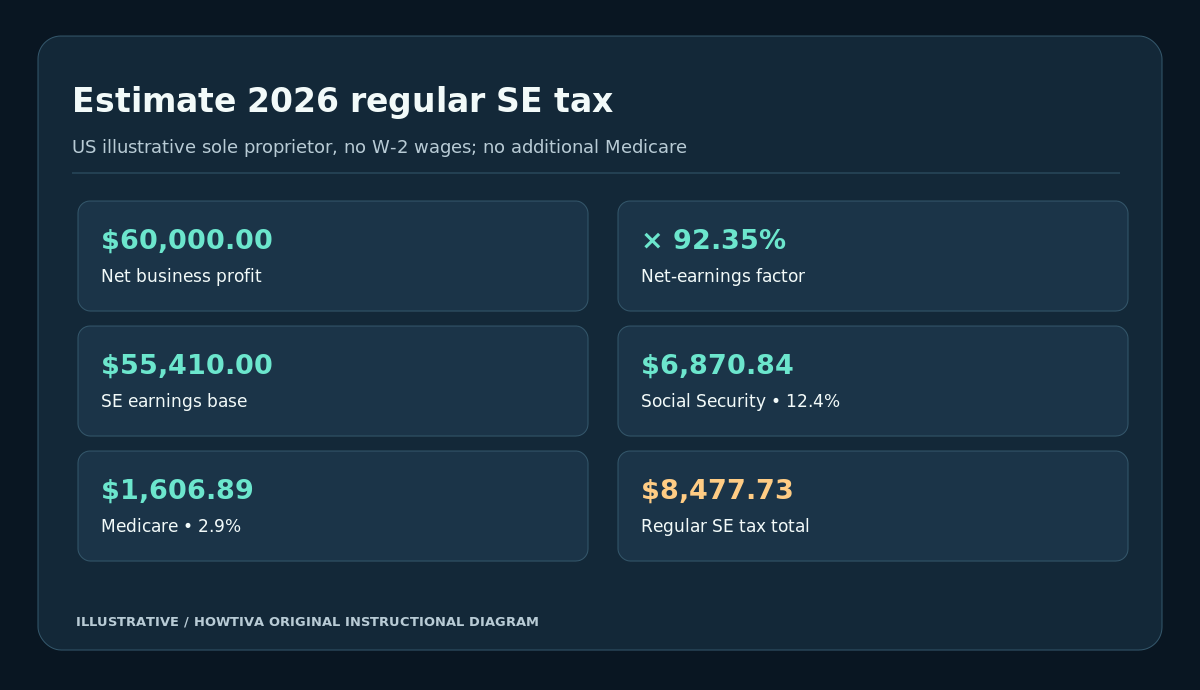
For an illustrative sole proprietor, annual receipts are $80,000 and substantiated ordinary business expenses are $20,000. Net business profit is $60,000. This $60,000 is an assumed tax worksheet input; do not mistake the figure for an official average. Business income tax calculations can have additional adjustments not modeled here.
Step 2 — Apply the 92.35% net-earnings factor
Under the usual method, net earnings subject to the SE tax computation start at 92.35% of net profit. With the assumed $60,000 profit, $60,000 × 0.9235 = $55,410. The IRS generally says SE tax applies when net earnings from self-employment are $400 or more, with defined exceptions. That $400 threshold refers to net earnings for SE-tax purposes, not simply to receiving $400 in invoices.
Step 3 — Calculate the Social Security part with the annual limit
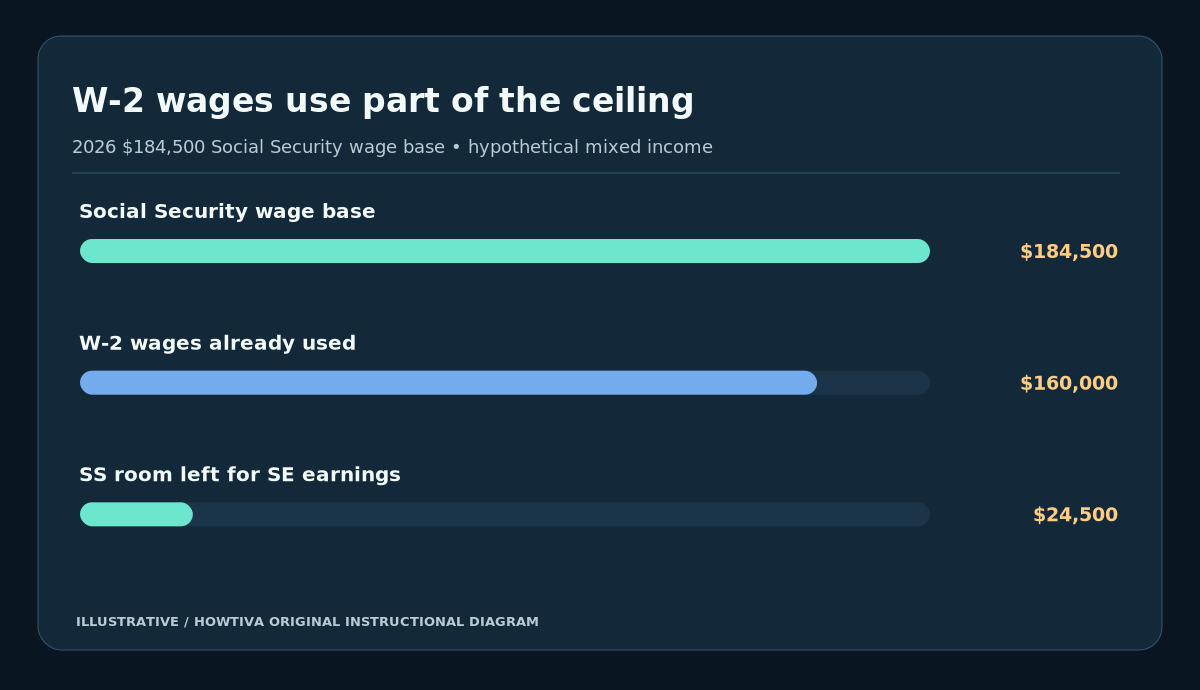
The Social Security SE tax component is 12.4% of qualifying net SE earnings up to the applicable annual earnings base. For 2026, that base is $184,500, not a permanent fixed number. An individual’s wages already subject to Social Security tax at another job reduce how much room remains under the annual base for the SE Social Security calculation.
Our main example has no W-2 wages and $55,410 of net SE earnings. It is under the ceiling. Social Security component: $55,410 × 0.124 = $6,870.84.
Step 4 — Calculate Medicare separately
The regular Medicare component is 2.9% of relevant net SE earnings and has no Social Security-style earnings cap. In the main example, $55,410 × 0.029 = $1,606.89. Keep it separate from Social Security so a cap never accidentally removes Medicare. A separate 0.9% Additional Medicare Tax can apply above filing-status thresholds and can combine Medicare wages and self-employment income; it is not included in this simple main example.
Step 5 — Add the two components and record the half-SE-tax adjustment
The assumed SE tax is $6,870.84 + $1,606.89 = $8,477.73. The approximate deduction for the employer-equivalent half is $8,477.73 × 50% = $4,238.87 after cent rounding. The half-SE-tax adjustment ordinarily reduces adjusted gross income for income-tax calculation; it does not cut the calculated $8,477.73 SE-tax amount in half. Follow the forms’ actual rounding conventions when filing.
Step 6 — Check whether W-2 wages change the Social Security piece
Suppose a different person has $160,000 in W-2 wages subject to Social Security tax in 2026 plus a fictional $35,000 net sole-proprietor profit. The SE net-earnings base is $35,000 × 0.9235 = $32,322.50. Remaining Social Security ceiling: $184,500 − $160,000 = $24,500. Social Security SE tax applies to the smaller of $32,322.50 and $24,500: $24,500 × 12.4% = $3,038.00. Medicare on the full $32,322.50 is $937.35; estimated regular SE tax is $3,975.35. This example is illustrative and deliberately below the stated Additional Medicare thresholds. With multiple employers, certain excess Social Security withholdings require a separate review; do not guess.
Step 7 — Estimate income tax and payment timing separately
Self-employment tax is not the whole tax bill. Federal income tax depends on taxable income, deductions, filing status, credits, current law and other items. State or local income taxes may apply. If self-employment income is not subject to paycheck withholding, you might have to make estimated tax payments during the year. Use Form 1040-ES or relevant IRS worksheets to calculate a year-specific amount; do not simply divide $8,477.73 by four and call that your complete quarterly payment.
IRS Publication 505 gives the general estimated-payment periods and due dates, but exact payment dates depend on the year, holidays, uneven income and exceptions. For 2026, the generic instalment dates shown in the IRS guidance are April 15, June 15, September 15, 2026 and January 15, 2027, adjusted where a weekend/holiday rule applies. Verify a deadline before paying, particularly if filing in a later year.
Step 8 — Recalculate when your situation changes
Update expected profit at least every quarter, especially after a large new client, refund, equipment purchase or shift to W-2 employment. Keep receipts and proof of all tax payments. If you have net losses, mixed income, Social Security benefits, foreign tax obligations or unusual work arrangements, check an IRS worksheet or obtain professional guidance rather than using the single-rate shortcut.
Formula worksheet (ordinary below-cap case)
| Quantity | Formula | Illustrative result |
|---|---|---|
| Net business profit | $80,000 receipts − $20,000 valid expenses | $60,000.00 |
| Net SE earnings | $60,000 × 0.9235 | $55,410.00 |
| Social Security | $55,410 × 0.124 | $6,870.84 |
| Medicare | $55,410 × 0.029 | $1,606.89 |
| Regular self-employment tax | $6,870.84 + $1,606.89 | $8,477.73 |
| Half-SE-tax income adjustment | $8,477.73 ÷ 2 | $4,238.87 |
The example assumes the entire $55,410 fits under the Social Security wage base, no Additional Medicare Tax and no special Schedule SE adjustments. It is not a statement of an actual taxpayer’s return.
Common mistakes and how to correct them
Applying 15.3% to total sales: Rebuild profit from receipts and allowable costs, then apply 92.35% where applicable. Do not calculate SE tax on the owner’s transfers or unadjusted sales.
Treating the Social Security ceiling as a cap on all SE tax: The annual ceiling applies to Social Security, not the 2.9% regular Medicare component.
Forgetting another job’s wages: Cross-check each W-2 and the total 2026 Social Security wage base when computing the SE Social Security part.
Calling half-SE-tax deduction a credit: It is normally an adjustment affecting income-tax calculations; it is not a dollar-for-dollar rebate of the SE tax.
Using last year’s threshold: Rates and ceilings should be checked against the tax year being filed, not just the calendar date when a guide was read.
Missing estimated payments: Use an IRS worksheet and consider income tax, SE tax, credit and withholding effects. Save official payment confirmations.
Alternative methods and special situations
An IRS tax-preparation worksheet can perform the computation step by step and is safer for multiple W-2 jobs or special Schedule SE cases. A professional tax preparer can review partner income, election rules, clergy exemptions, Additional Medicare Tax or overseas work. For cash-flow planning, a separately labelled savings reserve may help prevent tax funds being spent, but a universal percentage to set aside would be misleading.
Country differences
United States: Figures and Schedule SE rules above are US federal rules for tax year 2026; state taxes and entity classification differ. United Kingdom, Canada and Australia: This 15.3% calculation does not apply. Those countries have different income-tax, social-insurance and self-employment systems; use HMRC, CRA or ATO guidance rather than converting the example into another currency.
Frequently asked questions
Do I owe SE tax if my profit is exactly $400?
The IRS refers generally to net earnings from self-employment of $400 or more, not simply $400 of profit. Follow Schedule SE instructions, including possible exceptions and optional methods, to determine whether your actual case meets the threshold.
Does a 1099-NEC automatically prove I am an independent contractor?
No. Classification depends on the real working relationship, not just the label on a form. The IRS considers behavioral control, financial control and the relationship of the parties.
Is 15.3% my total federal tax rate?
No. It is the combined ordinary Social Security and Medicare SE rate before limitations, not your federal income-tax bracket and not necessarily the final SE tax on all your earnings.
If my business loses money, can I owe tax on something else?
Yes. Other income, prior-year or other obligations can matter. A loss generally changes the SE-tax calculation, but do not infer your entire federal tax balance from one line.
Can I deduct the full self-employment tax from my income tax?
Typically the employer-equivalent half is an income adjustment, subject to the applicable form rules. It does not reduce the SE tax itself by half.
Final self-employment estimate checklist
- [ ] Net business profit uses substantiated business expenses.
- [ ] The 92.35% step is shown explicitly.
- [ ] The 2026 $184,500 Social Security cap and W-2 wages are checked.
- [ ] Social Security 12.4% and Medicare 2.9% are computed separately.
- [ ] Additional Medicare Tax and special situations are reviewed if relevant.
- [ ] Half-SE adjustment is not misrepresented as a tax credit.
- [ ] Income tax and estimated payments are calculated separately.
- [ ] The completed return is checked against the current Schedule SE instructions.
Sources & Further Reading
- IRS: Publication 505 (2026), Tax Withholding and Estimated Tax
- IRS: Topic 554 — Self-employment tax
- IRS: Self-employment tax (Social Security and Medicare)
- IRS: Topic 751 — Social Security and Medicare rates and wage limits
- IRS: Topic 560 — Additional Medicare Tax
- IRS: Independent contractor or employee?
- IRS: Estimated taxes
Official tax information checked on 27 October 2026. All personal figures are assumed examples, not filing advice. Apply the forms and law for the year actually being filed.
Use the checklists as you go, and confirm the result before moving on to a more involved repair.