How to Clean a Dishwasher Filter
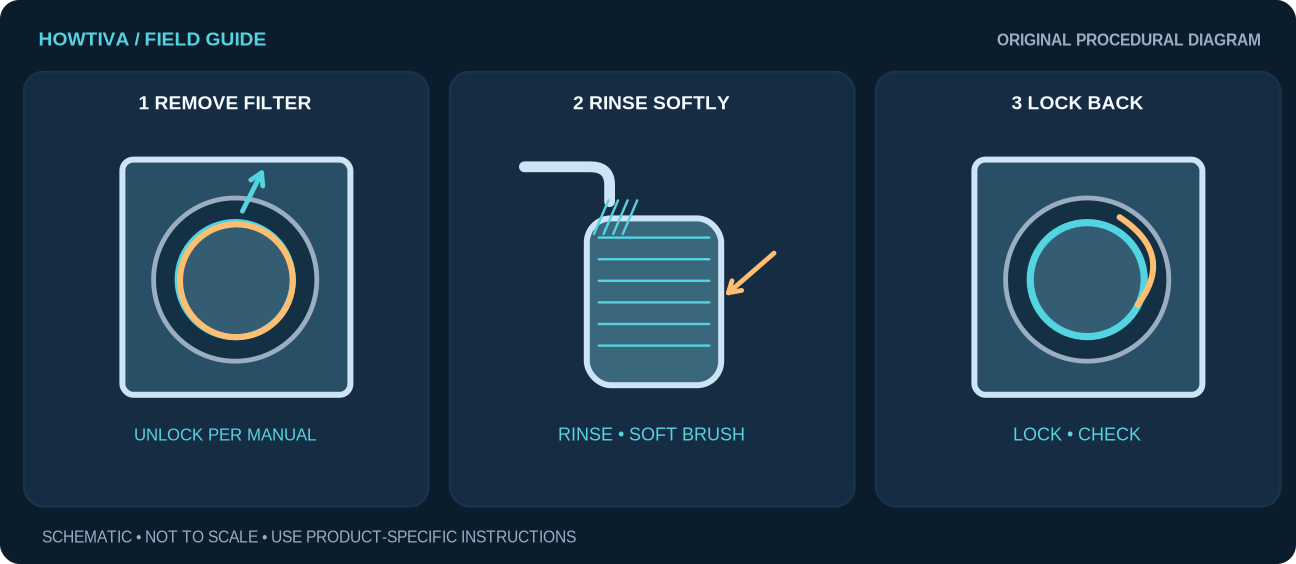
Allow the dishwasher to cool, remove the lower rack and confirm the model has a removable filter. Rinse gently with water and a soft brush; reassemble and lock the filter before use.
Quick answer: After the dishwasher cools and stops, remove the lower rack and locate its filter. If the owner’s manual identifies a removable filter, unlock and lift it as shown for that model, rinse the screens under running water and use a soft brush for debris. Reassemble and lock the filter completely before operating the dishwasher. Do not assume all dishwashers have a removable filter.
For owner-removable filters at the bottom of household dishwashers. Maintenance-free or self-cleaning filter systems can differ; not every model should be opened. Sharp glass or bones in the sump, deep standing water and electrical faults require additional precautions or professional attention.
Before you begin: safety and materials
What you need:
- Dishwasher model’s filter diagram and cleaning instructions
- Soft nonmetal brush, clean water and towel
- Gloves appropriate for handling wet food debris; avoid contact with broken glass
- Flashlight, shallow bowl for catching loose food
Step-by-step instructions
Step 1: Turn off operation and allow the machine to cool
Wait until the wash and dry program is finished; dishes, water and metal parts may be very hot. Remove the lower dish rack only when it is safe to handle. Do not reach under the heater or into a running sump.
Step 2: Identify the exact filter system
Locate the drain/filter area, often centrally near the lower spray arm or in a back corner. Whirlpool documents both a removable upper/lower filter arrangement and an alternative maintenance-free system with a foreign-object cup. Do not force a cylinder that your manual does not identify as removable.
Step 3: Unlock and lift as directed by the manufacturer
On many Whirlpool removable systems, turn the upper cylindrical filter about a quarter-turn counterclockwise, lift it, then remove the lower filter. Bosch diagrams show a twist release and separate mesh elements. Take a photo of orientation before removal.
Step 4: Rinse without damaging the screen
Carry parts to a sink. Remove food debris, rinse under running warm water and gently brush mesh folds if needed. Whirlpool advises against scouring pads or wire brushes, which can damage the filters. Avoid chemical drain openers in the appliance.
Step 5: Reassemble and lock the entire unit
Seat lower flat components in their original grooves, replace the upper filter and twist to its marked locked position. Whirlpool warns that the appliance should not run with loose or missing filters; a freely spinning upper assembly may not be locked.
Step 6: Inspect drainage on a controlled cycle
Replace the rack and, if safe, use a model-approved rinse cycle. Watch for abnormal leaks, errors or water remaining unexpectedly. If debris is broken glass or the sump needs dismantling, stop and contact service.
Practical examples: how the steps change
Washed dishes have sandy particles
Check whether the filter mesh is blocked or damaged and whether the unit was reinstalled tightly; a clean screen may not solve a blocked spray arm.
An old dishwasher seems to have no removable cylinder
Consult the actual manual before trying to pry the lower grate. Some machines use self-cleaning/maintenance-free systems or a different cup.
Troubleshooting the problems people actually encounter
Filter turns but will not lift: The lock may require a specific angle or a tab; do not pry against plastic. Find the correct model illustration.
A small piece of glass is near the sump: Do not reach blindly. Use the manufacturer’s safe procedure or professional help.
Filter continues turning after reinstall: Likely not locked or mismatched; stop and confirm orientation before any cycle.
Water still stands in the tub: A clean filter is only one potential cause; drain hose, pump, float or installation can be involved. Do not dismantle energized equipment.
Alternatives, product differences and limitations
For a documented maintenance-free design, clean only user-accessible foreign-object cups and visible soil as instructed; do not cut screens or remove fixed pump covers. For heavy mineral buildup, use only approved dishwasher-care products per model instructions.
When to stop and seek qualified help
Stop if the filter is cracked, will not lock, glass is embedded, wastewater is overflowing or the machine trips power. Do not operate with the filter absent or damaged.
Frequently asked questions
How often should the filter be cleaned?
Follow the maker’s schedule; household use, soil level and filter design change intervals.
Can I use a stiff wire brush?
No. Whirlpool and Bosch specify soft brushing and rinsing; rough tools can tear mesh or damage plastic seals.
Sources & further reading
-
Whirlpool Product Help: Cleaning the Removable Filtration System
Use the checklists as you go, and confirm the result before moving on to a more involved repair.