How to Compare Nominal and Inflation-Adjusted Wages
Compare nominal and inflation-adjusted wages using CPI and learn whether a salary raise actually outpaces price increases.
Quick answer: To compare nominal wages after inflation, express both pay amounts in the same date’s purchasing-power units. Convert a later wage into earlier-period money using later wage × (earlier price index ÷ later price index); then compare it with the earlier wage. An increase on the payslip does not necessarily mean a real pay increase.
What you will achieve: You can check whether a raise outpaced measured consumer inflation. This compares purchasing power of gross or net wages (specify which); it cannot prove that an employee’s quality of life or personal cost of living increased by the same amount.
Before you begin
Have consistent wage measures for both dates: hourly, weekly or annual; gross with gross, or net with net; hours worked and bonuses treated consistently. Find a price-index series for the same location/coverage and precisely comparable periods. Do not compare full-time annual salary with part-time monthly earnings.
Deflate later wages with a consistent CPI series, then compare like-for-like hours and pay definitions. Inflation-adjusted gross wages are not equivalent to take-home purchasing power.
Step-by-step instructions
Step 1: Pick a wage unit
Use hourly pay if you want to isolate rates from changing hours. Use annual salary only when contracted periods and bonus treatment match. Document overtime, hours, commission and unpaid leave separately so a changed workload does not disguise the wage comparison.
Step 2: Gather the earlier and later pay amounts
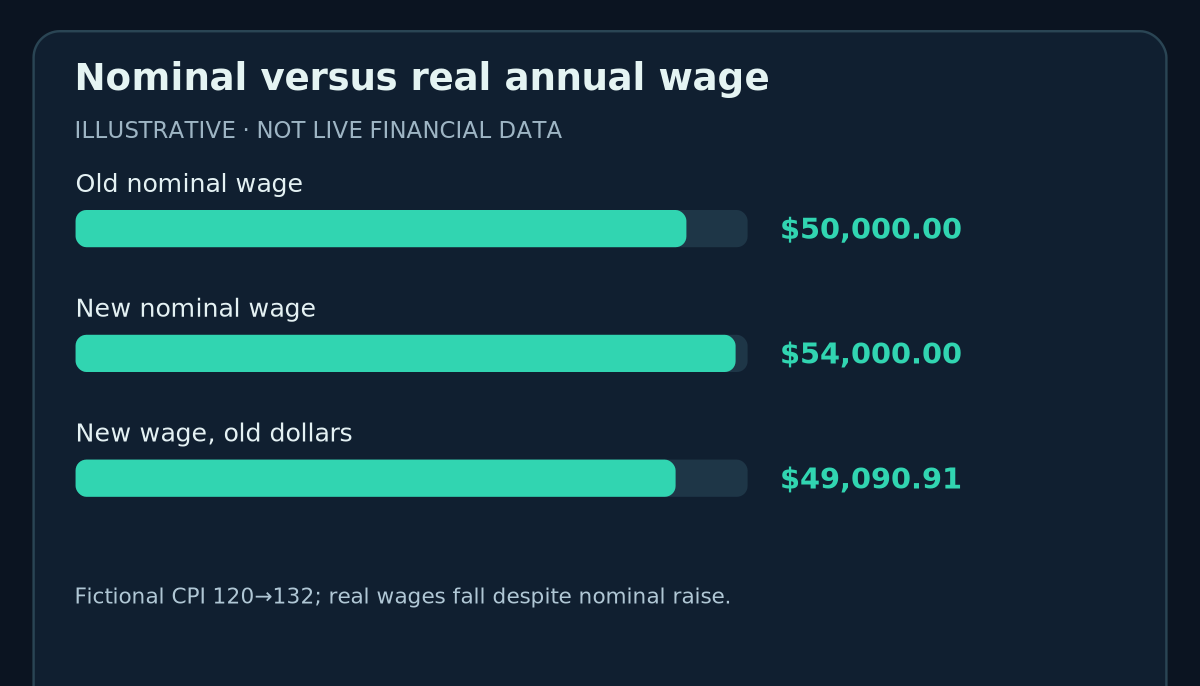
The worked example assumes $50,000 and $54,000 annual gross pay. Nominal wage growth = (54,000 − 50,000)/50,000 = 8%. This headline pay rise is only the first half of a meaningful comparison.
Step 3: Get two matched consumer price-index observations
Use CPI values from one official series, one geography and matched frequency. The illustrative index rises from 120 to 132, a 10% change. It is not an actual CPI release. Prices and wages must refer to coherent reference periods.
Step 4: Convert later pay into earlier dollars
Multiply later wage by earlier index / later index. With assumed values: 54,000 × 120/132 = $49,090.91 in earlier-period dollars. The converted amount can now be compared directly against the old $50,000 wage.
Step 5: Calculate the real wage percentage change
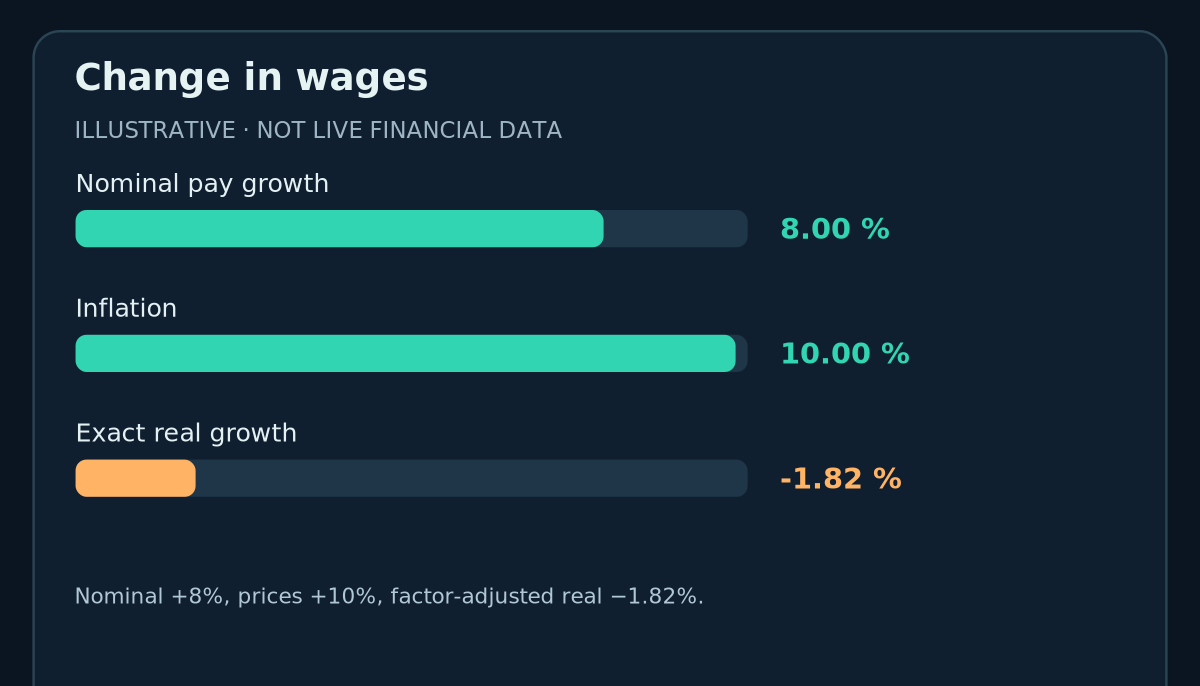
Compute (49,090.91 / 50,000 − 1)×100 ≈ −1.82%. You can alternatively calculate (1.08/1.10 − 1)×100 and get the same exact relative real change before rounding.
Step 6: Reverse the conversion as a check
Ask what later nominal wage would have preserved purchasing power: 50,000 × 132/120 = $55,000. A later wage of $54,000 falls $1,000 short of that illustrative constant-basket benchmark.
Step 7: Inspect working hours and deductions separately
An 8% salary rise with 15% more working hours may reduce compensation per hour. A gross real wage comparison does not automatically tell you net take-home pay after taxes, pensions, social contributions and benefits.
Step 8: Interpret index limitations honestly
National CPI is an aggregate basket and does not reflect all household spending weights. Your rent, transport and childcare costs may follow different patterns. The proper conclusion is “inflation-adjusted using this index,” not “everyone is worse off by precisely 1.82%.”
Formula and assumptions
Real later pay in earlier currency units = nominal later pay × CPI_earlier/CPI_later. Real wage growth = [(nominal later/nominal earlier) ÷ (CPI_later/CPI_earlier) − 1] ×100%.
Fully worked example
Fictional wage series: gross annual pay increases from $50,000 to $54,000, nominal +8%. Fictional CPI increases from 120 to 132, inflation +10%. Later pay in earlier-period dollars = 54,000×120/132 = $49,090.91. Exact real wage growth = 1.08/1.10 −1 = −1.82%.
Second scenario and interpretation
The later nominal wage needed just to preserve the prior indexed purchasing power is $50,000×132/120 = $55,000. The actual hypothetical $54,000 is $1,000 below that benchmark. This comparison says nothing by itself about whether the worker changed hours, moved, or received noncash benefits.
Common mistakes and troubleshooting
Subtracting headline inflation from nominal pay growth and treating it as exact
8% −10% = −2 percentage points is an approximation, while factor division yields −1.82%.
Comparing different work hours
Total earnings can rise even when hourly pay fails to keep up.
Mixing periods or price-index series
A 12-month wage change needs a comparably dated price change.
Forgetting gross versus net differences
Deduction changes can alter spendable money independent of nominal wage changes.
Alternatives and special cases
Real hourly wage
Use actual hourly rates for comparable roles, shift premiums and hours worked.
Salary including bonuses
Make base-salary and total-compensation comparisons separately and document irregular awards.
Personal expense-basket comparison
Use actual household essential expense categories as a supplement, while labeling the bespoke index as non-official.
Differences by country
United States
BLS publishes official real earnings series using CPI deflators. For individual calculations, identify CPI-U/CPI-W and reporting frequency rather than mixing indices.
United Kingdom
Use an ONS price series appropriate to the UK; employment hours, pension contribution changes and tax bands can affect net outcomes.
Canada
Use a Statistics Canada index and Canadian-dollar wage amounts; region-specific living costs differ.
Australia
Use an Australian CPI series; awards, enterprise agreements, overtime and superannuation can complicate like-for-like compensation comparison.
This how to compare nominal and inflation-adjusted wages procedure is general education. Confirm current official rules and product or employment details where relevant.
Frequently asked questions
Can a positive raise be a real pay cut?
Yes, whenever comparable consumer prices grow faster than your wage.
Why is 8% minus 10% not exact?
Growth factors divide rather than subtract; 1.08/1.10 −1 ≈ −1.82%.
Should I use gross or net wages?
Choose based on the question, but keep the measure consistent across dates and label it.
What if I worked more hours?
Calculate real hourly pay separately to avoid mixing compensation rate and quantity of labor.
Final checklist
-
[ ] Match the wage unit and gross/net basis
-
[ ] Record older and newer pay
-
[ ] Select a consistent official CPI series
-
[ ] Compute nominal wage growth
-
[ ] Deflate later pay to older units
-
[ ] Calculate real growth with factor division
-
[ ] Consider hours and changes in deductions
Sources & Further Reading
-
US Bureau of Labor Statistics: Income and the Consumer Price Index — Deflating nominal wages into real wages. Checked 27 October 2026.
-
US Bureau of Labor Statistics: Real Earnings Technical Note — Use of different BLS price deflators in official real earnings. Checked 27 October 2026.
-
US Bureau of Labor Statistics: Purchasing power and constant dollars — Price-index ratio and equivalent historical dollar values. Checked 27 October 2026.
Use the checklists as you go, and confirm the result before moving on to a more involved repair.