How to Reduce Monthly Subscription and Recurring Costs
Reduce monthly subscriptions with an audit, annualized cost comparisons, a $636 illustrative savings plan and a safe cancellation checklist.
Quick answer: Review at least three months of bank, card and app-store charges; convert every recurring bill to its monthly and yearly equivalent; decide which services you actually use; then cancel, pause, downgrade or renegotiate the rest. Save the confirmation, check the next billing cycle and confirm the charge has stopped. Stopping a payment method alone does not necessarily end a contract.
What you will finish: One accurate subscription inventory, a monthly cost baseline, a priority list, and a cancellation-verification routine. Prices below are hypothetical US-dollar examples, not actual provider plans or guaranteed savings.
Why recurring costs escape notice
Small automatic charges can be spread across debit cards, credit cards, PayPal-like wallets, app-store billing, household accounts and bank standing orders. Some recur monthly; others are annual, weekly or after a trial. A service may appear under a parent-company or payment-processor descriptor. The main risk is not always a large single fee, but forgetting that a charge will repeat. You can reduce recurring costs without giving up the services that genuinely improve your life.
The FTC advises consumers to review trial and automatic-renewal terms and keep records of cancellation; UK MoneyHelper distinguishes bank Direct Debits, standing orders and recurring card payments. The correct steps depend on the payment arrangement and the contract.
Preparation: the records you need
Gather three to twelve months of bank and credit-card statements, receipts and email confirmations, app-store purchase histories, membership agreements, insurance/phone/internet renewal notices, household shared subscriptions and payment-wallet histories. Do not upload account passwords, full card numbers or unredacted bank statements to a random subscription-audit website. Note which family member holds each account and whether cancellation affects essential medical, professional, security or accessibility services.
Create columns for provider; billing descriptor; product; payment account; price; billing frequency; next renewal; commitment or notice date; use in last 30 days; proposed action; cancellation evidence; next-charge verification. An annual invoice may need to be identified in twelve months of records; three months alone will miss it.
Step-by-step: cut charges without creating new problems
1. Make a master list from financial records
Scan line-by-line for repeated merchant names and amounts. Match unfamiliar entries to receipts and official account billing pages; do not guess that a repeated charge is fraud. Search email for ‘renewal’, ‘membership’, ‘receipt’, ‘trial’ and ‘subscription’. Check mobile-platform subscription screens using current official instructions and note whether the purchase was made through an app store or directly with the provider. The company taking the payment is not always the company that will cancel the service.
2. Normalize mixed billing periods
For a charge billed monthly, use its monthly amount. For an annual invoice, divide by 12 to find a monthly planning equivalent (not an actual monthly debit). For a weekly charge, multiply by 52 ÷ 12 ≈ 4.333; do not assume every month has exactly four weeks. For a quarterly fee, divide by three. Example: a hypothetical $120 annual service represents $10 per month in a twelve-month budget, even though the money leaves all at once.
3. Identify the actual baseline
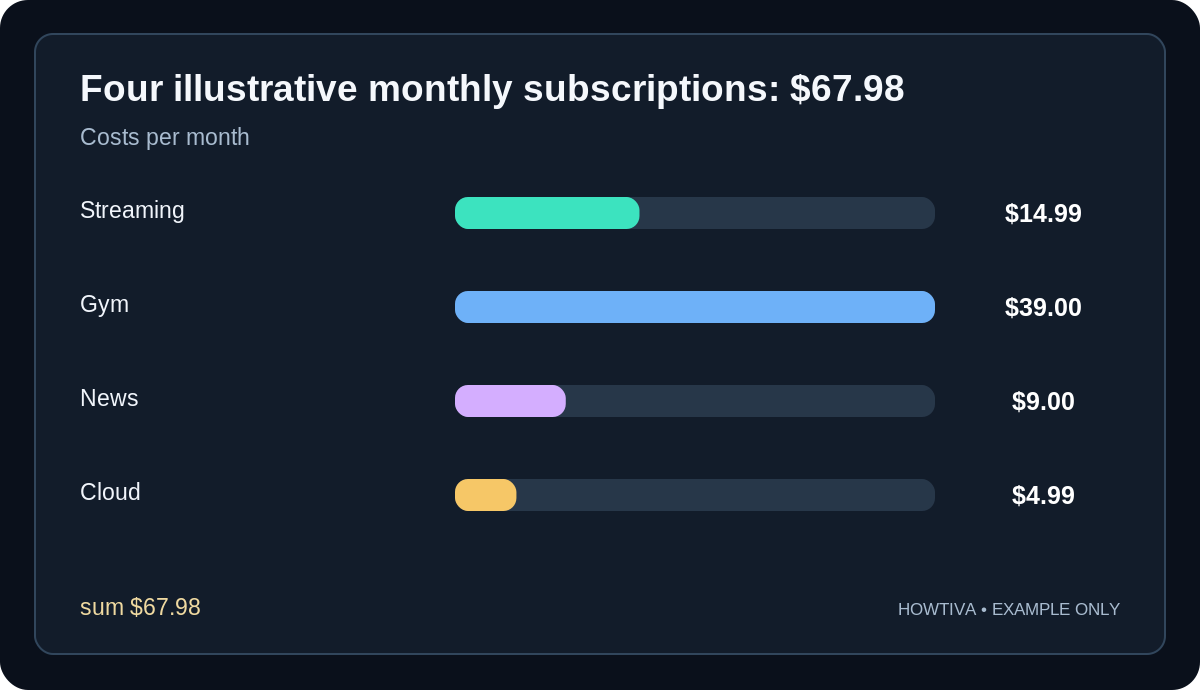
Assume four fictitious monthly subscriptions: streaming $14.99, gym $39.00, news $9.00 and cloud storage $4.99. Their combined monthly total is $67.98 and a twelve-month run rate, if unchanged, is $815.76. ‘Run rate’ is not a promise of future cost: tax, currency conversion, promotions and rate increases can change what is billed.
4. Rank by use, role and restrictions
Mark each item keep / downgrade / pause / cancel / investigate. Keep necessary accounts with good value; consolidate duplicate entertainment or cloud subscriptions only after verifying data retention and family access. An annual plan may appear cheaper per month but tie up cash and carry restrictions. Avoid canceling a security, backup or healthcare service before deciding what will replace it. Check if canceling early triggers an explicitly stated termination charge; never invent a provider’s current policy.
5. Cancel through the correct contracting party
Use the service’s actual cancellation path and terms. For a subscription bought through an app store, review the store’s subscription controls. For a direct contract, contact the merchant via its official site. If a trial is approaching renewal, act before the stated cutoff and account for notice requirements and time zones. Document the date, cancellation request, confirmation number, effective end date and any promised refund. Do not rely on deleting an app, closing an email address or changing a card as proof the contract ended.
Important distinction: You may be able to tell a bank to stop an automatic debit, but the merchant may still claim payment under a separate valid contract. A stop-payment request and contractual cancellation are different actions. For an unrecognized unauthorized charge, follow your payment provider’s dispute process promptly rather than labeling an authorized but unwanted service as fraud.
6. Compare before-and-after savings on the same basis
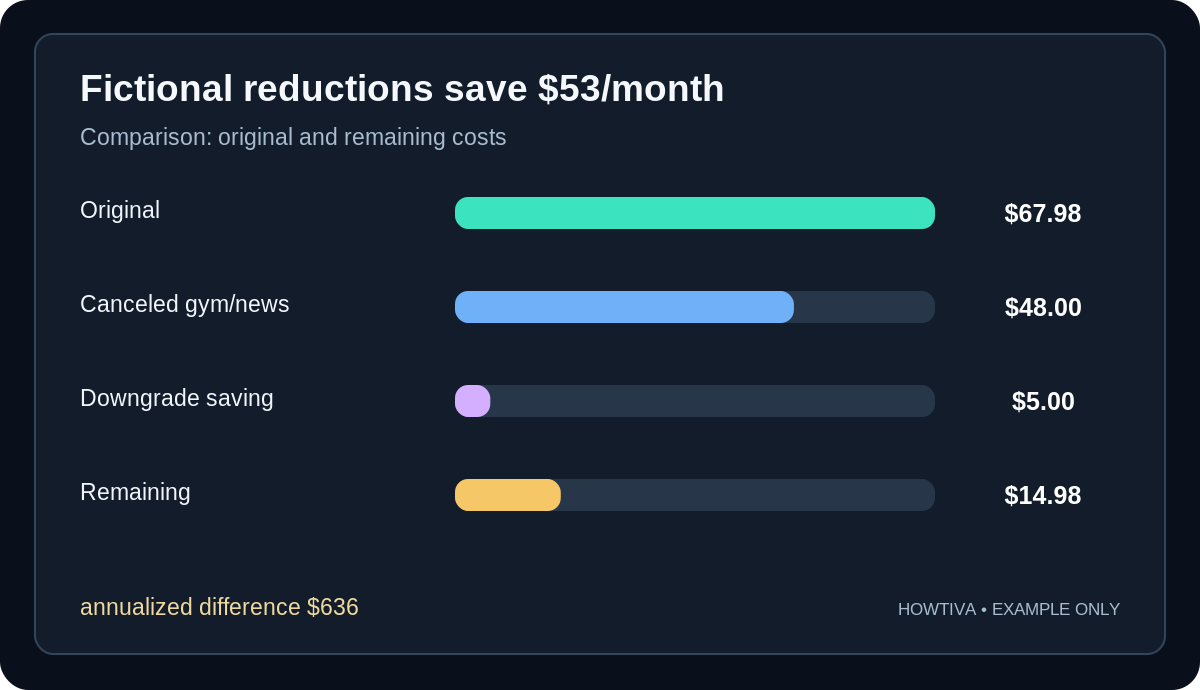
Suppose you cancel the hypothetical $39 gym and $9 news charges, and voluntarily switch streaming from $14.99 to a fictional $9.99 plan. The new total is $9.99 + $4.99 = $14.98 a month. The monthly reduction is $67.98 − $14.98 = $53.00. If those lower rates and your cancellation status remain unchanged for twelve months, the illustrative difference is $53 × 12 = $636. The actual amount depends on effective dates, refunds and provider terms.
7. Confirm the next billing cycle and revisit quarterly
Check confirmation messages immediately, then review the payment account after the next expected renewal. A final charge may reflect service already received, a lawful early-termination fee or a mistake; compare the merchant’s terms and the billing period before disputing. Keep records safely. Review subscriptions every quarter and again before annual renewals, insurance renewals or trials expire.
What to do when cancellation goes wrong
A merchant shows no cancel button: find the official help process or provider contact, not a search-ad imitation. Charged after a confirmation: identify the service period and effective date, contact the merchant, and dispute promptly if still wrong. A bank payment was blocked but invoices continue: check whether the agreement itself was terminated; arrange payment for amounts genuinely owed. Subscription bundled with another service: verify whether the bundle remains priced as expected. Shared-family plan lost access: check whose login owns it before trying changes. Unknown charge: contact the bank/card issuer through trusted official channels; do not email full card details.
Alternatives when you cannot cancel now
Change to an appropriately priced tier, pause a nonessential plan if the provider allows, use a family tier legitimately where terms permit, request a lower-cost plan, or set a calendar reminder for the next cancellation window. Compare prepaid and monthly options including tax, data limits and early termination; a cheaper displayed sticker price can conceal a bigger total. For essential ongoing services, consider reducing unused add-ons rather than terminating the core product.
Jurisdiction notes — reviewed 27 October 2026
US: FTC consumer guidance covers trial/auto-renewal concerns; consumer protection and card-debit dispute rules differ by transaction type and state. The 2024 federal ‘Click-to-Cancel’ rule was vacated by the Eighth Circuit on 8 July 2025, and the FTC began a new rulemaking process in 2026. Do not cite the vacated amendments as current rights; other federal and state protections may still apply. UK: MoneyHelper differentiates Direct Debits, standing orders and continuous-payment authorities; canceling the payment mechanism does not by itself remove a contract obligation. Canada and Australia: verify local consumer-law rights and bank/card dispute rules with official agencies and your provider; this guide does not claim a universal cancellation deadline or refund right. Check agreements and rules on the date of action.
Frequently asked questions
Does deleting an app cancel its subscription? Not reliably. Use the actual billing provider’s cancellation process and confirm the next invoice.
Should I cancel every unused service? Usually worth reviewing, but examine contracts, data backup, insurance, professional tools and shared use first.
Can I save money by switching to an annual plan? Possibly, if you will use it all year and can safely commit the upfront cash. Compare true twelve-month cost and refund conditions.
What if a free trial requires a payment card? Check when billing begins, amount after trial, time zone and how to cancel; save proof of terms and cancellation.
Can I dispute every charge after I cancel? No. First determine whether the charge was authorized and relates to a valid service period. Dispute genuinely incorrect charges using the applicable issuer process.
Final checklist
- Search financial and merchant records for monthly, quarterly and annual renewals.
- Convert to consistent monthly equivalents and calculate the total.
- Check user/benefit, cancellation cutoff, data access and contractual penalties.
- Cancel or downgrade only with the proper provider and preserve evidence.
- Stop payment authorizations where appropriate without assuming that cancels the contract.
- Verify the following billing period and log the realized, not hypothetical, savings.
- Repeat the audit periodically and protect financial account details.
Sources & Further Reading
- FTC — Getting In and Out of Free Trials, Auto-Renewals, and Negative Option Subscriptions.
- CFPB — How to stop automatic payments from a bank account.
- MoneyHelper — Direct Debits and standing orders.
- Moneysmart — Bank accounts.
- FTC — Negative Option Rule, current rulemaking status.
Financial education, not legal advice. Hypothetical prices do not represent live offers. Source review date: 27 October 2026.
Use the checklists as you go, and confirm the result before moving on to a more involved repair.