How to Budget with Irregular Income
Budget with freelance, shift-work or seasonal income using a conservative baseline, payment calendar and income-smoothing buffer.
Quick answer: Start from a conservative income level rather than your best month, fund essential bills first, keep a dated cash-flow calendar, and put extra money from strong months into a dedicated income-smoothing buffer. Review upcoming tax obligations separately if you earn self-employment income. Make a plan for a genuinely low-income month before it arrives.
What you will finish: A low-income baseline budget, a cash calendar, a buffer rule and a process for variable pay. Figures below are hypothetical and denominated in US dollars merely for illustration; they are not occupational averages, mandated tax reserves or a forecast.
Who this method is for, and what it cannot solve
Freelancers, contractors, shift workers, seasonal workers, commission earners, gig workers and people with variable benefits may receive different amounts at irregular dates. A typical fixed-income monthly budget can overstate the money available when a high month is followed by a low one. MoneyHelper recommends budgeting around a low-income month; ASIC Moneysmart describes smoothing bills and building savings for casual income. This method can reduce surprises, but it cannot replace an income source if reliable receipts are consistently below essential living costs.
Gather at least six recent months of after-tax, actually spendable receipts if possible (or as many as you have), confirmed upcoming invoices/pay dates, due dates, essential bills, annual costs and an account balance. For contractors, distinguish gross client invoices from money genuinely available after business expenses and estimated tax obligations. Do not assume a universal flat tax rate; estimate and verify relevant taxes in your jurisdiction separately. If you do not yet have an income history, use a conservative confirmed-income scenario and update often.
Step 1 — Build an evidence-based income range
Record the actual amount received in each of several months; issued but unpaid invoices are not cash. This hypothetical six-month series illustrates a realistic range:
| Month | Net, available income received |
|---|---|
| 1 | $3,600 |
| 2 | $4,200 |
| 3 | $2,800 |
| 4 | $4,500 |
| 5 | $3,300 |
| 6 | $3,900 |
| Six-month total | $22,300 |
The average is $22,300 ÷ 6 = $3,716.67 after rounding. The lowest observed is $2,800. An average helps long-run forecasting; $2,800 is a more conservative illustrative baseline. However, the next month could be below the historical minimum. Consider a stress test for even less income and avoid presenting past receipts as a guarantee.
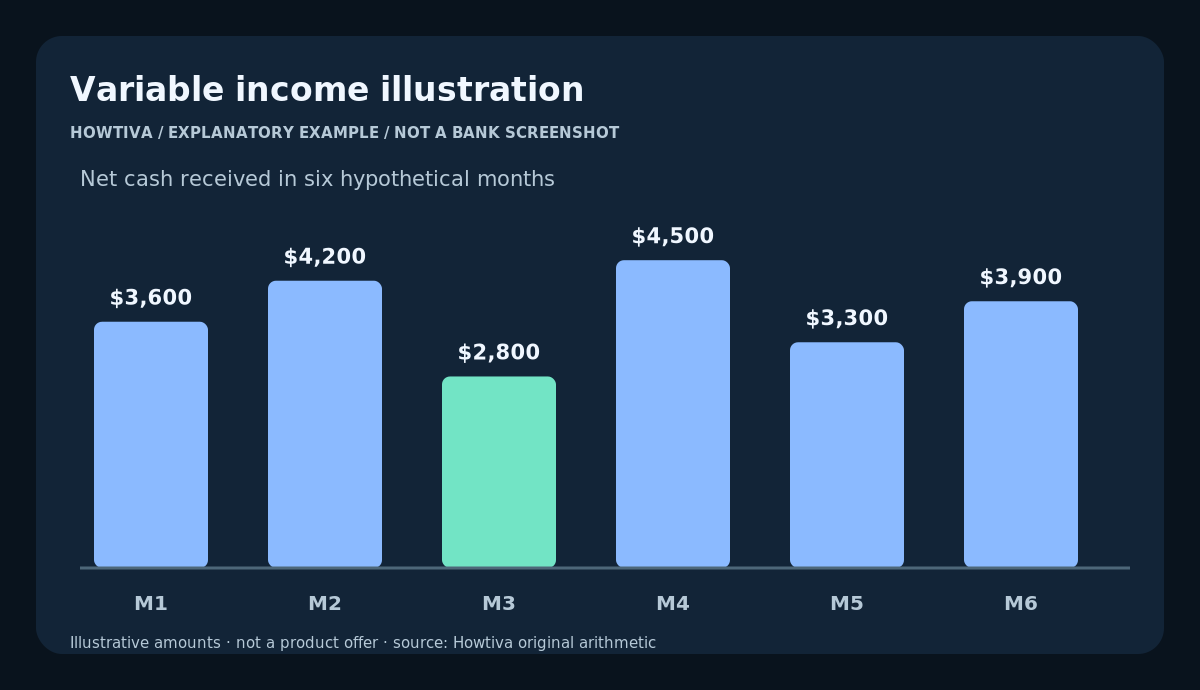
Figure: Six hypothetical monthly net receipts: $3,600, $4,200, $2,800, $4,500, $3,300 and $3,900, with $2,800 lowest.
Step 2 — Create a minimum viable monthly spending plan
List things you must pay even in a low month: housing, food, critical utilities, essential transport, insurance and required debts. The example below assumes net income already excludes any separately necessary tax reserve. If self-employed, complete the business/tax reserve calculation independently before calling any amount net and spendable.
| Monthly allocation | Hypothetical baseline |
|---|---|
| Housing | $1,200 |
| Utilities | $220 |
| Groceries | $380 |
| Essential transport | $180 |
| Essential insurance | $120 |
| Mandatory debt minimum | $200 |
| Phone and connectivity | $80 |
| Essential monthly subtotal | $2,380 |
| Basic flexible spending | $200 |
| Known future costs (sinking fund) | $100 |
| Total planned baseline | $2,680 |
| Remaining from $2,800 low-month income | $120 |
The flexible allowance is a ceiling that can be reduced in harder periods, not a guarantee of spending. If your own essential subtotal exceeds conservative confirmed income, do not invent a positive buffer; work on prioritizing bills, seeking support and handling debt or income gaps early.
Step 3 — Add the calendar: payment dates matter
Mark when deposits clear, not just when work is performed. Mark rent, card payments, utilities and insurance on their actual due dates. Compare the starting cleared balance plus confirmed inflows with bills through each week. The cash-flow identity is ending cash = starting cash + cash received − cash paid. Include planned buffer transfers only when money is available; a monthly surplus is not helpful if the first week goes negative.
When payment dates are mismatched, ask the biller whether an alternative due date or an installment arrangement exists. In Australia, Moneysmart notes that some utilities offer smaller periodic “bill smoothing” payments. Your provider may not offer that feature, and changing a direct debit can have rules or consequences; confirm before modifying anything.
Step 4 — Build an income-smoothing buffer in strong months
Choose a separate pot for predictable income variation. The emergency fund is for unexpected shocks; an income-smoothing buffer handles expected slow seasons or weeks between contracts. Define a target in terms of your own baseline costs—for example, one baseline month as a first working goal—then expand if work patterns justify it. This is a planning choice, not an official required amount.
A three-month cash illustration assumes the $2,680 baseline cost each month, zero opening income buffer, no interest, no taxes outstanding and all income already net/spendable:
| Period | Cash received | Baseline paid | Net change in buffer | Buffer after period |
|---|---|---|---|---|
| A | $2,800 | $2,680 | +$120 | $120 |
| B | $4,200 | $2,680 | +$1,520 | $1,640 |
| C | $2,400 | $2,680 | −$280 | $1,360 |
The period C shortfall ($280) is paid from the prior buffer, leaving $1,360. This example assumes you save all surplus in periods A and B; if you allocate some to other goals, recompute the balance. It is not a forecast that future strong months will compensate for low months.
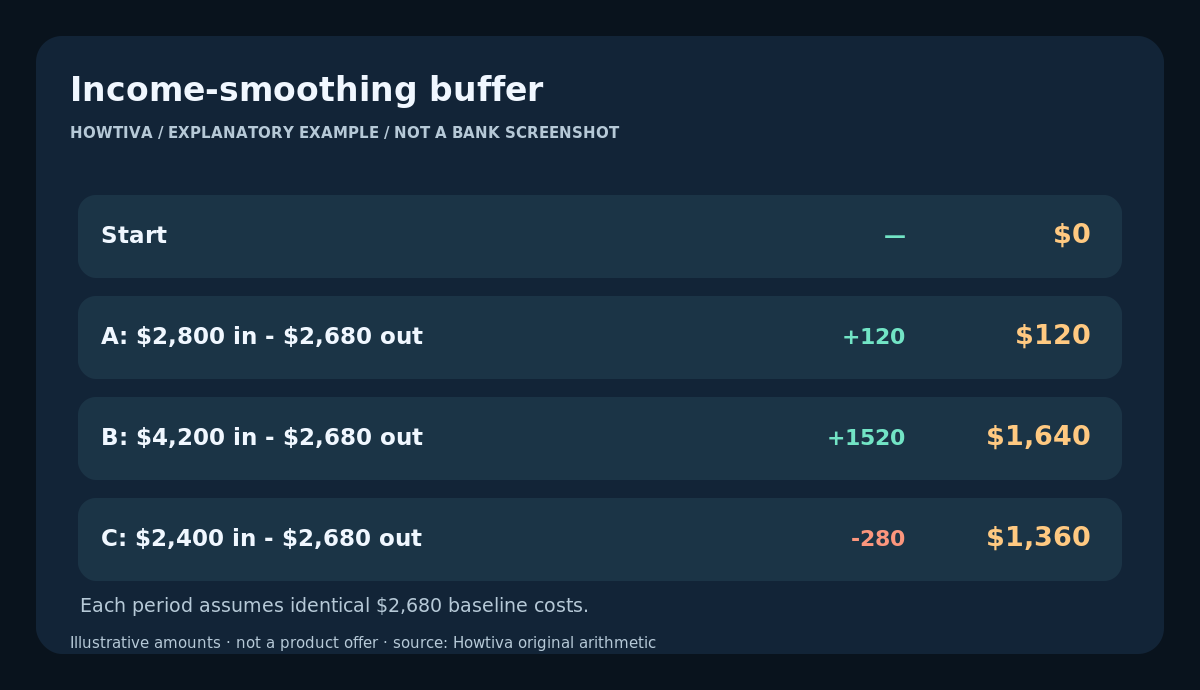
Figure: Hypothetical buffer: $0 start, plus $120 in period A, plus $1,520 in B, minus $280 in C, equals $1,360.
Step 5 — Create rules for unusually good and bad periods
Write a simple sequence for high-income months: first replenish unpaid essentials and any legitimate tax/business reserves; second refill a used income buffer; third contribute to true emergency savings and sinking funds; only then increase discretionary spending if affordable. In low periods, pay critical essentials from income and the buffer, pause optional transfers early and adjust flexible costs. Avoid taking expensive short-term debt to preserve an arbitrary savings target without first checking hardship options and consequences.
For contractors, gross receipts are not personal pay. Track invoice status, business costs and applicable tax payments in a separate business ledger. UK self-employed tax and National Insurance, US estimated tax, Canadian self-employment requirements and Australian tax/pay rules differ; check each local authority directly, not a single imported percentage. Benefits and income-assistance programs can also use different assessment periods, including the UK’s Universal Credit rules; a budgeting spreadsheet alone cannot determine eligibility.
Step 6 — Close the month and reforecast
At month end, compare confirmed receipts against conservative assumptions, classify actual necessary and discretionary expenses, reconcile the buffer and shift the next three months’ forecast. Flag large expected costs early: annual insurance, travel required for work, equipment replacement or childcare schedules. If you have exhausted the buffer for several months, treat that as an evidence-based warning to rethink baseline costs and income, not a motivation issue.
Troubleshooting and common mistakes
- A big client invoice makes the month look rich. Use cash received, not the date you issued an invoice. Unpaid invoices should be listed separately.
- I calculate net income from gross invoices without tax. Set aside a jurisdiction-specific, verified tax and business-expense reserve before estimating personal spendable cash.
- My average exceeds my minimum, so I budget to the average. An average can hide a cash shortage. Start from a conservative level and show surplus only after it arrives.
- I use my emergency fund every slow season. Create a dedicated income buffer for predictable variability; preserve emergency savings for shocks where feasible.
- A calendar month has three paydays instead of two. Frequency and dates matter; budget by cleared pay dates, not just annualized averages.
- The baseline won’t cover essentials. Prioritize housing, food, utilities and legally required payments as applicable, explore official hardship or benefits guidance and seek qualified help when necessary.
- A benefits payment changes suddenly. Verify assessment periods, reporting and eligibility with the relevant authority rather than extrapolating from prior deposits.
Alternatives and exceptions
Use a weekly cash-flow budget when payments arrive frequently or irregularly; a percentage-of-receipts approach may help route each deposit to tax, essentials and buffers once your real obligations are known, but no universal percentages apply. A two-account method (bills account plus discretionary account) may clarify what is safe to spend; check provider fees and transfer timing. For people with little historical data, prepare a “confirmed income only” version and a stress scenario at 20% less cash as a hypothetical exercise, not a prediction.
Country notes
US: CFPB’s cash-flow worksheets focus on the timing of weekly income and outgoings, useful for freelancers and variable hours. UK: MoneyHelper advises planning around lower-income months and separately discusses tax and Universal Credit assessment timing. Canada: FCAC’s budget planner can help identify the gap between income and living costs. Australia: Moneysmart explains casual-income budgeting and bill-smoothing options. Any tax or benefits rule is location-, date- and situation-dependent; the jurisdictional guidance here was reviewed 27 October 2026 and includes no tax-rate or eligibility claim.
Frequently asked questions
Should I use my lowest or average monthly income?
Use the average as background information; a lower conservative level is often safer for essential commitments. Stress-test a month below the historical minimum as well.
How much income buffer is enough?
There is no universal figure. Start with what you can afford, then relate the target to baseline costs and the size/duration of typical low periods.
Is the income buffer the same as an emergency fund?
No. One addresses predictable variation; the other is meant for unexpected financial shocks. You can keep both in one account with separate ledger balances if your provider lacks sub-pots.
Can I spend a commission before it clears?
Treat it as uncertain until it is paid and accessible. Plan only against confirmed cash plus buffer actually held.
What if I am self-employed?
Track business cash, expenses and applicable taxes separately first. Personal net/spendable receipts should not include money you owe for tax or essential business operations.
Final checklist
- Record actual received, spendable income over several months.
- Compute an average, a conservative baseline and a lower-income stress case.
- List essentials and mark exact bill and deposit dates.
- Distinguish tax/business reserves, planned future bills and emergency funds.
- Build a separate buffer for predictable gaps where feasible.
- Allocate strong-month surplus only after it is received.
- Reconcile and reforecast monthly; seek help if essentials remain underfunded.
Sources & Further Reading
- MoneyHelper — How to budget for an irregular income
- ASIC Moneysmart — Managing on a casual income
- CFPB — Your Money, Your Goals companion tools
- FCAC — Making a budget
- MoneyHelper — Budget planner
Editorial note: Reviewed against official budgeting guidance 27 October 2026. All figures are fictional after-tax illustrative receipts; actual tax, benefits, fee and transfer rules require personal verification. No bank or tax workflow was tested.
Use the checklists as you go, and confirm the result before moving on to a more involved repair.