How to Read Clothing Care Symbols
Read the symbols from left to right: washing, bleaching, drying, ironing and professional textile care. A crossed symbol means that treatment is not allowed; numbers in a wash tub give the maximum wash temperature in °C, and bars below a symbol signal gentler handling.
Quick answer: Read the symbols from left to right: washing, bleaching, drying, ironing and professional textile care. A crossed symbol means that treatment is not allowed; numbers in a wash tub give the maximum wash temperature in °C, and bars below a symbol signal gentler handling.
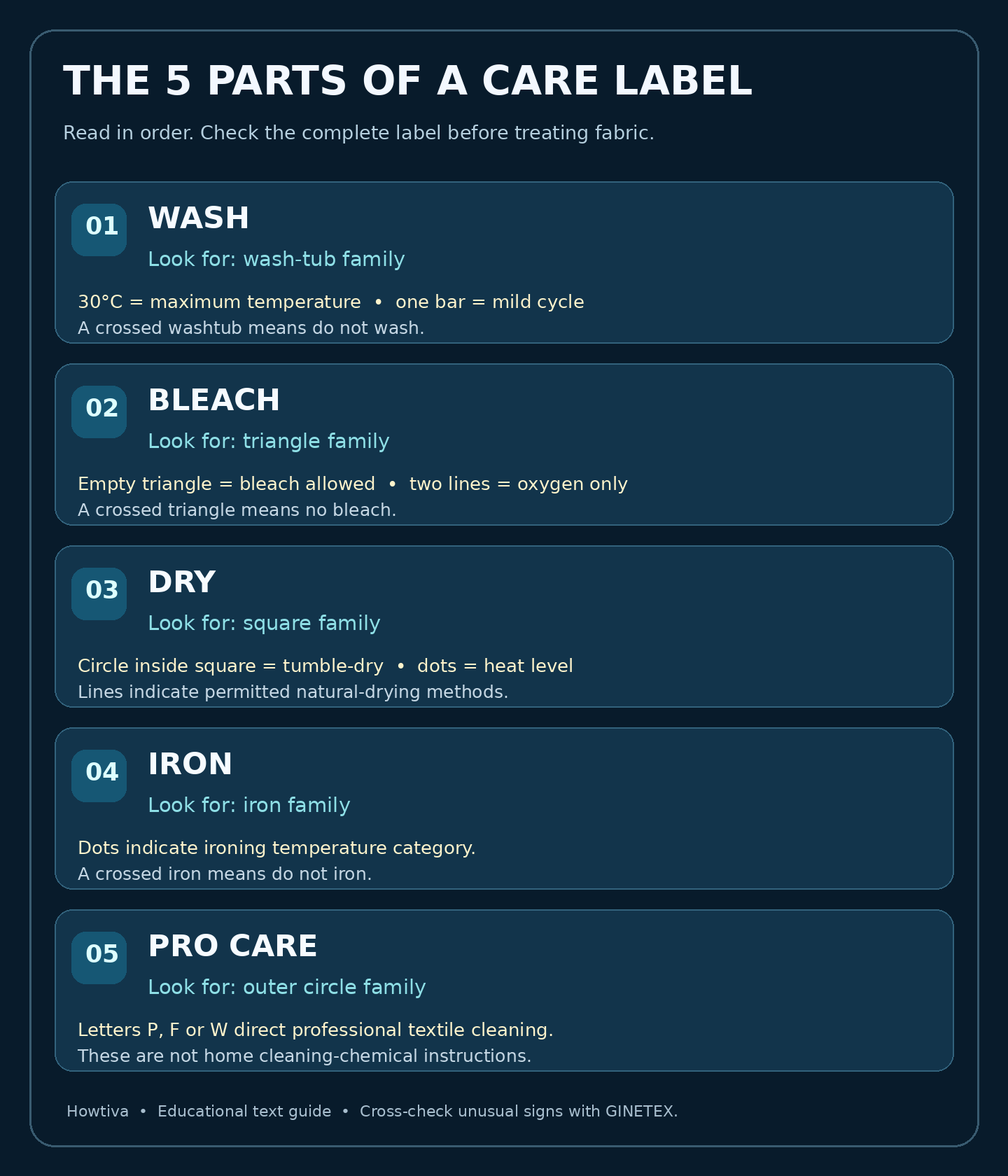
Explains the ISO 3758 / GINETEX-based international pictogram families and common meanings. Actual tags may use national systems, written instructions and symbols beyond the examples. The protected official symbol artwork is not reproduced here: the original chart is a text-based decision diagram.
Before you begin: safety and materials
Find the garment’s sewn-in care label and read all printed instructions before washing or treating it. The care symbols describe the maximum permitted treatments, not a requirement to use the hottest or strongest setting. For mixed-material garments or missing labels, follow the manufacturer’s guidance rather than guessing.
What you need:
- The actual garment care label and fiber-content details
- Bright light or a magnifier for small printed labels
- Washer program manual for matching temperatures and gentle cycles
- Official GINETEX symbol reference for less common variants
- Space to sort items needing professional care
Step-by-step instructions
Step 1: Find every part of the sewn-in label
Check a side seam, neck, waistband or interior pocket; multi-piece outfits may contain different care tags. Read written warnings and brand instructions as well as icons. A label may describe both the garment shell and a removable lining, so do not apply a single setting blindly.
Step 2: Decode washing first: tub, temperature and bars
The washtub family indicates whether domestic washing is permitted. A number such as 30 or 40 is the maximum temperature in °C, not a target to reach. One bar below the tub indicates a mild cycle, while two indicate a very mild cycle. A crossed washtub means do not wash; use the other label instructions or contact a textile-care professional.
Step 3: Check the triangle before adding any bleach
An empty triangle indicates any bleach type may be used; two diagonal strokes permit only oxygen/non-chlorine bleach. A crossed triangle forbids bleaching, including non-chlorine bleaching. Plain detergent can still be suitable for many washable garments when bleaching is not allowed.
Step 4: Read the square for tumble or natural drying
A circle in a square signifies tumble drying; dots communicate gentler versus normal drying heat. Lines in a square refer to natural drying choices such as flat or line drying. If the tumble-dry symbol is crossed out, use the allowed alternative rather than guessing from fiber content.
Step 5: Check the iron and professional-care circle
Iron dots specify temperature categories and a crossed iron forbids ironing. A plain outer circle with letters such as P, F or W gives professional cleaner directions; these are not instructions to pour solvents into a home appliance. Bars further restrict professional processes.
Step 6: Translate the complete tag into one compatible routine
Consider the full sequence before setting the washer: choose the lowest temperature and gentlest action required in a shared load; omit forbidden products; and plan the allowed drying method. If the tag is unreadable or two panels have incompatible rules, contact the clothing maker or professional cleaner.
Practical examples: when the procedure changes
A tag says 30°C with a bar below the wash icon
30°C is the maximum recommended wash temperature and the bar means reduced mechanical action. Match a gentle washer program that observes both requirements; “30” alone is not permission for normal agitation.
A printed white blouse says “do not bleach”
White does not override a crossed bleach mark. Use a compatible non-bleaching detergent and follow the rest of the label, including low-temperature and drying restrictions.
Troubleshooting: what can go wrong
The symbols differ from pictures online: There are international and regional variants. Use the maker’s written text and an official reference for that jurisdiction; avoid inferring from a decorative-looking icon.
Label ink has worn off: Contact the brand for model-specific textile instructions instead of guessing at temperature or chemical compatibility.
Care instruction conflicts with a generic stain trick: The garment care label and safe product label take precedence.
A crossed drying symbol is confusing: Check whether it crosses the whole tumble-dry square/circle or refers to another natural-drying method; compare with official GINETEX reference.
Alternatives, materials and model differences
Consult the care reference for uncommon wet-cleaning and dry-cleaning symbols. Some labels are standardized in an ASTM system with different temperature markings; use the specific regional guide rather than forcibly converting every mark. This article intentionally uses generic original text boxes, not the trademarked official icon artwork.
When a label uses uncommon natural-drying or professional-care markings, compare the entire marking with the official GINETEX reference. A care symbol is not a guarantee that every stain can be removed. If two garment components have different care limits, follow the more restrictive requirements or ask a qualified textile cleaner.
Stop conditions and when to request qualified help
Do not wash, bleach, iron, tumble-dry or dry-clean a garment where that activity is expressly prohibited by its label. For missing, conflicting or unusually technical labels, stop and ask the garment maker or a qualified textile professional.
Final verification and prevention
Before starting laundry, confirm the full sequence: allowable wash temperature and agitation, bleach permission, drying method, ironing limit and any professional-care restriction. Keep items with incompatible care limits in separate loads. If the garment or label is damaged or the instructions conflict, contact the manufacturer. This is an editorial guide to reading labels; no garment was physically tested.
Frequently asked questions
Does a 40°C number mean I must wash at 40°C?
No. It indicates a maximum; lower temperatures may be used if the garment and detergent allow.
Can I use oxygen bleach if a triangle is crossed out?
No. A crossed triangle forbids bleach, including oxygen-based bleach.
What do letters inside a circle mean?
They guide professional textile cleaning methods and solvents, not home machine settings.
Sources & further reading
-
GINETEX: Care Symbols (ISO 3758:2023)
-
Whirlpool: Laundry Sorting Guide
Use the checklists as you go, and confirm the result before moving on to a more involved repair.