How to Remove Candle Wax from Fabric
Let spilled wax harden, gently lift the thick pieces with a blunt edge, and assess the fabric care label. On washable, heat-tolerant fabric only, use clean white absorbent layers and a warm—not hot—iron to lift remaining wax; then pretreat any oily or colored mark and launder according to the label.
Quick answer: Let spilled wax harden, gently lift the thick pieces with a blunt edge, and assess the fabric care label. On washable, heat-tolerant fabric only, use clean white absorbent layers and a warm—not hot—iron to lift remaining wax; then pretreat any oily or colored mark and launder according to the label.
Who this is for: This method is intended for ordinary washable garments such as care-label-approved cotton or sturdy blends. Delicate silk, wool, velvet, coated/printed pieces, upholstery, flame-retardant fabric, and dry-clean-only materials need tailored instructions or professional care.
Before you begin: materials and safety
Keep all wax-handling away from open flames. Never iron over a fresh liquid-wax spill, synthetic fabric that forbids ironing, adhesive decorations, or unknown coatings. A warm iron can still melt or scorch some textiles. Do not substitute a hair dryer, solvent, or very hot iron as a universal solution.
What to gather:
- Blunt plastic card or dull table knife; clean white paper towels or plain unprinted absorbent cloth
- A sealable bag of ice if the wax remains soft; never soak delicate fibers unnecessarily
- Warm iron only when the garment label permits ironing; protective press cloth if needed
- Suitable laundry pretreatment and detergent matched to the care label
Step-by-step instructions
Step 1: Check the care label, dye, and extent of the spill
Read washing and ironing symbols before you move the fabric. Inspect a hidden area for loose dye, surface coatings, sequins, glued trims, or a delicate nap. For dry-clean-only, unknown, antique, or heat-sensitive textiles, stop after safe removal of any loose surface wax and consult a cleaner. Dark or intensely dyed candle wax can leave a separate color stain that needs additional care.
Step 2: Allow the wax to solidify
Let the material cool at room temperature. If still tacky, hold a sealed bag of ice against the wax briefly without soaking the textile; remove it once the deposit firms. Do not pull a flexible wax sheet off with force, because it can lift or distort threads. Spread the garment flat over a clean towel before proceeding.
Step 3: Lift only the hardened surface wax
Keep the fabric taut with one hand and slide the flat edge of a plastic card under the raised wax. Move away from the fabric rather than gouging downward. Work from the outer edge inward; collect broken flakes so they do not stick elsewhere. Stop scraping when only the embedded film remains. A blade or aggressive abrasion can cut fibers even if the wax seems stubborn.
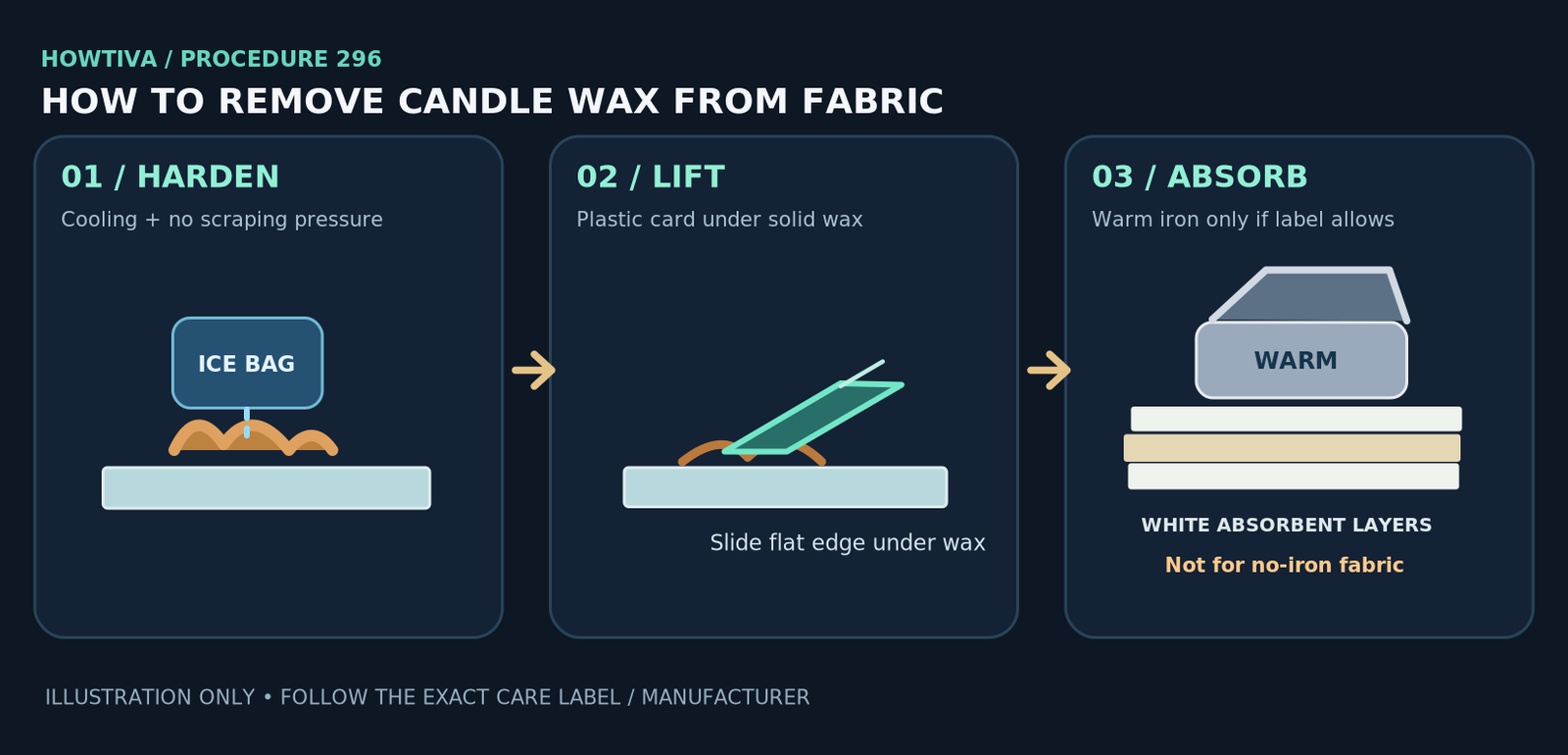
Procedure illustration: original step sequence showing how to remove candle wax from fabric; follow material and manufacturer limitations, not a simulated hands-on test.
Step 4: Transfer embedded wax only if ironing is permitted
Put clean, white absorbent paper or plain unprinted cloth above and below the stained section so the stain is sandwiched. On a low/warm setting approved by the care label, press the iron briefly without dragging it, then lift and inspect the paper. Shift to fresh areas as residue transfers. Never let paper overheat or leave the iron unattended; stop if it smokes, discolors, or the fabric changes texture.
Step 5: Treat the remaining oil or dye mark separately
Once bulk wax has transferred, check the mark under good light. Test a fabric-appropriate prewash treatment on a hidden area, then apply only as the product label directs. Do not saturate trims or combine different spot-removal chemicals. Candle pigments can remain even when the wax has gone; do not promise full color removal, particularly on white fibers with bright candle dye.
Step 6: Wash, air-dry, and inspect before tumble drying
Launder at the highest temperature allowed by the clothing label—not an arbitrary hot setting. Before applying dryer heat, inspect both sides under daylight. If the residue remains, repeat a compatible pretreatment or seek professional help. Air-dry until satisfied, because machine drying can make remaining oily or colored marks more difficult to remove.
Real-world cases that change the plan
Wax on polyester or stretchy activewear
Many synthetic garments restrict ironing. Do not run a heat-transfer experiment; carefully remove only hardened surface wax and ask the maker or professional cleaner about any remaining film.
Wax on a tablecloth with a printed design
Check both print and base textile: even if the base is cotton, an applied design may melt or transfer. Work around the print; do not assume a warm iron is safe.
Troubleshooting: when the first attempt does not work
- Wax smears instead of lifting: Let it cool and firm again. Return to gentle edge lifting; do not spread it with your fingers.
- A shiny patch appears after ironing: Stop heating immediately. The finish or fibers may be altered; extra scrubbing will not necessarily restore the original surface.
- Color remains after wax removal: Treat it as a dye stain only if the fabric and product label allow; otherwise ask a professional cleaner.
- The fabric pulls or frays: Stop scraping. A woven or delicate fiber may be damaged by further mechanical removal.
Alternatives and important model differences
- For upholstery, identify its cleaning code before any moisture or heat; do not transfer the garment procedure unchanged.
- For delicate or dry-clean-only fabric, a qualified textile cleaner is usually safer than household heat or stain-removal solvents.
- For a removable table runner, lay it flat rather than working while it is on painted furniture; protect any underlying surface from heat and color transfer.
Common mistakes to avoid
Do not set an iron to high heat just to speed up wax removal. Never place hot paper on flammable clutter, treat a mystery fabric as cotton, or machine-dry an item with obvious residue.
If only brittle surface wax comes off and a colored mark remains, that does not mean the technique failed: dyes and wax bind differently. Protect the garment and choose a separate care-label-safe treatment.
Frequently asked questions
Can I use parchment paper instead of paper towels?
No universal substitution: nonabsorbent baking paper does not lift wax the same way absorbent white material does. Follow textile and iron-care guidance.
Does freezing the entire garment always work?
It can make wax brittle but may not remove wax embedded in fibers or dyed residue. Localized, gentle cooling is often easier to control.
Should I use bleach afterward?
Only if the fabric care label and specific laundry product explicitly permit it. Never mix cleaners, and do not assume candle dyes will disappear.
Sources & Further Reading
- American Cleaning Institute — Stain Removal Guide (checked 2026-10-27)
- University of Georgia Extension — Remove Stains from Candle Wax, Paraffin (checked 2026-10-27)
Use the checklists as you go, and confirm the result before moving on to a more involved repair.