How to Compare Loan APRs and Total Borrowing Costs
Compare loan APRs, nominal rates, lender fees, monthly payments and total borrowing cost using step-by-step calculations.
Quick answer: Compare loans using the disclosed APR, payment schedule, all lender charges, total interest and total amount repaid. Compare equivalent loan amount, term, fees and repayment timing. APR generally reflects more than the nominal interest rate, but does not replace a careful comparison of cash received and total dollars paid. See the worked $12,000 loan comparison below to understand why a nominal rate alone cannot tell you the full cost.
What you will achieve: This procedure explains why the “lowest monthly payment” can still be a costly loan and why APR should be compared to APR, not to a nominal interest rate. It also separates a simplified amortization exercise from an official lender APR calculation.
Before you begin
Collect two written offers including loan proceeds, nominal annual rate, disclosed APR, repayment frequency, length of term, origination fee, other required charges, prepayment conditions and late-fee policy. Identify whether the upfront fee is withheld from funds advanced or paid separately, because this affects usable proceeds.
Two loans with similar APRs can have different monthly payment amounts and total dollar costs when terms differ. Compare the same borrowed amount, disbursement timing and fees before drawing conclusions.
Step-by-step instructions
-
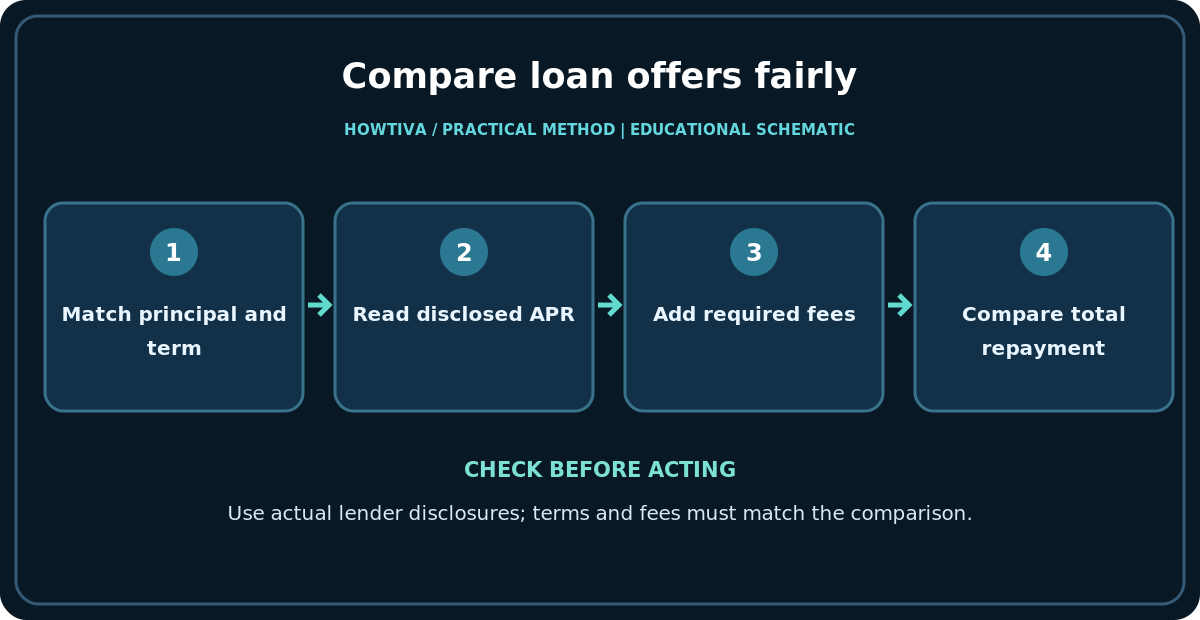
Match the borrowing need: If you require $12,000 in hand, a loan that deducts $300 from the advance may not meet your need even if its contract principal is $12,000. Ask both lenders for the actual amount available.
-
Compare like disclosure fields: The same word “rate” can refer to nominal interest, APR, effective annual cost or promotional pricing. Do not compare one lender’s APR with another lender’s nominal rate.
-
Calculate a standard installment payment: For a fixed-rate amortizing loan with principal P, monthly rate r = nominal annual rate/12, and n months, payment = P × r / [1 − (1 + r)^(-n)]. Use the interest rate for payment mathematics, not the disclosed APR when fees are already handled separately.
-
Add scheduled cash payments: For an evenly paid loan, scheduled total = monthly payment × number of months, with final-payment rounding adjustments. Interest paid = sum of monthly installments − principal advanced, before separately paid fees.
-
Account for financed and deducted fees: If origination fee is financed, payments may accrue on a larger principal; if deducted, the net amount delivered falls; if paid separately, add that outlay to total financing cost. Avoid adding the same fee twice.
-
Compare the repayment horizon: A longer term can make a payment affordable but increase lifetime interest. Different loan terms need both affordability and total-cost columns, not APR alone.
-
Examine risk clauses: Read whether the rate is variable, whether a deferred-interest provision applies, what happens after an introductory period, and whether early repayment triggers a fee.
-
Choose based on your actual constraints: Use an official loan disclosure where available; calculate total dollars and cash flow separately. For mortgages, use comparable Loan Estimates and their five-year cost line where appropriate.
Worked financial example
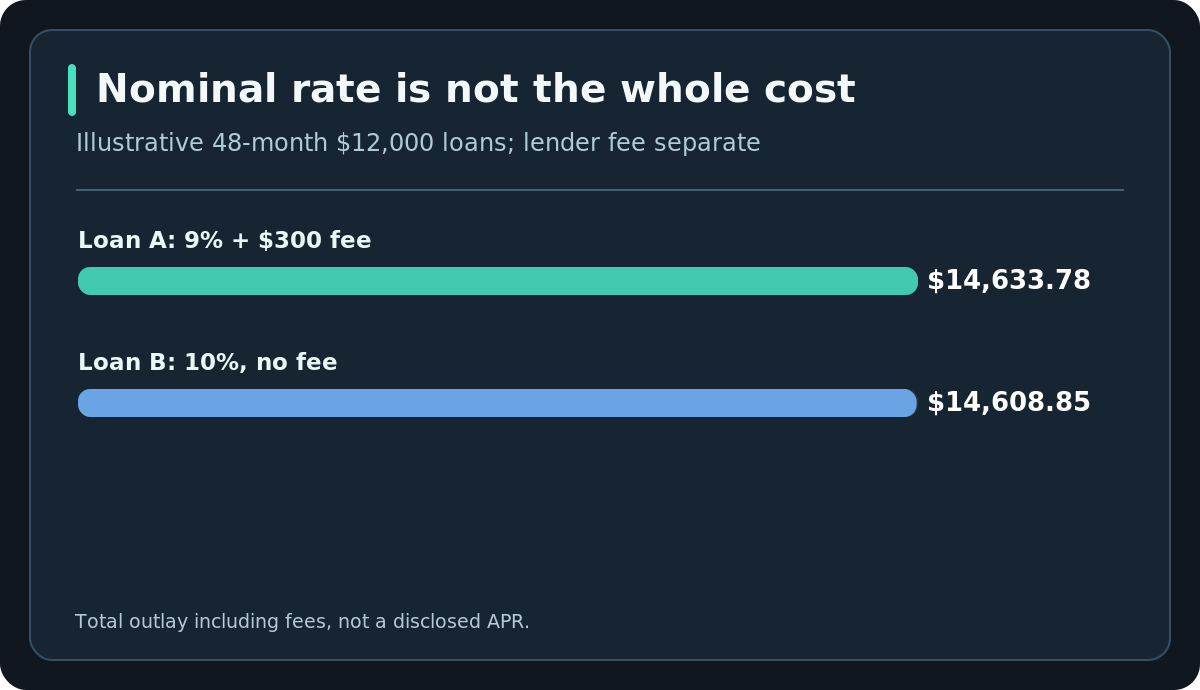
Fictional same-principal 48-month installment offers: Loan A nominal 9.0% a year with $300 paid separately; Loan B nominal 10.0% with no separate origination fee. Both advance $12,000 in full. Loan A’s amortized monthly installment is approximately $298.62; B is approximately $304.35. Compare the total rounded payment stream plus A’s fee, not a guessed APR.
Second worked scenario and interpretation
For a $12,000 loan at 9.0% and 48 months, total scheduled installments using unrounded arithmetic are about $14,333.78, plus the separately paid $300 fee is about $14,633.78. At 10.0% and 48 months, about $14,608.85. Under those fictional terms B has a slightly lower total outlay despite its higher nominal rate. The official disclosed APR for each would require the lender’s proper finance-charge and timing computation; do not treat 9% + ($300/$12,000) as the APR.
Common mistakes and troubleshooting
- Picking the smallest payment: A longer term can produce more interest even at a lower payment.
- Adding an APR surcharge manually: APR calculation follows disclosure rules; it is not the sum of nominal rate and an upfront-fee percentage.
- Counting fees twice: Track whether the fee was paid out-of-pocket, deducted from proceeds or financed.
- Comparing different usable amounts: A loan with less net cash is not equivalent to one that actually delivers your requested funds.
Use lender disclosures for origination fees, prepayment rules, optional products and other charges. A simple interest-rate calculation cannot substitute for a legally required APR disclosure.
Alternative methods and exceptions
- Mortgage Loan Estimate comparison: For eligible US home loans compare lender charges, cash to close, monthly costs and five-year interest-and-fee comparison.
- Variable-rate loan: Make an explicit rising-rate stress scenario; a single fixed-rate formula is insufficient.
- Early repayment: Ask for an illustrative settlement quote and verify prepayment rules before assuming interest savings.
Country-specific considerations (checked 2026-10-27)
- US: Truth-in-Lending APR disclosures help compare credit products. Mortgage Loan Estimates have specific sections; personal-loan disclosures may differ.
- UK: Compare the representative APR alongside total amount payable, eligibility and any arrangement fees; lender’s actual offer can differ.
- Canada: Annual cost-of-borrowing disclosures and provincial rules can differ by loan type; read the lender’s contract.
- Australia: Consider the comparison rate and the actual fee schedule when applicable; a comparison rate alone does not include every possible incidental charge.
Frequently asked questions
Is APR the same as the interest rate?
Usually not when included fees affect the cost calculation.
Can higher nominal interest have lower total cost?
Yes, when fees, terms and net loan proceeds differ.
Can I compare loans of different terms by APR alone?
No. Add repayment totals and the payment burden over each offered term.
Should I calculate the APR myself?
Use the lender’s legally required disclosed APR for legal comparisons, and reproduce cash flows as an independent affordability check.
Final checklist
- [ ] Same usable loan proceeds
- [ ] Compare APR to APR
- [ ] Verify fee treatment
- [ ] Calculate monthly installment from nominal rate
- [ ] Estimate total payments and fees
- [ ] Check early repayment and variable-rate risks
Sources & Further Reading
- Consumer Financial Protection Bureau — Difference between loan interest rate and APR — APR compared with simple nominal rate and costs.
- Consumer Financial Protection Bureau — Compare and negotiate your loan offers — Loan Estimate fees, multi-year cost, loan comparison.
Use the checklists as you go, and confirm the result before moving on to a more involved repair.