How to Calculate Your Debt-to-Income Ratio
Calculate your debt-to-income ratio with gross monthly income and required debt payments, including a worked example.
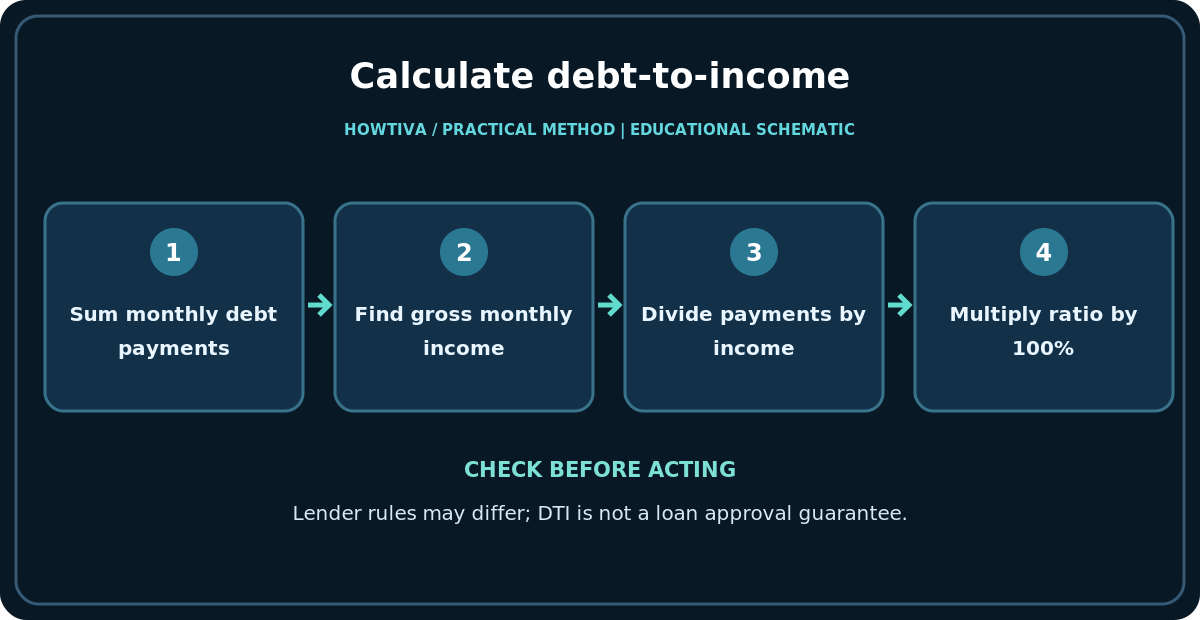
Quick answer: Calculate debt-to-income ratio (DTI) by dividing your total required monthly debt payments by gross monthly income and multiplying by 100. For example, $1,450 monthly debt obligations ÷ $5,200 gross monthly income × 100 = 27.9% when rounded to one decimal place.
What you will achieve: DTI is a cash-flow comparison often used in lending reviews, but a lender can define included debts and qualifying income differently. The result is not your spending rate, savings rate or the percentage of after-tax earnings left at the end of a month.
Before you begin
Collect recent gross pay documentation, other documented income, mortgage or rent obligations as applicable to the lender’s specific method, minimum card payments, student/auto/personal loan installments, child support or alimony where counted, and proposed new debt payments when relevant. Never treat groceries and utilities as debt payments under the ordinary CFPB explanation.
Debt-to-income ratio divides required monthly debt payments by gross monthly income under the defined lender method; groceries and utilities are normally outside that narrow formula.
Step-by-step instructions
-
Choose the time basis: Convert all entries to monthly equivalents. If paid every two weeks, there are generally 26 pay periods a year, so multiply gross biweekly pay by 26/12 to obtain an average gross monthly amount.
-
Use gross—not take-home—income: The denominator normally reflects income before taxes and payroll deductions. When earnings are variable or not qualifying, lenders may average or document them differently; do not automatically count every hoped-for earning.
-
Identify monthly debt obligations: List required repayments for credit cards, loans and other contractual obligations included under the relevant lender definition. Mortgage-related costs and rent treatment can differ by product; ask for the lender’s worksheet.
-
Normalize periodic bills: Convert quarterly loan payments divided by 3 or annual obligations divided by 12 where the lender wants monthly equivalents. Keep non-debt essential spending in a separate affordability budget.
-
Add the debt payments: Use required minimum installments rather than total outstanding balances or voluntary extra repayments, unless the lender specifically requests something else.
-
Divide then multiply by 100: DTI percent = (monthly debt obligations ÷ gross monthly qualifying income) × 100. Retain enough precision to round only at the end; never divide by zero.
-
Stress-test a new payment: Add a proposed installment to debt payments, then recompute; the new obligation can increase your ratio. This is a calculation, not an approval decision.
-
Check interpretation with the lender: There is no universal pass/fail percentage. Product type, housing costs, credit history, verified earnings and lender policy can affect the result.
Worked financial example
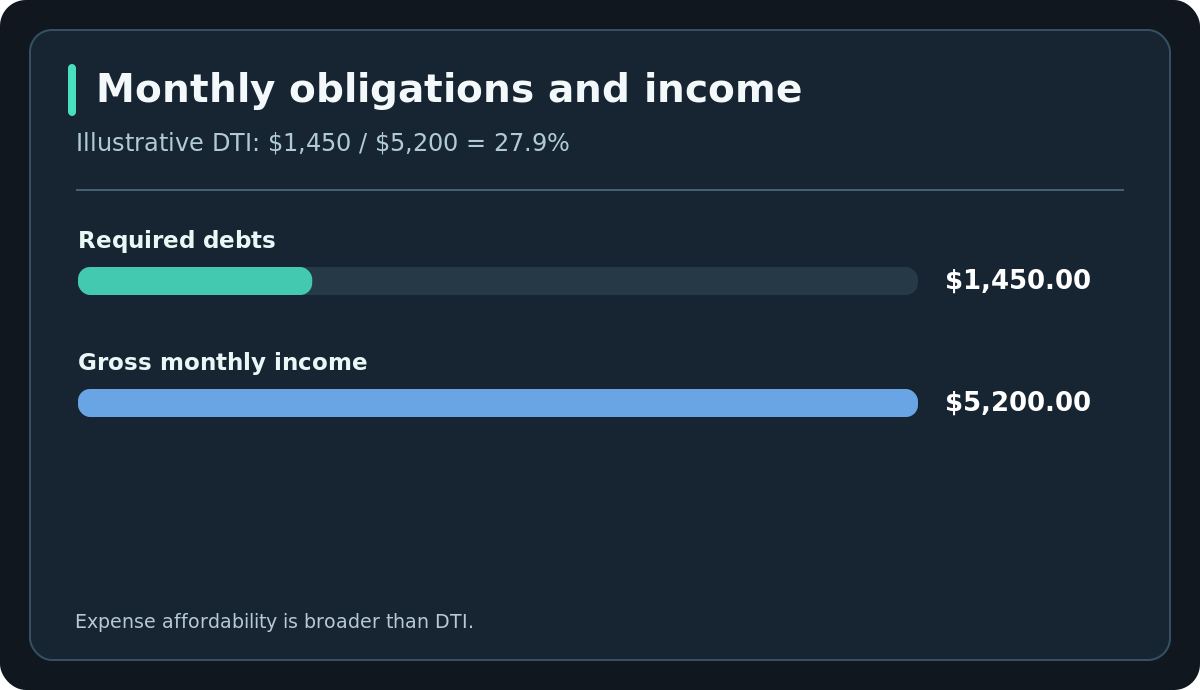
Illustrative monthly debts: housing obligation $1,000, car $300, required card payment $150; total $1,450. Gross income is $5,200. DTI = ($1,450/$5,200) × 100 = 27.8846…%, or 27.9%. That is a ratio, not a judgement of creditworthiness.
Second worked scenario and interpretation
If an additional hypothetical required payment of $150 is included, obligations rise to $1,600. With the same income, DTI = ($1,600/$5,200) × 100 = 30.8% to one decimal. A consumer whose biweekly gross pay is $2,400 would have illustrative average monthly gross income $2,400 × 26/12 = $5,200. This matches the denominator in the example.
Common mistakes and troubleshooting
- Using net pay: DTI usually uses gross qualifying income, not cash after payroll deductions.
- Adding utilities to a debt total: Ordinary living costs are essential to budgeting but are not typical debt installments in the CFPB general formula.
- Using outstanding loan balances: The ratio uses required monthly payments, not your total debt principal.
- Treating one ratio as a guaranteed lender rule: Qualifying standards depend on lender and loan product.
A low DTI does not guarantee loan approval. Lenders may separately examine credit history, income stability, residual income and other affordability measures.
Alternative methods and exceptions
- Budget ratio: For personal cash-flow planning, compare all essential and discretionary expenses to take-home pay separately.
- Joint application: Some lenders combine eligible applicant incomes and obligations under their underwriting rules.
- Irregular income: Document history and ask how the actual lender averages variable income.
Country-specific considerations (checked 2026-10-27)
- US: CFPB defines DTI as monthly debt payments divided by gross monthly income; underwriting rules and limits vary by loan type.
- UK: UK lenders may place more emphasis on affordability and expenditure assessments; US DTI terminology does not imply a universal UK cutoff.
- Canada: Mortgage qualification may use gross debt service and total debt service measures distinct from a generic DTI.
- Australia: Credit assessments examine income, expenses and debt obligations; no single US DTI convention should be imported into Australian law.
Frequently asked questions
Should I use gross or net income?
For standard DTI use qualifying gross income before taxes and payroll deductions.
Are groceries included?
Not in the general monthly debt-payment numerator, though lenders may evaluate living expenses separately.
Does a 30% DTI mean a loan is approved?
No. No universal approval threshold exists across products and lenders.
How are variable earnings counted?
Lenders may use documented history and income verification; ask the institution’s underwriting team.
Final checklist
- [ ] Convert amounts to monthly equivalents
- [ ] Use qualifying gross income
- [ ] Gather required monthly debt installments
- [ ] Exclude non-debt spending from this ratio
- [ ] Divide and multiply by 100
- [ ] Do not interpret ratio as a guaranteed decision
Sources & Further Reading
- Consumer Financial Protection Bureau — What is a debt-to-income ratio? — Definition, formula and absence of single universal limit.
Use the checklists as you go, and confirm the result before moving on to a more involved repair.