How to Calculate the Inflation Rate
Calculate CPI inflation from two consistent index observations and avoid confusing monthly, yearly and annual-average rates.
Quick answer: Calculate an inflation rate from a consistent price index using ((new index − old index) ÷ old index) × 100. Use the same index series with the correct dates—for a 12-month rate, compare the same calendar month in consecutive years. A single item’s price rise is not an economy-wide inflation rate.
What you will achieve: This gives a reproducible percentage change in a consumer price index and clarifies the difference between monthly, 12-month and annual-average inflation measures. It is an educational calculation, not a projection of future prices.
Before you begin
Find two published index observations, their exact months, location, population group, index formula and seasonally adjusted status. The US BLS publishes CPI series; other regions use national statistical offices or harmonized indexes. All numbers in this lesson’s examples are invented, not the latest CPI print.
Use the same price index series and comparable time periods in both parts of the formula. Monthly and year-over-year rates answer different questions.
Step-by-step instructions
-
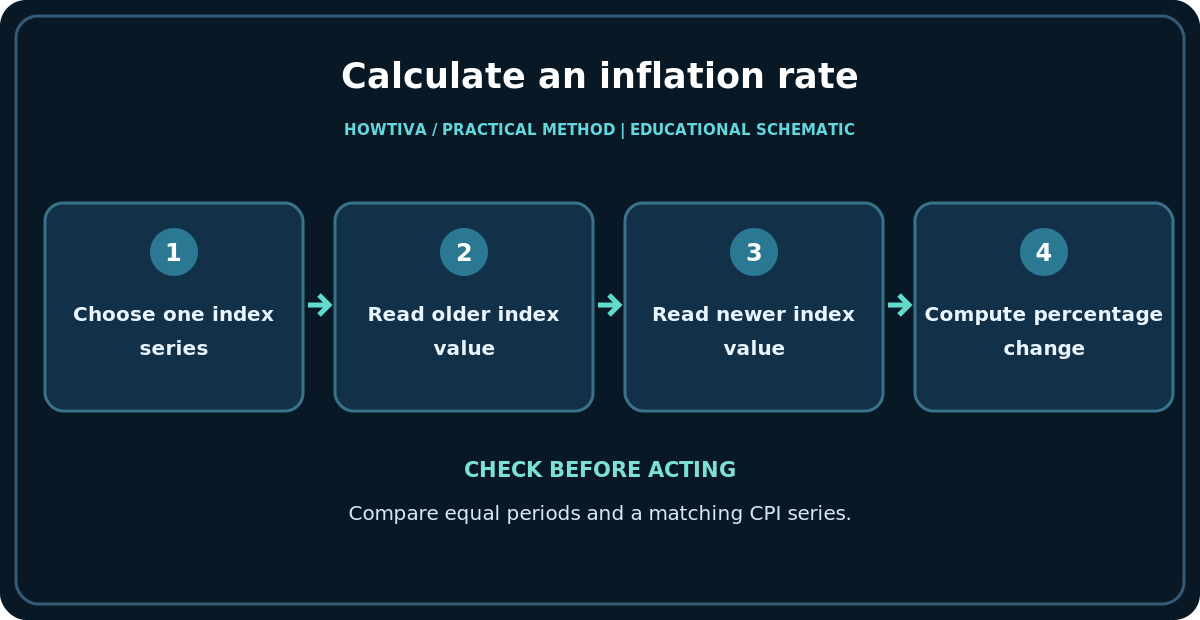
Choose the intended measure: Are you comparing one month with the preceding month, the same month 12 months earlier, or two annual averages? Specify this in the title of your result.
-
Select one consistent official index series: Use the same area, basket coverage, base period and adjustment type in both dates. Mixing one index series with another can yield a meaningless result.
-
Find the old and new observations: Write the older index observation first, and record its exact date and full published decimal precision. Ensure the older index is not zero.
-
Subtract old from new: Compute the index-point change (new − old). An index level is not a price in dollars; the difference alone is not the inflation percentage.
-
Divide by the old observation: Scale the change relative to the earlier base: (new−old)/old. Dividing by the new number instead produces a different percentage.
-
Convert to percentage and round at end: Multiply by 100 and state your number of decimal places. A decline yields a negative number—deflation for the particular measure and interval.
-
Label the exact period: For an “over the year” figure, compare e.g. May this year with May last year, not January with December. Annual averages use twelve observations for each year and answer a different question.
-
Distinguish official release and personal experience: National indices estimate price changes for a defined basket and population. Your own spending basket can change at a different rate; that does not invalidate the published CPI.
Worked financial example
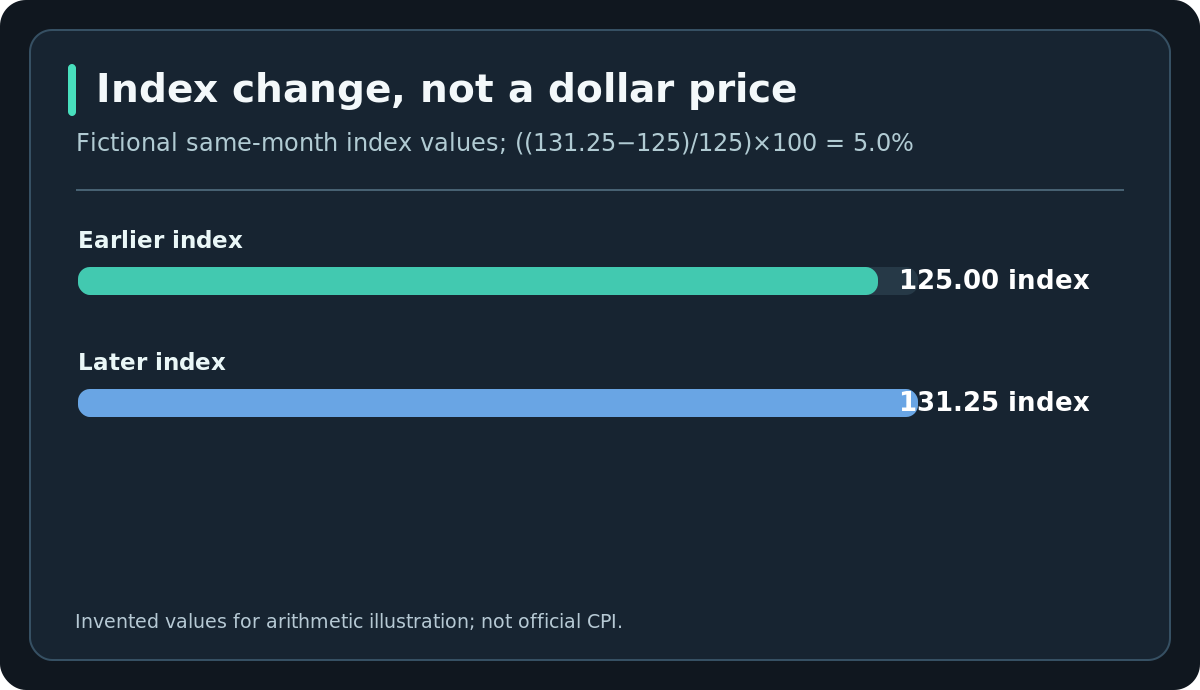
Hypothetical price index: earlier same-month value = 125.00, later same-month value = 131.25. Difference = 6.25 index points. Inflation = (131.25 − 125.00)/125.00 × 100 = 5.0%. These are fictional index values and must never be attributed to BLS, ONS or another statistics agency.
Second worked scenario and interpretation
Now compare two consecutive fictional months: index rises from 130.00 to 131.25. Monthly percentage change = (1.25/130.00) × 100 = 0.96% when rounded to two decimals. You cannot add twelve rounded monthly percentage changes to reproduce an exact 12-month inflation rate; compounding and changing comparison bases matter.
Common mistakes and troubleshooting
- Dividing by the later index: The denominator for percentage change is the older index observation.
- Mixing monthly and annual readings: One-month change and 12-month rate are different questions.
- Combining index definitions: Never splice different base periods, populations or seasonal adjustment conventions without proper methodology.
- Calling a personal item’s rise “national inflation”: That computes the change for that item, not for the full CPI basket.
An aggregate CPI change describes an index basket, not the exact change in every household’s spending or every individual price.
Alternative methods and exceptions
- Calculate a personal basket index: Record quantities and prices using a consistent weighting method, clearly labeling it as a personal estimate rather than official CPI.
- Negative price change: If the index falls, state the negative percentage and the comparison period.
- International comparisons: Use published local CPI or harmonized measures and verify methods before comparing regions.
Country-specific considerations (checked 2026-10-27)
- US: BLS CPI factsheets explain the percent-change formula and separate 1-month, 12-month and annual-average calculations.
- UK: Use ONS CPI/CPIH figures for UK inflation; the basket and publication conventions differ from US CPI-U.
- Canada: Statistics Canada publishes the Canadian CPI; do not use the US BLS CPI as a Canada-specific measure.
- Australia: Australian Bureau of Statistics provides Australian CPI; period frequency and methods depend on the selected series.
Frequently asked questions
Does 5% inflation mean every price rose 5%?
No. It is the change in a defined index of prices, not a claim about every individual product.
Can inflation be negative?
Yes; a falling price index over the specified interval yields a negative percentage change.
Why does annual inflation differ from monthly inflation?
The comparison periods differ, and the index evolves multiplicatively.
Can I use CPI index points directly as dollars?
No. CPI index levels are relative measures with specified reference bases.
Final checklist
- [ ] Select monthly or 12-month comparison
- [ ] Use one consistent official index series
- [ ] Record older and newer observation dates
- [ ] Subtract and divide by older value
- [ ] Multiply by 100 and label period
- [ ] Separate illustrative examples from observed inflation
Sources & Further Reading
- US Bureau of Labor Statistics — Calculating percent changes in CPI — One-month and twelve-month CPI percent changes.
Use the checklists as you go, and confirm the result before moving on to a more involved repair.