How to Calculate Your Personal Savings Rate
Calculate a personal savings rate step by step, with a 20% illustrative example, consistent savings definitions and a worksheet for irregular income.
Quick answer: Calculate your personal cash savings rate = (money newly saved ÷ take-home income) × 100 for the same time period. If you add money to emergency savings, other savings and retirement accounts from your take-home pay, add those contributions once, divide by actual take-home income, and state which items you included. This guide uses a personal budgeting metric, not the official household saving-rate series used by statistical agencies.
What you will finish: A defensible percentage for one month and a repeatable quarterly or annual comparison. Every monetary example is hypothetical US dollars, not typical income, a target return, or a recommendation that everyone save the same percentage.
What a personal savings rate measures
A savings rate answers: of the income available to me during this period, what share did I set aside for later instead of spending? It can help assess whether a budget leaves room for future bills, savings goals, or retirement contributions. A higher rate is not automatically better if current essential bills are unpaid or expensive debt is growing. The number is descriptive, not a score of your financial worth.
Two methods are common in personal planning. Cash-contribution method: count actual transfers or deposits allocated to savings and divide by take-home income. Income-minus-consumption method: income minus all spending yields residual saving, including amounts left in an account that were not intentionally separated. These methods can differ because of timing, debt repayments, investment gains and transfers. Pick one, name it, and compare like with like. The OECD publishes a household saving rate using national-accounts definitions, disposable income and pension adjustments; do not present a simple personal percentage as the OECD statistic.
Before you start: prepare a clean period and consistent definitions
Gather net payslips or deposit totals, cash-income records, savings account contributions, investment/retirement deposits made from take-home pay, and a list of transfers between accounts. Choose a calendar month, pay period, rolling quarter, or year. Use the same currency for numerator and denominator. With variable income, quarterly or twelve-month totals can be less misleading than one unusual payday.
Include salary received after payroll deductions, net self-employment draws after separately reserving taxes, and regular income that you genuinely use for the household budget. Exclude loan proceeds, moving cash between your own accounts, one-time internal transfers and unrealized increases in a portfolio. If you receive an extraordinary gift or asset-sale proceeds, disclose your treatment separately rather than hiding a change in definition. Do not count the same contribution both when you set aside the money and when you later transfer it to another savings account.
Pre-tax retirement contributions and employer matches are not normally part of a take-home-pay numerator, because they did not come from the same denominator. To build a total-compensation or gross-income rate, redesign both numerator and denominator consistently, accounting for payroll deductions and employer amounts. Label it clearly. Do not mix two denominator conventions in a time series.
Step-by-step: calculate your monthly rate
1. Find the income that actually arrived
Add amounts available for spending and saving during the month: for example, net pay from two deposits, plus any net side income. A pending invoice is not cash received. If work expenses or taxes still need to come out of business income, reserve them before treating money as personal take-home pay.
2. Identify new savings rather than account balances
Count money you intentionally moved out of spendable cash into emergency savings, future-expense pots or investments. An old $8,000 emergency-fund balance is not $8,000 saved again this month. A savings-account transfer is a change in location, but qualifies under this cash-contribution method only if you are deliberately treating it as this month’s new allocation. Reverse transactions/refunds, or spending funded from those pots, need separate attention so the reported result is meaningful.
3. Use a worked example with explicit assumptions
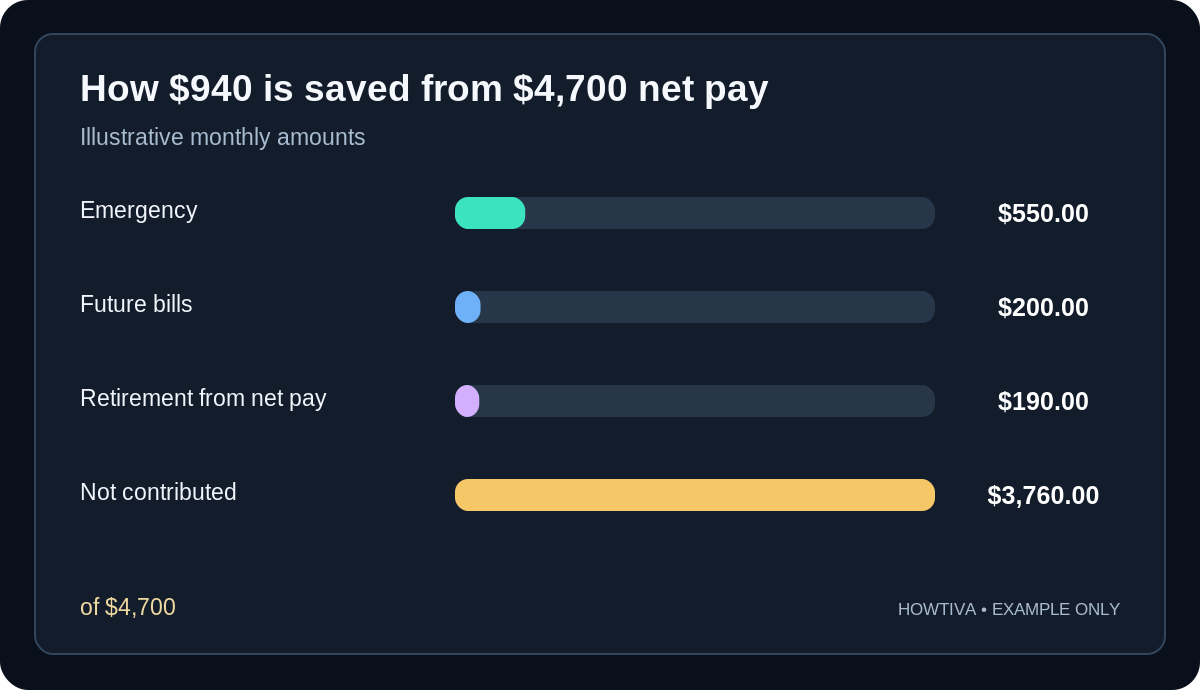
Assume net income received during April is $4,700. The household transfers $550 to emergency savings, $200 to planned-expense savings, and $190 to a retirement account out of take-home cash. No other amounts are included. Thus new contributions = $550 + $200 + $190 = $940. The rate = $940 ÷ $4,700 × 100 = 20.00%. The remaining $3,760 is not automatically proven to have been consumed; it is simply the difference between income and these chosen contributions.
4. Check the numerator against account movements
Look at a bank statement or budgeting ledger: mark each contribution, reverse any transfer that only shuffled previously saved funds, and separate account interest or investment market movements. If a deposit came from last month’s checking balance, distinguish newly earned income from money carried forward. When withdrawing $100 from an emergency fund, report this as a withdrawal; for an overall net change in liquid savings, adjust net deposits by withdrawals. Avoid quietly switching from a gross-contributions metric to net saving halfway through the year.
5. Compare months using total amounts, not an average of percentages
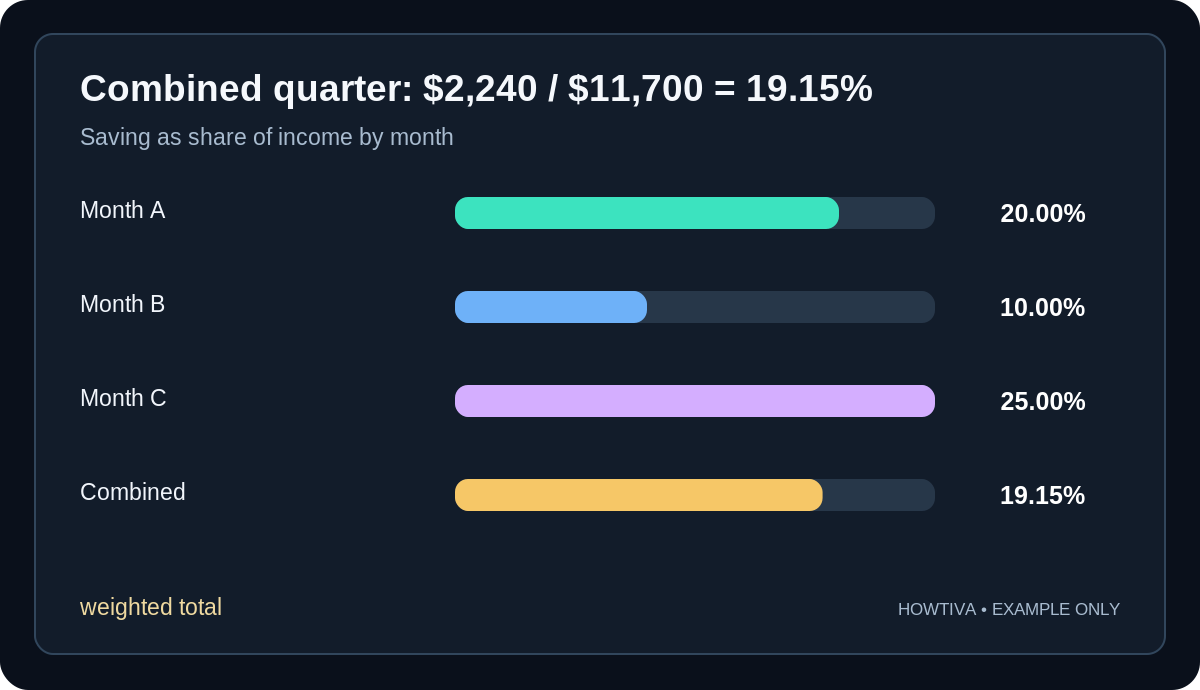
Suppose month A has $4,700 net income and $940 saved (20%); month B has $3,000 income and $300 saved (10%); and month C has $4,000 income and $1,000 saved (25%). The three-month savings rate is ($940 + $300 + $1,000) ÷ ($4,700 + $3,000 + $4,000) × 100 = $2,240 ÷ $11,700 × 100 ≈ 19.15%. Averaging 20%, 10%, and 25% to 18.33% would weight the small-income month equally and answer a different question. Keep an earnings-weighted period total as the headline.
6. Record your method and a realistic next action
Write down the denominator (net or gross), which savings count, the dates and any extraordinary items. Your next action may be to make contributions automatic, build a small buffer, or address costly debt first. If the figure is zero or negative, diagnose the cash flow before comparing yourself with national statistics or online savings-rate challenges.
Calculating a rate from spending instead
If you have reliable income and spending records but no separate saving transfers, the alternative income-minus-consumption calculation can be useful: (income − consumption spending) ÷ income × 100. On a fictional net income of $3,800 and genuine consumption of $3,450, the implied remainder is $350 and the rate is approximately 9.21%. But paying down loan principal, spending from savings, reimbursable expenses, taxes not yet set aside and account balance timing make classification important. A $200 loan payment comprising $30 interest and $170 principal is not the same as $200 of groceries. Use your method for budgeting; ask an accountant about formal financial statements if necessary.
Frequent mistakes and how to fix them
Numerator and denominator cover different dates: compare deposits and income in the same interval, or explicitly use accrual accounting throughout. Counting employer retirement contributions with net pay: either exclude them or design a gross-income metric. Counting investment gains as new savings: separate contributions from changes in market value. Counting a transfer twice: record origin and destination and tag each new contribution once. Treating credit-card purchases as savings until the bill is paid: track purchases when they occur and obligations owed. Unusually high one-off month: also calculate trailing twelve months.
If the computed rate exceeds 100%, investigate uncounted windfalls, prior-period cash transfers or a mismatched basis. Negative savings can occur; show it rather than concealing it. If income is zero, a percentage is undefined—report amounts and explain the situation instead of dividing by zero.
Alternative methods and useful exceptions
A self-employed worker can calculate quarterly saving divided by net personal income after tax and business reserve allocations; record estimated taxes outside the cash-savings numerator. A pension-focused household may prefer separate rates for accessible cash savings and retirement contributions. A household with multiple earners should decide in advance which inflows and savings belong to the shared budget, so member-to-member transfers are not double counted. If your objective is emergency liquidity, measure months of essential spending covered instead of relying only on a saving-rate percentage.
Country notes — checked 27 October 2026
The calculation itself is jurisdiction-neutral. In the US, distinguish take-home pay and payroll retirement deductions; this is a budgeting metric, not a tax filing figure. In the UK, decide how employee pension contributions through payroll fit your chosen denominator. In Canada and Australia, retirement-related payroll systems and account names differ; keep pre-tax/employer amounts separate unless using an explicitly gross or total-compensation method. Do not equate any of these personal rates to government household-saving statistics. No rates or tax rules are asserted here.
Frequently asked questions
Is a 20% savings rate required? No. The 20% above is a mathematical example, not a universal standard. Cash-flow constraints and priorities vary.
Does repaying debt count as saving? Principal repayment increases net worth by lowering liabilities, but it is not normally a cash deposit to savings. Track debt reduction separately or define a broader wealth-building rate transparently.
Should I include savings interest? For a contributions-only rate, exclude interest earned so the figure measures what you set aside. For an income-minus-spending method, it may be income if recorded consistently.
What about a tax refund? Treat it as a separately identified inflow under a stated policy. If a refund reflects earlier withholding, calling it ordinary recurring pay distorts a monthly rate.
Can I calculate the rate weekly? Yes, if both numerator and denominator cover the same week; use longer periods for variable pay.
Final checklist
- Choose a period and a net-income or gross-income convention.
- Add only eligible income received in that period.
- Count new savings allocations once, without investment gains or recycled transfers.
- Calculate savings ÷ matching income × 100 and verify with a calculator.
- For multiple months, divide combined totals, not an unweighted average of rates.
- Label excluded retirement items, debt principal, windfalls and transfers.
- Review the number alongside emergency liquidity, liabilities and essential expenses.
Sources & Further Reading
- OECD — Household savings and household savings forecast: national-statistics definitions, intentionally contrasted with this personal metric.
- FCAC — Making a budget.
- MoneyHelper — Emergency savings: how much is enough?.
Educational information only. Every amount and percentage in the worked examples is illustrative. Source review date: 27 October 2026.
Use the checklists as you go, and confirm the result before moving on to a more involved repair.