How to Calculate Gross Pay Versus Net Pay
Calculate gross and net employee pay with overtime and deductions, and learn why actual payroll taxes require official inputs.
Quick answer: Calculate gross pay as earnings before employee deductions. Estimate net pay by subtracting actual or explicitly assumed employee taxes, contributions and other deductions, then adding separately paid reimbursements where appropriate. Do not estimate take-home pay with a universal flat-tax percentage.
What you will achieve: You will calculate an example gross wage from hours and premium pay and reconcile it to net take-home pay. This method helps with budgeting or checking payroll, but only actual local tax rules and an employer’s payroll records can establish your real withholding.
Before you begin
Collect contracted rates, actual approved hours, overtime/shift terms, bonus and commission amounts, payroll period, benefits and employee contribution elections. For an accurate net forecast you also need employment location, tax residency, filing information, year-to-date history and current official withholding methods. Be cautious about handing payroll documents to third-party calculators.
Calculate gross earnings first, then subtract documented employee deductions. Employer-paid payroll costs do not ordinarily reduce an employee’s gross-to-net figure line by line.
Step-by-step instructions
Step 1: Determine pay frequency and classification
Confirm hourly versus salaried employment, weekly/biweekly/semi-monthly/monthly cycle and whether you are an employee. The same annual salary divided by 12 or 26 yields different payment sizes and timing; avoid using a “monthly” number for a four-week period.
Step 2: Compute ordinary wages
Multiply paid regular hours by the agreed rate. For illustrative $25 per hour and 160 regular hours, ordinary gross wages equal $4,000. Verify whether paid leave hours, holiday hours or unpaid absences alter the actual total.
Step 3: Compute special earnings separately
Apply the actual contract or locally required premium to each special category. For illustration only, 8 additional hours at an assumed $37.50/hour yield $300. This assumed premium does not assert that any jurisdiction legally requires it.
Step 4: Add all gross cash compensation
Total $4,000 regular plus $300 additional earnings = $4,300 gross. If the employer pays a performance bonus, include it in the proper payroll period. Distinguish expense reimbursements from wages when the payroll treats them separately.
Step 5: Read the employee deductions
Identify payroll income-tax withholding, applicable social charges, pension or retirement deductions, benefit premiums, union or voluntary payroll deductions and court-ordered withholding where applicable. Employer-only payroll charges are not automatically your deductions.
Step 6: Subtract actual or labeled assumed amounts
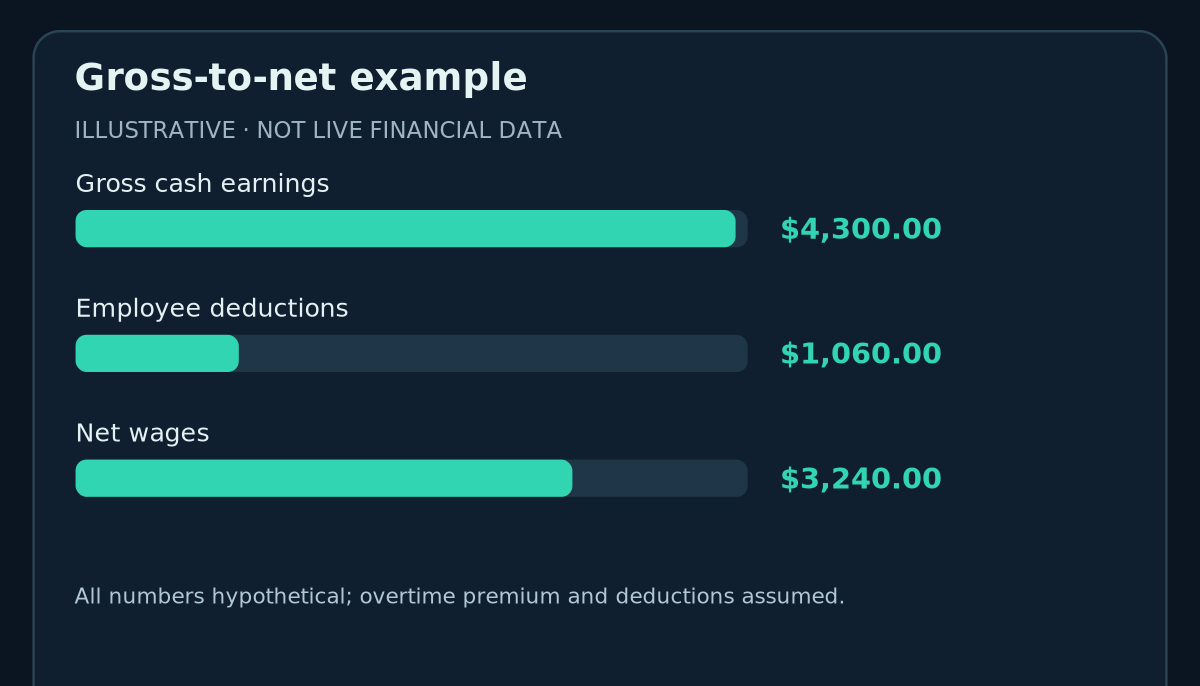
The hypothetical deductions are $600, $260, $120 and $80, totaling $1,060. Net cash earnings = $4,300 − $1,060 = $3,240. These are invented fixed numbers; they are not tax brackets, legal limits or estimates for a real worker.
Step 7: Adjust for cash reimbursements and account splits
If a genuinely nontaxable $50 expense reimbursement is paid outside wages, the bank cash deposit may be $3,290 even though wages after employee deductions are $3,240. Some reimbursements are taxable; classification depends on actual law and records.
Step 8: Validate using official methods
For US federal withholding, use the IRS estimator with actual W-2 paystub information and your current Form W-4. For other countries use local revenue agency guidance. Reconcile any discrepancy with payroll rather than setting your own fictional deduction rate.
Formula and assumptions
Gross earnings = regular pay + overtime/premium pay + other earnings. Net pay = gross earnings − all employee-paid deductions (plus appropriate separately paid cash reimbursements, if any). Actual deduction amounts require jurisdiction-specific records.
Fully worked example
Invented hourly employee: $25/hour ×160 regular hours = $4,000.00. Assume 8 extra hours paid at $37.50 = $300.00; total gross $4,300.00. Assume employee deductions $600, $260, $120 and $80 = $1,060.00. Net pay = 4,300 −1,060 = $3,240.00. None of these assumed deductions is a claimed statutory rate.
Second scenario and interpretation
The illustrative net-to-gross ratio is 3,240/4,300×100 = 75.35%, and the difference is $1,060. This ratio is an output of the invented example, not a universal take-home-pay percentage. If you changed retirement elections or withholding, the net result would change without the gross pay necessarily moving.

Common mistakes and troubleshooting
Assuming an overtime multiplier
Premiums depend on actual legal/contract rules; use the applicable rate, not the illustrative $37.50.
Treating employer payroll taxes as your take-home deductions
Only employee-borne deductions belong in the net reconciliation.
Using a flat tax estimate as verified pay
Tax brackets, allowances, payroll cycle and residence matter.
Ignoring tax treatment of reimbursements
Expense payments may or may not be included in taxable compensation.
Alternatives and special cases
Annual-salary conversion
Use annual gross divided by the real count of pay periods and account for unpaid leave/bonus adjustments.
Piecework and commission
Compute contracted earnings first, then determine actual payroll deductions and timing.
Budget estimate before first payslip
Use a range for net pay and state uncertainty until the first actual payroll and official tax withholding calculation are available.
Differences by country
United States
IRS explains federal withholding is based partly on Form W-4 and earnings, and recommends a paycheck-based estimator; Social Security/Medicare and state/local rules may also apply.
United Kingdom
PAYE income tax, National Insurance, pension and possible other deductions appear under UK payroll conventions; consult current HMRC rules rather than US assumptions.
Canada
Income tax, CPP/QPP and EI deductions are common employee payroll items; use local withholding tables and employer records.
Australia
PAYG withholding and employee payroll details vary; superannuation paid by an employer is not automatically deducted from the employee’s net cash wages.
This how to calculate gross pay versus net pay procedure is general education. Confirm current official rules and product or employment details where relevant.
Frequently asked questions
Is gross pay what lands in my bank account?
Normally no; the bank generally receives net cash after employee deductions and applicable adjustments.
Can net pay exceed gross wages?
Cash deposited can exceed gross wage earnings if reimbursements or other separately classified cash payments are included; check classification.
Are overtime rates identical everywhere?
No. Follow applicable laws, awards, contracts and the employee’s classification.
Will the IRS calculator give an exact future pay deposit?
It helps estimate federal withholding using your inputs; other deductions and actual payroll treatment can differ.
Final checklist
-
[ ] Find regular rate and hours
-
[ ] Verify overtime/premium terms
-
[ ] Add all gross earnings
-
[ ] List employee-only deductions
-
[ ] Subtract deductions to calculate net
-
[ ] Reconcile reimbursements and actual deposit
-
[ ] Validate real taxes using official rules
Sources & Further Reading
-
US Internal Revenue Service: Tax Withholding — US employee federal tax withholding context, W-4 inputs. Checked 27 October 2026.
-
US Internal Revenue Service: Tax Withholding Estimator — US estimator requires actual pay stubs, not a fixed flat tax rate. Checked 27 October 2026.
-
Financial Consumer Agency of Canada: Starting your first job — Canada gross pay, net pay, CPP/QPP, EI and income tax deductions. Checked 27 October 2026.
-
UK Government: Understanding your pay: Deductions from your pay — UK payroll deductions and permission rules. Checked 27 October 2026.
-
Australian Fair Work Ombudsman: Pay slips — Australian payslip required details and deadlines. Checked 27 October 2026.
Use the checklists as you go, and confirm the result before moving on to a more involved repair.