How to Pay Off Debt Using the Avalanche Method
Use the debt avalanche method to prioritize higher-rate debts, keep all minimums current and estimate interest costs.
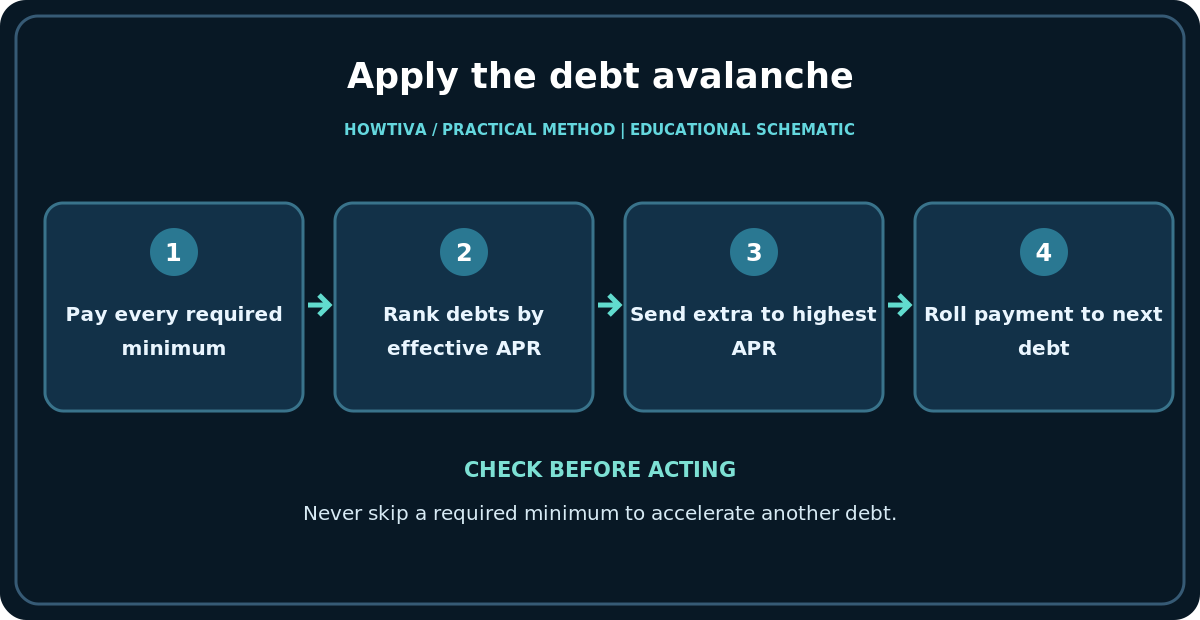
Quick answer: With the debt avalanche method, keep up at least the required minimum on every debt and direct every available extra payment to the debt with the highest interest rate. When that balance reaches zero, redirect its entire former payment toward the next highest-rate balance.
What you will achieve: The result is a debt payment order that is designed to minimize interest on comparable debts at unchanged rates and payments. It can take time before the first account closes, so it works best when you can stick with your extra-payment budget.
Before you begin
List every balance, annual interest rate, scheduled minimum, payment due date and whether extra principal payments are allowed without penalty. First protect housing, utilities, food and other essential/priority obligations. Tax, court, secured and overdue priority debts may need professional guidance before this unsecured-credit technique.
The avalanche prioritizes the highest effective interest rate after required minimums are covered. Verify promotional-rate expiry dates and the cost of any fees before choosing the next debt.
Step-by-step instructions
-
Make one accurate debt inventory: Record the balance as of the same date and the rate that currently applies. Variable rates and promotional expiries should be highlighted; do not confuse the card purchase APR with cash-advance APR.
-
Protect minimum payments: Automate or calendar minimum payments on every debt where possible. A missed payment can trigger fees, credit harm or a changed APR; avalanche does not mean skipping smaller debts.
-
Establish a sustainable debt budget: Subtract essentials and emergency margin from income before declaring the extra amount. The illustration uses a $240 total monthly debt budget; real affordability comes first.
-
Rank by effective borrowing rate: Sort target debts from highest APR to lowest, considering relevant fees or special terms. When rates tie, you may choose the smaller balance for a quicker completed account.
-
Apply remaining cash to the top rate: After all current minimums, send the entire extra payment to the highest-rate balance. Verify how the creditor applies amounts above minimum, especially if a single card has multiple APR buckets.
-
Roll the freed payment forward: As each target clears, keep the total monthly budget unchanged and transfer the freed minimum plus extra to the next APR target. Do not let the target payment vanish into untracked discretionary spending.
-
Re-sort if terms change: A rate increase or promotional expiry can change the true cost order. Revisit at least monthly and verify whether a prepayment fee makes a loan special.
-
Track principal and interest separately: Use a balance, monthly interest, payment and closing-balance ledger. Under identical modeling assumptions, compare avalanche with a snowball sequence before deciding.
Worked financial example
Illustrative starting debts: Card A: $1,200 at 24%, Card B: $500 at 15%, and Loan C: $2,400 at 8%. Fictional minimums are $35, $20 and $60, and the total monthly budget is $240. The initial required minimums total $115, leaving $125 extra for A, the highest APR. No fees or additional purchases are assumed.

Second worked scenario and interpretation
Using APR/12 simple monthly accrual, the first month has $24.00 interest on A, $6.25 on B and $16.00 on C. After minimums and the extra $125 to A, ending balances are approximately A $1,064.00, B $486.25 and C $2,356.00. The independent full amortization simulation in this package shows payoff timing and interest under the same monthly model for avalanche and snowball. The corresponding method in the monthly model takes 19 months with $378.81 total interest. For comparison, avalanche gives 19 months/$378.81 interest; snowball gives 19 months/$406.01 interest. These are model outcomes, not promises; real payment timing and rates matter.
Common mistakes and troubleshooting
- Skipping another creditor’s minimum: Always meet enforceable payments unless a hardship arrangement is in place.
- Sorting on balance size: That is the snowball method; avalanche ranks by cost/rate.
- Using an unrealistic extra payment: A plan that causes further high-interest borrowing may fail.
- Ignoring promotional rate expiration: The highest-cost target can change sharply when a special rate ends.
If a minimum cannot be paid, stop optimizing payoff order and contact the creditor or a qualified nonprofit debt counselor about hardship options.
Alternative methods and exceptions
- Snowball strategy: Pay smallest balance first when early visible wins improve consistency; total interest may be higher.
- Hybrid strategy: Start with a small quick win, then reorder remaining debts by APR.
- Serious arrears or collections: Seek independent local debt advice before reordering priority obligations; an unsecured consumer-debt worksheet is not a legal priority chart.
Country-specific considerations (checked 2026-10-27)
- US: Card minimums, promotional rates and additional payment allocation depend on applicable US law and the actual agreement.
- UK: MoneyHelper recommends prioritizing expensive borrowing while keeping required payments on other debts; rent, tax and secured arrears require separate prioritization.
- Canada: Verify each contract’s prepayment terms and fee rules; local credit counseling can help where minimums are unaffordable.
- Australia: Check credit contracts and seek local financial counseling where debt has entered hardship or collections.
Frequently asked questions
Does avalanche always save money?
With otherwise identical balances, rates and total cash paid, prioritizing higher rates generally lowers interest; fees, special timing and penalties may alter comparisons.
Which account do I pay first if APRs are identical?
A smaller balance can be selected for simplicity without changing interest attributable to equal nominal rates under a simplified model.
Should I close cards when paid off?
That is a separate decision involving fees, temptation to overspend and credit-profile effects.
What if I cannot afford all minimums?
Contact creditors immediately and seek reputable debt guidance; an avalanche schedule is not a substitute.
Final checklist
- [ ] Inventory balances, rates and minimums
- [ ] Keep priority bills and all minimums funded
- [ ] Rank by highest relevant APR
- [ ] Pay all extras to one target
- [ ] Roll freed payments forward
- [ ] Recalculate after any rate change
Sources & Further Reading
- UK MoneyHelper — How to reduce your borrowing — High-rate-first and minimum payment principles.
- Consumer Financial Protection Bureau — What should I do if I cannot pay credit card bills? — Contact lender and hardship options.
- Consumer Financial Protection Bureau — How does my credit card company calculate interest? — Average daily balance and periodic rate method.
Use the checklists as you go, and confirm the result before moving on to a more involved repair.