How to Read a Bank Statement
Read a checking account statement line by line and reconcile a fictional $1,250 opening balance to $2,302 closing balance.
Quick answer: Start with the statement date range and opening balance, read every posted credit and debit, identify fees and interest, and verify opening balance + total credits − total debits = closing balance. Then compare entries with your own records and report unfamiliar or incorrect transactions promptly through the bank’s official channels.
What you will finish: A correctly interpreted checking/current-account statement and a simple reconciliation sheet. This guide uses a made-up ledger for teaching—not a reproduction of a real bank’s statement or interface. Monetary examples are fictional US dollars.
What a statement actually tells you
A bank statement records posted activity on a deposit account for a defined period, often a calendar month or a different cycle. It may show customer details, masked account identifiers, a beginning or brought-forward balance, transactions with dates and descriptions, charges, interest, deposits and an end-of-period balance. Banks differ in wording and formatting. UK MoneyHelper notes that a statement is a record of transactions and may use abbreviations that vary by institution.
A statement is not the same as the app’s live available balance. A purchase you just made, a pending hotel authorization, an uncleared cheque, or a deposit under a hold may not appear as a posted entry in the statement period. Check which date and balance type you are reading before drawing a conclusion.
Prepare to review securely
Download or view statements only from the bank’s official site or mobile app or paper mail. Verify that the period and account belong to you without sharing the document publicly. Keep receipts, a personal ledger or spreadsheet, past statement’s ending balance, transaction notifications and records of expected standing orders, Direct Debits or automatic payments. Avoid emailing a full unredacted statement or bank-login screenshots. If you must share a copy as proof of address or with an adviser, verify the recipient and conceal data not required by that organization.
Step-by-step: interpret and reconcile
1. Read the header carefully
Locate account holder; masked account number; statement start and end dates; currency; account type. A checking account (US), current account (UK) and chequing account (Canada) may serve similar payment purposes but have different terminology. If you hold multiple accounts, the statement may cover only one. Confirm whether the printed dates are transaction dates or the dates funds were posted.
2. Identify opening and closing balances
The opening balance is the amount carried forward into the period; the closing balance is the book balance after the entries posted within that statement. Some statements present a running balance after every line. If the previous statement is available, verify that its closing posted balance agrees with the new opening balance, allowing for any unusual correction that the bank explains.
3. Label money in and money out
A credit to a deposit account typically increases the balance: pay deposits, refunds, interest or incoming transfers. A debit reduces it: purchases, cash withdrawals, bill payments, outgoing transfers or fees. This is the usual consumer deposit-account perspective; credit-card statements use different language and must not be reconciled as if they were checking accounts. Labels such as ‘DR’, ‘CR’, ‘withdrawal’, ‘deposit’, ‘paid in’ or ‘paid out’ depend on your provider.
4. Add a complete illustrative ledger
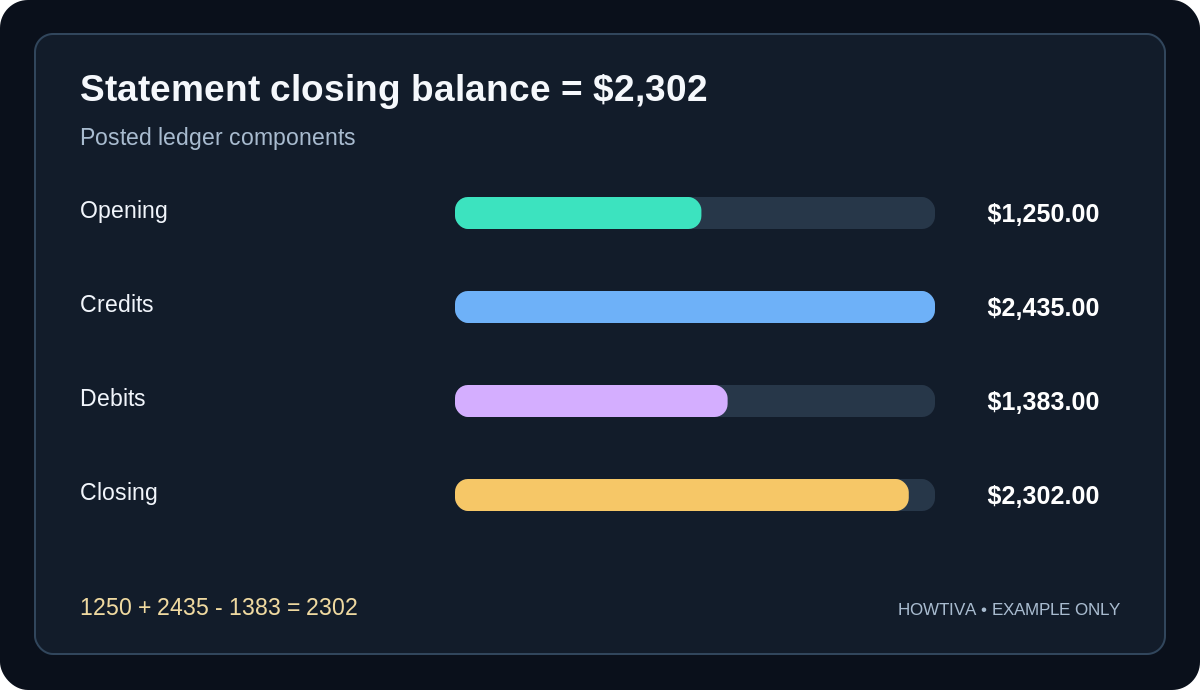
Assume opening balance $1,250. Posted credits: pay deposit $2,400 and refund $35, totaling $2,435. Posted debits: rent $1,000, groceries $185, utilities $90, service fee $8, and ATM withdrawal $100, totaling $1,383. The closing balance is $1,250 + $2,435 − $1,383 = $2,302. If your sum differs from the statement, reread line signs, refunds, currency and missing entries. Do not create a balancing number to hide a real discrepancy.
5. Understand codes and merchant descriptors
Statement descriptions can show a payment processor, abbreviated merchant, purchase location or shortened identifier rather than the name on the shopfront. Look for recurring debit or standing-order indications, transfer references and fees. In the UK, MoneyHelper lists examples such as Direct Debit and standing-order abbreviations, but codes are not guaranteed to have a standard meaning at every bank. Check the bank’s own key or contact it through a trusted number when unsure. Never assume that ‘credit’ means income; a refund or internal transfer also increases the account.
6. Separate posted entries from pending or scheduled payments
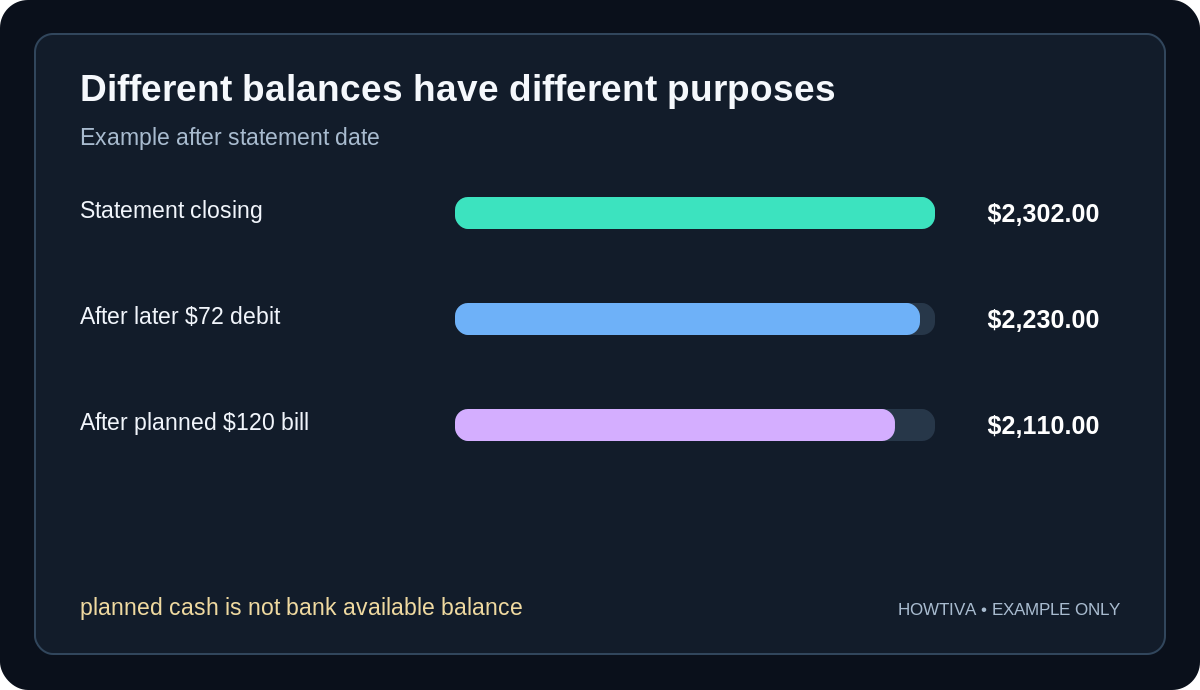
Suppose the statement closed at $2,302. The next day a $72 debit card purchase posts, so a running register would show $2,230 if nothing else changes. You also plan for a $120 bill that has not yet posted; your simple planned cash figure is $2,110. This is not a prediction of your bank’s available balance: holds, settlement, additional transactions and available-funds policies can differ. Don’t subtract the same transaction twice when it changes from pending to posted.
7. Match transactions and flag discrepancies
Work line-by-line with receipts, pay records and spending logs. Mark each expected payment ‘matched’. For a missing debit, check whether it occurred after the closing date or remains pending. For a deposit not yet posted, check payment date and possible hold—not just the advertised transfer time. For any unfamiliar charge, secure your account and contact the bank using contact details from its verified website, app or card. Reporting deadlines and liability protections depend on location and payment type; do not wait for your next statement when fraud is suspected.
8. Review charges and finalize the audit
Identify maintenance fees, overdraft-related charges, ATM costs, foreign-currency fees and service adjustments separately. Compare them to the actual account fee schedule. Record the statement date, balance agreement, transactions investigated and any case number. Save statements in encrypted or otherwise access-controlled storage according to your needs and any legal recordkeeping requirements.
How to read a balance mismatch
A $15 mismatch could reflect a missed deposit, a fee, reversed/refunded purchase, incorrectly signed withdrawal or duplicated line. Re-add all credits and debits from the original bank document, not copied spreadsheet text alone. Check whether the statement totals already include the fee lines; double counting is common. Compare the last reconciled transaction date with the statement close. If figures still disagree, ask the bank to explain or correct them; do not edit its document to force a match.
Common issues and troubleshooting
Unrecognized merchant: search your own receipts and merchant confirmation, then speak to the bank if still unfamiliar. Debit appears twice: determine whether one entry is a pending authorization and the other a settled payment. Account balance seems lower than expected: check uncleared checks, card holds, service fees and interest charges. Statement missing: check electronic delivery settings and request an official copy. Wrong personal details: contact the bank through verified channels. Transaction dates differ from purchase date: merchants may settle later; use posted dates consistently during reconciliation.
Other approaches and exceptions
A monthly paper or PDF statement is useful for formal records, while a transaction-export CSV helps sort spending but may not include balances, pending holds or adjustments. Reconciling a small-business account requires segregating business and personal transactions; seek professional advice for formal books. For multi-currency accounts, review exchange-rate conversion lines and fees individually rather than adding incompatible currencies. For accounts that pay interest, compare posted interest to the bank’s explanation, not an unverified annual percentage.
Country notes — checked 27 October 2026
US: CFPB guidance explains that federal periodic-statement duties for consumer checking accounts depend on electronic fund-transfer activity; it is not universally true that every account must receive a statement every month. UK: MoneyHelper explains typical statement features and common abbreviations. Canada: terminology often uses ‘chequing’ and local account disclosure/dispute rules. Australia: use the bank’s official statement and relevant consumer protections; statement layouts and transaction codes are not international standards. For disputed or unauthorized payments, verify applicable time limits promptly with your bank and local regulator rather than relying on an invented universal deadline.
Frequently asked questions
What is the difference between balance and available balance? The posted ledger total and the amount currently available for spending may differ due to pending holds, uncleared transactions and bank policies.
Why is a merchant name different from the store? Banks sometimes display processor or company descriptors. Confirm through receipts or the merchant and bank.
Can a bank statement show savings interest? Some account types show interest credits and related charges; check the account terms.
Is an online transaction list a statement? Not necessarily. A formal statement typically has a defined period and account summary; an activity screen may include pending items.
What if an entry is unauthorized? Contact your bank immediately using trusted channels and follow the applicable dispute process; save transaction dates and evidence.
Final checklist
- Confirm account, currency and statement period.
- Match opening balance to the prior closing balance where available.
- Add all posted credits and debits, including fees and reversals.
- Verify opening + credits − debits = closing.
- Keep pending and scheduled items separate from statement postings.
- Match entries with records and report discrepancies without delay.
- Store statements safely and revisit monthly or each statement cycle.
Sources & Further Reading
- MoneyHelper — What is a bank statement?.
- CFPB — When a US checking-account statement is required.
- FDIC — Overdraft and account fees.
- CFPB — Unauthorized transaction help.
The diagrams are invented calculations, not bank screenshots. Educational only. Source review date: 27 October 2026.
Use the checklists as you go, and confirm the result before moving on to a more involved repair.