How to Transfer Money Between Bank Accounts Safely
Safely transfer funds between accounts using verified destination details, payment-rail awareness and clear illustrative transfer calculations.
Quick answer: Start a transfer inside your bank’s verified app or website, select the correct source account and payment method, independently confirm the receiving account details and ownership, check the amount, fees and expected availability, then review the bank’s final confirmation carefully before authorising. If sending to a newly linked external account, use the institution’s official verification process and consider a small test payment when appropriate. Do not send money to an account supplied through an unexpected call, text or last-minute invoice change without independently confirming the details.
Your result: A repeatable transfer safety checklist and a transaction record that distinguishes scheduled, pending, sent, settled and actually available money. Bank menus, limits, processing times and the ability to cancel vary by institution and payment rail; no specific bank workflow has been physically tested for this guide.
Understand the type of transfer first
A transfer between accounts you own at the same institution may be an internal book transfer, often but not always fast. A transfer between two institutions you own may use local bank rails such as ACH in the United States, Faster Payments in the UK, Interac e-Transfer or bank transfers in Canada, or Osko/NPP and standard bank transfers in Australia. International transfers have separate FX, receiver fees and regulatory treatment. Wire transfers, real-time systems, bank-to-bank transfers and peer-to-peer payments are not interchangeable; cancellation/recovery rights can vary materially. Just because an app shows ‘completed’ does not necessarily mean the recipient can spend the funds that instant.
The CFPB explains that US ACH can clear on the same day but may take days to complete, and that banks can impose transfer limits or fees. UK MoneyHelper cautions that misdirected transfers can be difficult to recover. For a high-value or urgent transaction, ask the sending and receiving providers about the specific rail and availability timeline before initiating.
What you need before starting
Prepare the legal receiving-account name, correct routing/sort code/BSB/IBAN/account number or other identifier appropriate to your country, currency, reason for transfer, amount, and desired arrival date. Use only the fields your financial institution actually requires. If it’s your own external account, verify ownership with the bank’s legitimate process—some banks use small test deposits, authentication through another bank or an account-linking service. Verify any provider’s data-access policy; avoid giving credentials to a third-party site you do not trust. Check your available funds after upcoming bills, any holds, transfer limits, cut-off times, holidays, fees, and daily account caps.
Security: A real institution should not require you to send money to a ‘safe account’ to stop a fraud attack. If told to move money urgently because it is ‘under investigation,’ stop and contact your bank using a number from its own official website or card. Payment instructions received only by email or chat are not proof of destination ownership.
Step by step
1. Decide whether you are moving your own money or paying someone else
For own-account transfers, confirm both accounts belong to you and consider a genuine official account-link option. For third-party payments, double-check why the transfer is needed and whether a payment method with appropriate purchase protections would be safer. If an invoice’s account number has ‘changed’, telephone the known recipient using a previously trusted number—not one printed in the suspicious new message. Do not rely on a sender name, QR code or shared screenshot as proof that payment details are genuine.
2. Verify destination details independently
Check the recipient’s legal account name and exact account identifier against the official bank or the intended recipient using an established channel. For UK domestic bank transfers, some banks use Confirmation of Payee name-checking; a warning or missing match should prompt investigation, not a blind override. It is a useful safety check but not proof that a recipient is honest. For US ACH, routing and account numbers should be confirmed at both ends; correct-looking routing numbers alone don’t prove that an account belongs to your intended recipient. The CFPB warns that a wrong account or routing number can mean money may not be recoverable.
3. Compute the safe transfer amount
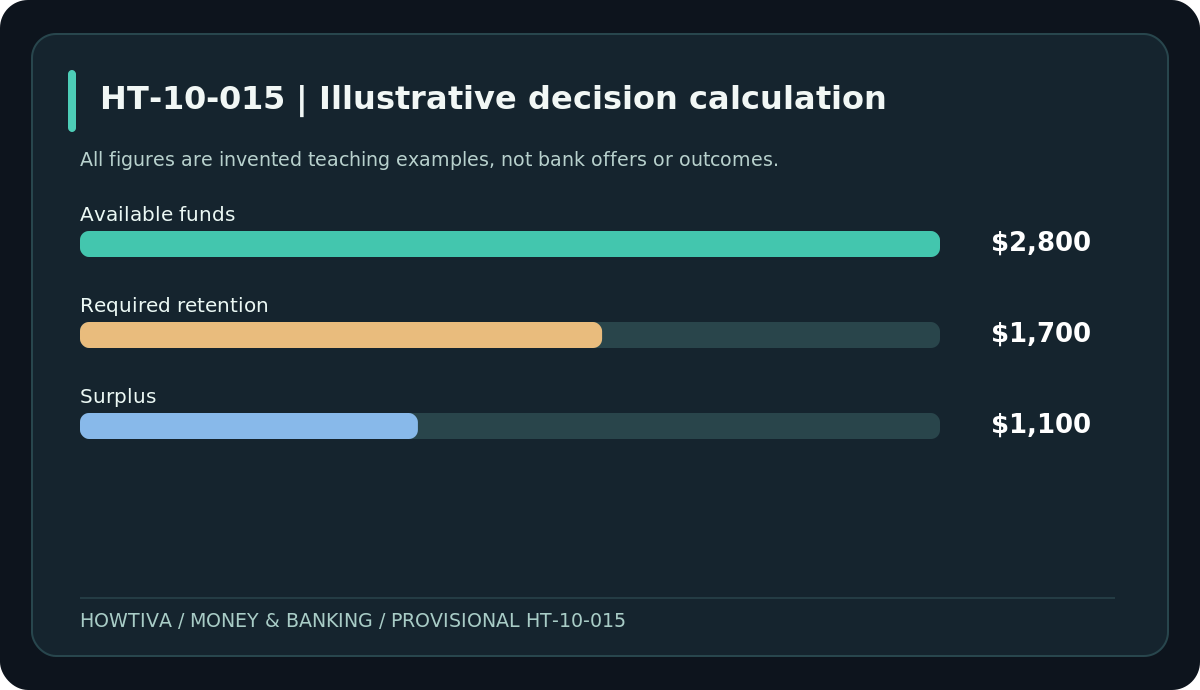
Suppose a hypothetical checking account shows $2,800 available, with $950 rent, $300 utility/insurance, $250 planned daily spending and a self-chosen $200 safety buffer still to cover before payday. Funds required to retain are $950 + $300 + $250 + $200 = $1,700. The illustrative safe surplus is $2,800 − $1,700 = $1,100. This is a planning calculation, not a bank-authorised transfer limit. If a pending cheque, scheduled transfer, deposit hold or fee exists, include it before sending. Never send the last of your bill money just because the app reports a positive available balance.
4. Compare speed, fees and ability to reverse
Read the bank’s summary for the exact rail offered. An internal transfer may be immediate; ACH is subject to banking cut-offs and returns; domestic real-time payments may be fast but harder to cancel; wires generally deserve additional verification. Some providers charge sending or receiving fees, especially across borders. A ‘free transfer’ can still have an exchange-rate markup in international transactions. If time is tight, contact both banks before relying on a quoted arrival time. Don’t assume a faster method is better for an unfamiliar payee.
5. Consider a small test transfer for a new destination
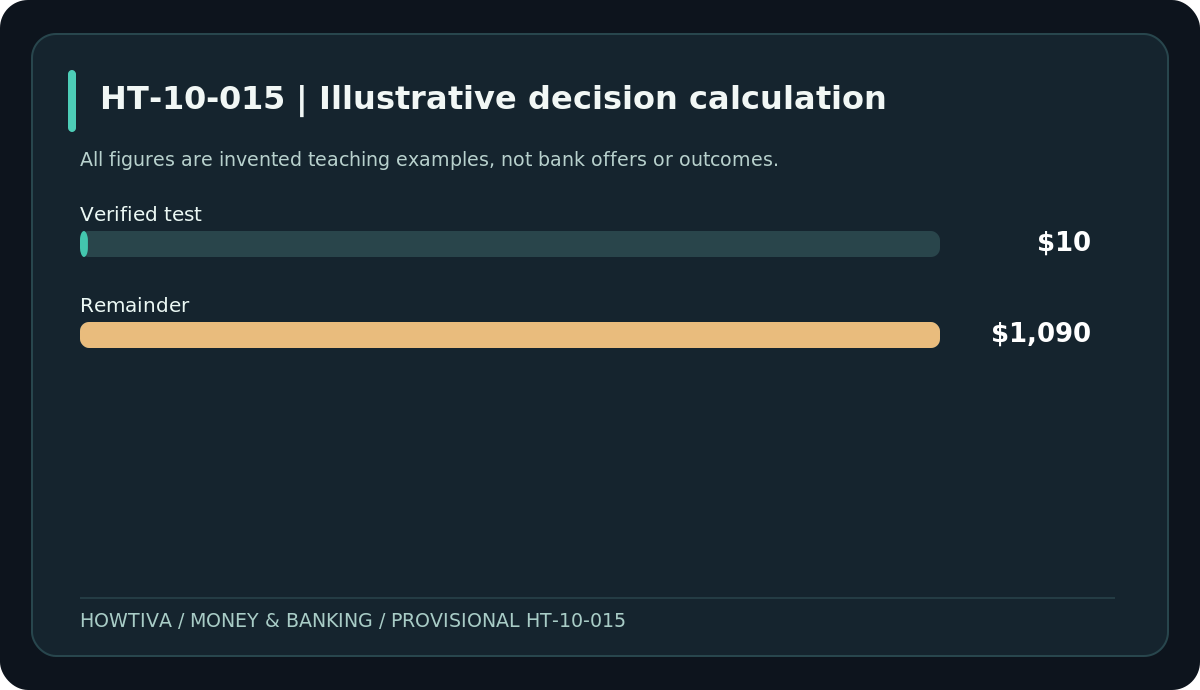
When the recipient and transfer method make this sensible, send an affordable small first payment, then verify through a separate trusted channel that the correct account actually received it. UK MoneyHelper suggests a £1 test payment for reassurance. An example: for a planned $1,100 own-account transfer, send an illustrative $10 test amount, verify it arrived at the intended destination, then—if still appropriate—send the remaining $1,090. That is $10 + $1,090 = $1,100 in total. Check whether test and follow-up transfers incur extra fees or limits. A test transfer is not a guarantee a later payment cannot be intercepted or sent to a scammer; fraudsters may control the account that receives both transactions.
6. Review the confirmation screen before approving
Check the source account, recipient name or identifier, amount, currency, any disclosed charges, arrival estimate and reference. Do not allow auto-complete or copied clipboard content to override the account number without checking. Reverify details after the bank’s payee confirmation and after any warning screen. Authorise only once. If the app seems frozen, inspect transaction history before retrying; otherwise you might unintentionally submit a duplicate.
7. Save records and monitor both ends
Keep the bank’s transaction ID/reference, timestamp, transfer rail, sent amount, recipient details in a secure record and status. For transfers between your own accounts, inspect the outgoing debit and receiving credit without double-counting the movement as new income or expenditure in a budget. Some institutions show an incoming transfer before it becomes available for withdrawal. Do not release goods or change your financial plans based solely on a screenshot of a payment confirmation; check actual settled funds through the relevant official bank channel.
8. If something is wrong, contact the bank immediately
For an incorrect beneficiary, duplicate submission, or suspected fraud, contact the sending bank or payment service at once, supply the transaction reference and ask if it can stop, trace, recall or attempt recovery. Do not assume a recall will succeed. If your credentials were compromised, request a fraud investigation, secure account access and record all case numbers. Keep copies of correspondence and promptly escalate via the provider’s formal complaint route if unresolved. Do not send extra ‘release fees’ to recover supposedly frozen money; that is a frequent fraud pattern.
Transfer methods at a glance
Within one bank: may be quick; confirm the correct source/target and account treatment. Domestic standard bank-to-bank: often low-cost but depends on clearing windows and holds. Instant/real-time rails: may arrive promptly with stricter cancellation limitations and bank-specific caps. Wire/international: additional fees, FX spread, bank identifiers and fraud risk demand more verification. Third-party wallets/P2P: convenient but may be unsuitable for unknown sellers; network and consumer-protection arrangements differ. These are broad categories, not promises of processing time or refund.
Troubleshooting common errors
Payment does not arrive when expected: verify actual scheduled/send date, cut-off, recipient institution hold and pending versus settled status; request an official trace. A name-check doesn’t match: stop and verify the recipient’s legal name and account details; do not interpret a warning as a routine nuisance. Transfer limit reached: check official daily or new-payee limits; never break a transfer into pieces to evade fraud checks or limits without provider guidance. Duplicate debit: verify both entries and contact the bank; do not resend automatically. Paid the wrong person: contact the bank immediately, even if the error was yours. A contact asks for a new destination at the last minute: verify using a previously known number before sending anything.
Country-specific notes — verified 27 October 2026
United States: CFPB says ACH timing and charges depend on network processing, availability and individual provider rules; a bank’s recall of an erroneous payment is not guaranteed. Wire transfers to strangers present major fraud and recovery risks. United Kingdom: FCA states that domestic bank transfers generally must reach the receiving bank by the end of the next business day under applicable rules, subject to context. Wrong sort code/account information can be hard to recover, although banks must make a reasonable effort. Confirmation of Payee is an additional check. The UK Payment Systems Regulator’s authorised push payment fraud reimbursement regime began for qualifying payments on 7 October 2024, with defined scope, exclusions and claim rules—it is not a universal refund for payment mistakes. Canada: verification of recipient, bank account and Interac conditions should be based on the actual provider, and unauthorized payment protections must not be conflated with self-authorized mistaken transfers. Australia: Moneysmart distinguishes a mistaken transfer made with wrong details from an unauthorized transfer initiated without consent; report either promptly and check the bank’s response.
Alternatives and safeguards
For purchases from unfamiliar sellers, consider a payment method with buyer/chargeback protections instead of a direct transfer. For urgent large transfers, speak with the bank about suitable verified instructions and cut-off times. For payroll and recurring own-account transfers, automatic standing arrangements reduce manual entry—but audit details periodically, particularly when moving banks. For international transfers, compare the total received amount after FX and receiving fees, not only the advertised sending fee. For joint, company and trust accounts, confirm who is authorised to initiate transfers and any dual-approval policy.
Frequently asked questions
Will a $1 or $10 test transfer make the next transfer safe? It can verify the destination under limited conditions but cannot remove all fraud risk.
Can I cancel a bank transfer after I click send? Sometimes, depending on the rail and timing; ask the provider immediately. Do not assume reversal is possible.
Is an ACH payment always next day? No. Processing, holidays, returns and holds can affect when the money is received or available.
Does a matching recipient name prove the account is trustworthy? No. Verification addresses some data-entry risk, not the payee’s intentions.
Should I send money to a ‘safe account’ when someone calls about fraud? No. Independently contact your bank via its official channel; fraudulent callers use that pretext.
Final checklist
- I know whether the destination belongs to me or a third party.
- I independently verified the recipient and account details.
- I checked scheduled bills and kept adequate available cash.
- I reviewed method, fees, cut-off and irreversibility risk.
- I considered a legitimate small test when appropriate and checked receipt.
- I saved the confirmation securely and checked the actual receiving account.
- I know whom to contact immediately if money is missing or misdirected.
Sources & Further Reading
- CFPB — What is an ACH transaction?.
- CFPB — Incorrect recipient information on a transfer.
- FTC — What to know before wiring money.
- MoneyHelper — How to make a bank transfer safely.
- FCA — Making and receiving payments.
- Payment Systems Regulator — APP fraud reimbursement.
- ASIC Moneysmart — Bank transaction problems.
- ASIC Moneysmart — What to do if you’ve been scammed.
Last researched: 27 October 2026. The money figures are illustrative. No payment instructions were executed or bank interfaces tested.
Use the checklists as you go, and confirm the result before moving on to a more involved repair.