How to Pay Off Debt Using the Snowball Method
Build a debt snowball payoff plan from smallest balance upward while protecting minimum payments and checking the interest tradeoff.
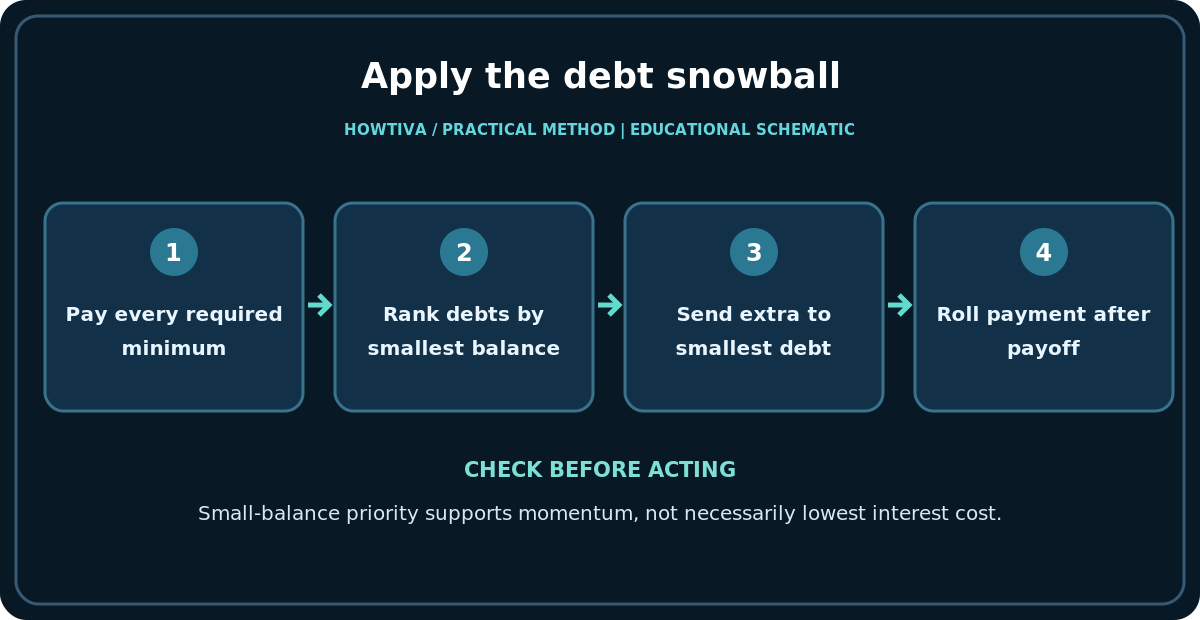
Quick answer: With the debt snowball method, make all required minimum payments, then direct every extra payment to the smallest outstanding balance. After that debt is cleared, roll the entire released payment onto the next-smallest debt until the list is finished.
What you will achieve: This method creates early account closures that can encourage follow-through. Because it does not rank by APR, it may cost more interest than the avalanche method. The sensible choice is one you can sustain without missing minimums or essential obligations.
Before you begin
Gather balances, minimums, current interest rates, due dates and any special terms. Keep secured, tax, court or other high-priority debts separately reviewed; a snowball for ordinary unsecured balances should not supersede legal or essential obligations.
The snowball prioritizes the smallest remaining balance to produce earlier account payoffs; that is a behavioral structure, not a guarantee of minimum total interest.
Step-by-step instructions
-
List debts in ascending balance order: Use actual current payoff balances, not original borrowed amounts. If two balances match, use a higher APR or near-term promotional expiry as the tiebreaker.
-
Identify required monthly payments: Mark each minimum and exact due date. Snowball does not permit late payments to larger lenders; everything stays current to the extent possible.
-
Set one total monthly payment budget: Include all minimums plus an affordable extra amount. Use $240 in the lesson example for three debts; no need to use a prescribed percentage of income.
-
Target the smallest account: After paying other minimums, add every available extra dollar to the smallest balance. Verify early payoff procedures and whether a separate final payoff amount is needed.
-
Celebrate the closure without slowing the plan: Once the smallest debt is gone, transfer its old monthly amount to the next debt instead of spending it. The total budget stays the same while fewer accounts remain.
-
Check the rate tradeoff: A high-APR large debt can keep accumulating interest while a lower-rate small debt is targeted. Run an avalanche comparison and decide whether the motivation is worth the extra expected cost.
-
Reorder monthly: Balances, interest and fees may shift. Recalculate the smallest current balance, especially when one debt gets close to zero or has a promotional offer ending.
-
Keep a payment confirmation trail: Record dated payments, statement balances and paid-in-full confirmations. A zero displayed balance can differ from a formal loan payoff where pending accrued interest exists.
Worked financial example
Illustrative debts: B: $500 at 15%, A: $1,200 at 24%, C: $2,400 at 8%. Required minimums are B $20, A $35, C $60. With a $240 monthly total, $115 covers minimums and $125 extra goes first to B because it has the smallest balance.

Second worked scenario and interpretation
In month 1 of the fictional APR/12 monthly simulation: B interest is $6.25; applying its $20 minimum plus $125 extra reduces B to $361.25. A receives its $35 minimum and finishes at $1,189.00 after $24 interest; C finishes at $2,356.00 after $16 interest and a $60 payment. The central math file compares eventual interest and months with avalanche, using identical funding and rates. The corresponding method in the monthly model takes 19 months with $406.01 total interest. For comparison, avalanche gives 19 months/$378.81 interest; snowball gives 19 months/$406.01 interest. These are model outcomes, not promises; real payment timing and rates matter.
Common mistakes and troubleshooting
- Sorting by interest rate: That is an avalanche and may have a different payoff order.
- Dropping the snowball budget after an account closes: The freed payment must be redirected to make the snowball grow.
- Forgetting minimums on other debts: A small win is not useful if larger accounts become delinquent.
- Ignoring exceptionally expensive credit: Check how much extra interest snowball would incur on a much higher-rate account.
Keep making every required minimum. When one debt reaches zero, redirect the freed payment toward the next smallest balance without adding new borrowing.
Alternative methods and exceptions
- Avalanche method: Targets highest APR for lower modeled interest under identical other assumptions.
- Hybrid plan: Pay an exceptionally small debt first, then rank remaining balances by interest rate.
- Hardship/urgent debt: Seek a qualified debt adviser for priority arrears or unaffordable minimum payments.
Country-specific considerations (checked 2026-10-27)
- US: Confirm each lender’s minimum-payment and prepayment allocation terms. Separate unsecured cards from critical mortgage, tax and support obligations.
- UK: MoneyHelper encourages keeping all borrowing current and prioritizing the most expensive debts; a snowball is a behavioral alternative, not a legal priority rule.
- Canada: Check lenders’ contractual terms; a debt consolidation or counseling arrangement is a separate choice.
- Australia: Hardship and formal assistance may be more important than any voluntary snowball when minimums cannot be maintained.
Frequently asked questions
Does snowball mean paying the lowest interest rate first?
No. It ranks by balance size, smallest first.
Will snowball definitely cost more?
Not necessarily in every fee/rate configuration, but with equal other assumptions it can accrue more interest than highest-rate-first.
Should I keep making payments after one debt closes?
Yes. Redirect the freed payment to the next target when financially feasible.
What happens if my balance is already in default?
Discuss priority and obligations with an independent debt counselor rather than following a generic order blindly.
Final checklist
- [ ] Make a list from smallest to largest balance
- [ ] Budget all mandatory minimums
- [ ] Choose affordable total payoff funding
- [ ] Target smallest balance with the extra
- [ ] Roll released payments into next debt
- [ ] Compare interest cost against avalanche
Sources & Further Reading
- UK MoneyHelper — How to reduce your borrowing — High-rate-first and minimum payment principles.
- Consumer Financial Protection Bureau — What should I do if I cannot pay credit card bills? — Contact lender and hardship options.
Use the checklists as you go, and confirm the result before moving on to a more involved repair.