How to Build an Emergency Fund
Build an emergency fund using essential monthly costs, a realistic savings target and an accessible account. Worked examples included.
Quick answer: Total the essential bills you would still need to pay during an income interruption, choose an achievable savings target, move money regularly into a safe and readily accessible account, and use the fund only for genuinely unplanned financial shocks. Start with whatever amount is possible; review the target as your household needs change.
What you will finish: A personal emergency-savings target, a concrete contribution schedule, a safe-access plan and rules for spending and replenishing the reserve. Any dollar figures below are hypothetical examples, not official required balances or interest-return forecasts. Emergency savings are not a substitute for appropriate insurance or specialized debt advice.
Know what an emergency fund is—and is not
Emergency savings cover shocks such as sudden unemployment, an urgent medical expense or necessary car/home repair. They generally do not cover a bill that arrives each year on a predictable date. Those costs belong in a sinking fund. The Canadian Financial Consumer Agency explicitly distinguishes unexpected expenses from occasional predictable expenses; the CFPB stresses that even a small reserve can help reduce the need for costly borrowing.
Avoid an amount presented as compulsory for everyone. Several official public financial-literacy sources describe approximately three to six months of essential expenses as a useful planning rule of thumb. Actual needs depend on employment stability, dependent care, health, insurance exclusions, accessibility of funds and other supports. Someone with variable pay may prefer a larger income buffer once basic necessities are covered. Where essential bills or high-cost arrears are immediate, seek local support and balance saving with urgent obligations.
Step 1 — Calculate monthly essential expenses
Review statements and list expenses you must continue paying if income unexpectedly falls. Include basic housing, utility bills, food, essential travel, vital insurance and mandatory minimum debt payments. Exclude expenses that can truly be paused without serious consequences; do not automatically exclude childcare, medical needs or connectivity if they are essential for your household. Use amounts appropriate to a lean but realistic month, not an impossible “zero spending” estimate.
For an entirely illustrative household:
| Essential monthly cost | Assumed amount |
|---|---|
| Housing | $1,200 |
| Basic food | $400 |
| Utilities and connectivity | $220 |
| Essential transport | $180 |
| Essential insurance | $100 |
| Required debt minimums | $200 |
| Total essentials | $2,300 |
Formula: fund target = essential monthly expenses × months to cover. Therefore three months = $2,300 × 3 = $6,900; six months = $2,300 × 6 = $13,800. The three-to-six-month span is an educational benchmark sourced from official financial-literacy guidance, not a guarantee of adequacy.
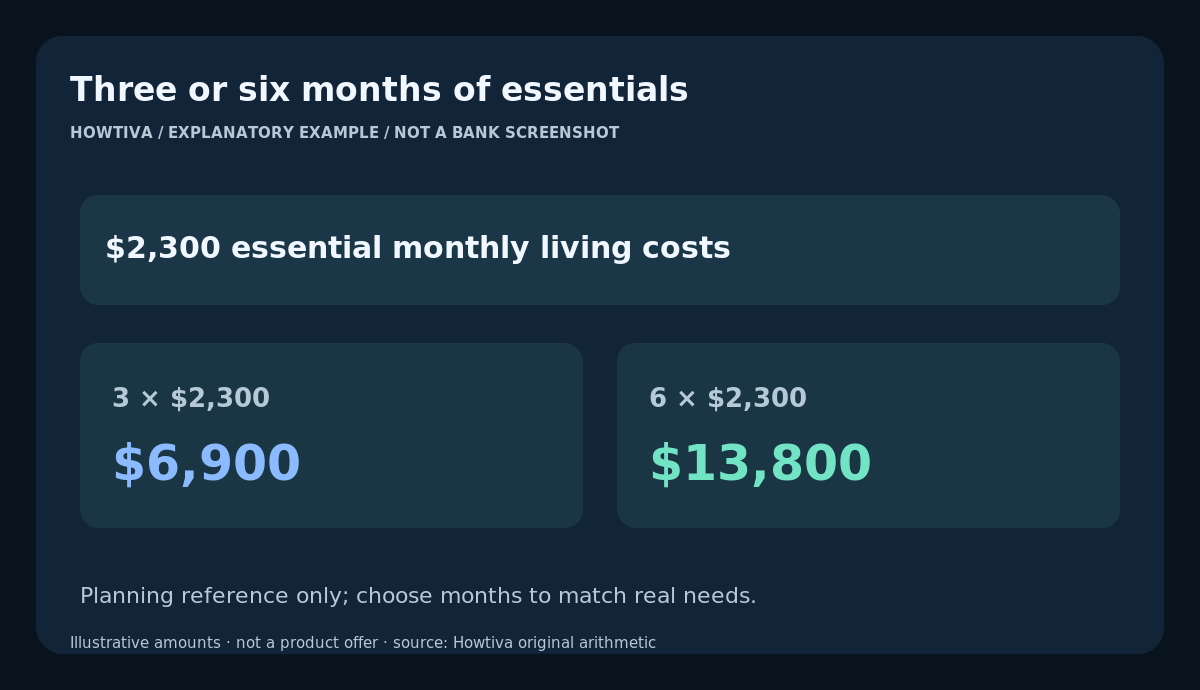
Figure: Illustrative monthly essential cost $2,300 implies a $6,900 three-month target or $13,800 six-month target.
Step 2 — Decide on a first milestone and final target
A large target can be intimidating, so set an attainable first milestone such as the amount of a realistic deductible or urgent repair in your own circumstances. This is your individualized planning input—not a universally sourced “starter fund amount.” Then plan to build toward one month of essentials, followed by additional months as circumstances allow. If your earnings are unpredictable, set a separate income-smoothing buffer rather than masking predictable slow seasons as emergencies.
Write down what you consider an emergency: job loss, urgent safety-related repair or medically necessary expense may qualify; a predictable annual insurance bill, planned holiday or optional sale purchase generally does not. Keep this brief rule visible when you review the balance.
Step 3 — Choose a place that balances safety and access
Look for a dedicated account where you can retrieve money when genuinely needed. Compare eligibility, fees, withdrawal timing, any access restrictions and applicable local deposit-protection arrangements with official sources before choosing a provider. Bank and credit-union protection schemes differ across countries; no single insurance limit or term is universal. Do not choose a volatile investment, long lockup or speculative token as the only emergency reserve, since a market drop or delay could coincide with an emergency.
A separate savings account or clearly labeled savings pot can reduce accidental use. Cash may help in a power outage or other immediate event, but large cash storage carries loss/theft risks. In Australia, ASIC Moneysmart mentions certain offset accounts as a possible option for homeowners; whether one meets your access needs depends on the actual loan contract. Do not assume an interest rate or bonus will continue unchanged.
Step 4 — Set a contribution that will not break bill payments
Subtract current saved emergency funds from the target to find the gap. Then divide by an affordable contribution amount or by the number of available paydays. Months to goal = ceiling((target − current emergency savings) ÷ monthly contribution), assuming steady contributions, no withdrawals and zero investment or interest growth in this illustration.
With the hypothetical $6,900 target above, an opening fund of $900 leaves $6,000. At $250 per month, the target takes 24 further monthly deposits ($6,000 ÷ $250 = 24). At $350 per month, it takes 18 deposits (17 deposits total $5,950, insufficient; 18 total $6,300). Check affordability rather than chasing the faster date. Actual interest, account charges, price changes and emergencies would alter the timeline.
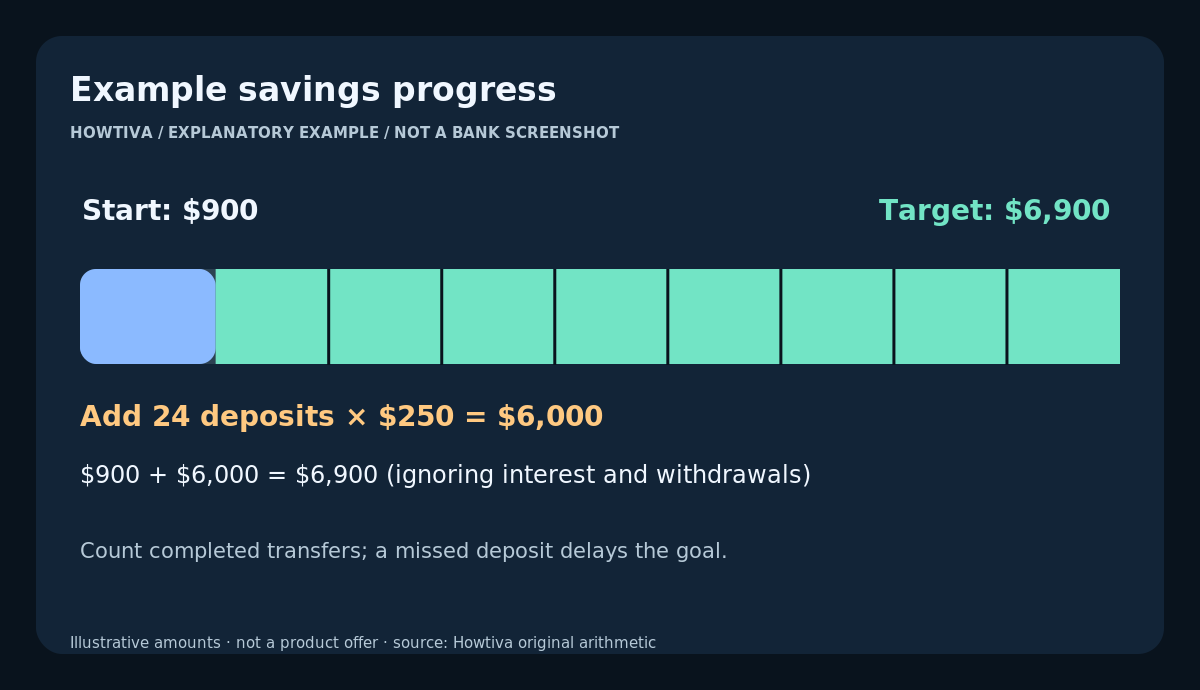
Figure: Starting savings $900 plus 24 monthly deposits of $250 equals a $6,900 emergency savings target, ignoring interest and withdrawals.
Step 5 — Automate carefully and verify the balance
Consider a recurring transfer soon after a reliable payday, or split direct deposit into spending and savings accounts if your employer/provider offers that feature. Confirm the account still has enough to cover bills and pending debits; the CFPB specifically warns that automated transfers can create overdraft problems if the source balance is insufficient. Start small if you have variable income, then add extra sums only in strong months after setting aside money for current obligations and taxes where applicable.
Update a simple balance tracker monthly: beginning emergency balance + actual deposits + credited interest − withdrawals − fees = ending balance. A promised rate of return is unnecessary to plan saving; if you include possible interest in an advanced forecast, treat it as an assumption, not a guaranteed outcome.
Step 6 — Decide when to withdraw, then replenish
When a surprise occurs, ask: Is it necessary? Was it unforeseen? Is payment time-sensitive? Is there a safer or lower-cost way to handle it? Use the reserve for a genuine emergency rather than paying high-cost credit just to protect a savings milestone. Save receipts, pay the bill from the appropriate account and record how much you withdrew. When the crisis passes, restore your regular contribution and update the target if your baseline living costs changed.
If you need the money immediately but your savings transfer takes time, check your provider’s actual transfer and withdrawal terms beforehand. Do not assume instant transfers, unlimited withdrawals or penalty-free access for every savings product.
Common mistakes and troubleshooting
- I count annual vehicle insurance as an emergency. Its approximate due date is known. Create a sinking fund using the real months remaining.
- I can’t save three months of expenses today. Start with a small affordable amount and set a first milestone. Do not skip necessities to meet a generic number.
- My savings rate causes my current account to overdraft. Reduce/pause automatic transfers, check payroll and due dates and assess fees with the bank.
- All my reserves are in investments. Consider accessibility and the possibility of selling at a loss when markets are down; avoid assuming invested principal will be available intact.
- The target stays fixed for years. Recalculate when housing, essential healthcare, dependents or fixed debt commitments change.
- I used some money and feel the plan failed. A legitimate emergency is exactly why the reserve exists. Document the expense and restart contributions when feasible.
- I have expensive overdue debt. Immediate arrears, penalties and hardship options can take priority; ask a qualified local debt adviser for help rather than applying a universal savings-versus-debt rule.
Alternative methods and special cases
Save a small amount each payday instead of monthly; use windfalls without assuming they recur. For irregular incomes, keep an income buffer for foreseeable lean months in addition to an emergency fund for genuine shocks. For a multi-adult household, agree whose emergencies qualify, who may withdraw and how to communicate use; respect privacy and financial autonomy. If finances are shared across countries, keep the emergency reserve in a currency you can actually use for essential bills, and consider payment delays and currency-conversion costs.
Country notes and verification
In the United States, CFPB offers general emergency-fund guidance and recommends an accessible dedicated reserve without naming a compulsory balance. In Canada, FCAC discusses an ideal of approximately three to six months and distinguishes predictable occasional bills from emergencies. In the UK, MoneyHelper describes three to six months of essential outgoings as a rule of thumb and addresses urgent debt situations. In Australia, Moneysmart recommends considering around three months as a starting target and explains separate savings accounts. Account guarantees, bank fees and tax treatment vary and must be checked locally. Official materials reviewed 27 October 2026; no current interest rate, bank protection threshold or financial return is asserted here.
Frequently asked questions
Is three months always enough?
No. It is a planning benchmark, not a guarantee. Consider how long your household could go without income and what costs may arise suddenly.
Should I save while repaying debt?
Balance essential bills, debt deadlines, interest/fees and the value of a basic buffer. Rules differ by debt and hardship situation; for costly overdue debt, seek accredited assistance.
Can I keep emergency money in a retirement account?
Access rules, potential tax and penalties depend on the account and country. Do not assume you can withdraw it promptly or without loss.
Can insurance replace emergency savings?
Insurance can protect against certain risks, but deductibles, exclusions, delays and uncovered expenses can still require readily available funds.
What if my target rises because prices rise?
Recalculate using current essential costs and adjust contributions without promising that savings interest will keep pace with inflation.
Final checklist
- Identify genuinely unavoidable monthly living costs.
- Calculate a personal target and first achievable milestone.
- Keep planned annual bills in separate sinking funds.
- Choose safe, accessible savings and check local account terms.
- Set a sustainable contribution with adequate bill-day cash.
- Monitor balance and reassess the goal periodically.
- Write down what qualifies as an emergency and replenish after use.
Sources & Further Reading
- CFPB — An essential guide to building an emergency fund
- FCAC — Setting up an emergency fund
- MoneyHelper — Emergency savings: how much is enough?
- ASIC Moneysmart — Save for an emergency fund
Editorial note: Official guidance checked 27 October 2026. All dollar targets and dates are explicitly illustrative; no account opening, withdrawal or interest return was tested.
Use the checklists as you go, and confirm the result before moving on to a more involved repair.