How to Calculate Percentage Increases and Decreases
Calculate percentage increases, decreases and repeated changes correctly, including reverse percentages and percentage points.
Quick answer: Calculate a percentage change as (new value − original value) ÷ original value × 100, where the original value is not zero. A positive result means an increase and a negative result means a decrease. Use the original value as the denominator, not whichever number is larger.
What you will achieve: You will measure changes in prices, wages, account balances and bills in a reproducible way; you will also avoid the trap of assuming equal percentage rises and falls cancel one another.
Before you begin
Collect two amounts representing the same unit, time scale and population. For example, compare one monthly price with another monthly price or two annual salaries measured on the same basis. If your baseline is zero, a conventional percentage change is undefined and an alternative description is needed.
The denominator is always the original value for a conventional percentage change. For successive changes, multiply the factors rather than adding the percentages.
Step-by-step instructions
Step 1: Write original and new values in chronological order
Label them before calculating. Original is the earlier reference amount, not automatically the lower number. That matters because a move from $80 to $100 is not the same percentage as the reverse move.
Step 2: Calculate the absolute difference
Subtract old from new and keep its sign. A bill rising from $80 to $100 increases by $20; a later drop from $100 to $80 changes by −$20. This is an amount in dollars, not yet a percentage.
Step 3: Divide by the original value
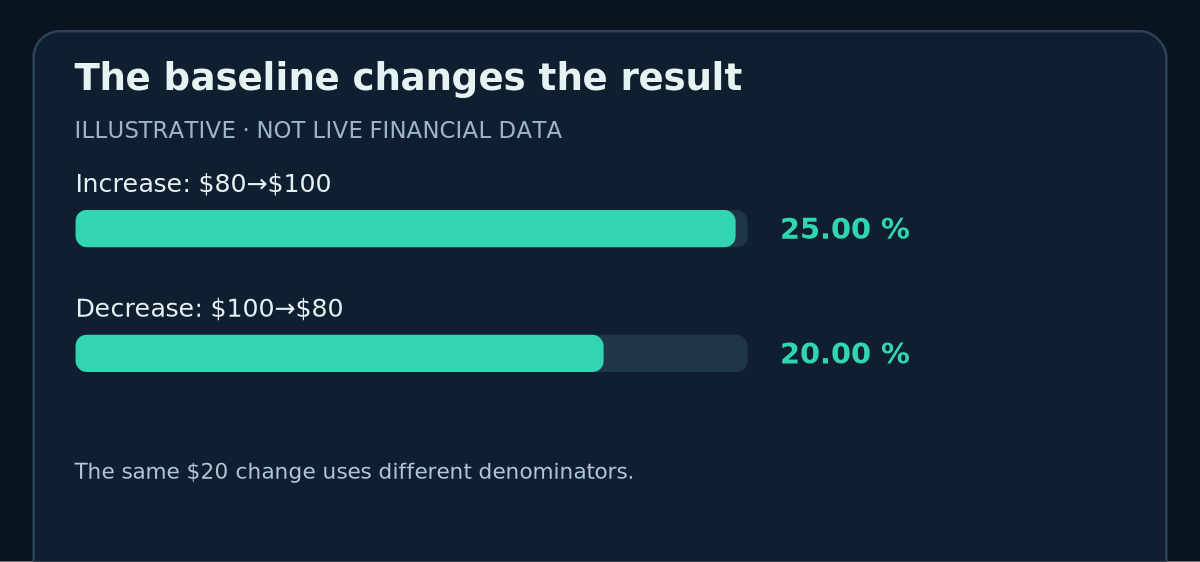
For the rise: $20 ÷ $80 = 0.25. For the fall: −$20 ÷ $100 = −0.20. The denominators differ because the starting point differs. Avoid dividing by the new value out of convenience.
Step 4: Multiply by 100 and label
0.25 ×100 = a 25% increase; −0.20 ×100 = a 20% decrease. State the starting amount and period beside the result; a percentage without its base can be misleading.
Step 5: Reconstruct the amount as a check
After a 25% rise, $80 × (1+0.25) = $100. After a 20% fall, $100 × (1−0.20) = $80. The reverse calculations confirm the denominator and sign.
Step 6: Handle repeated changes multiplicatively
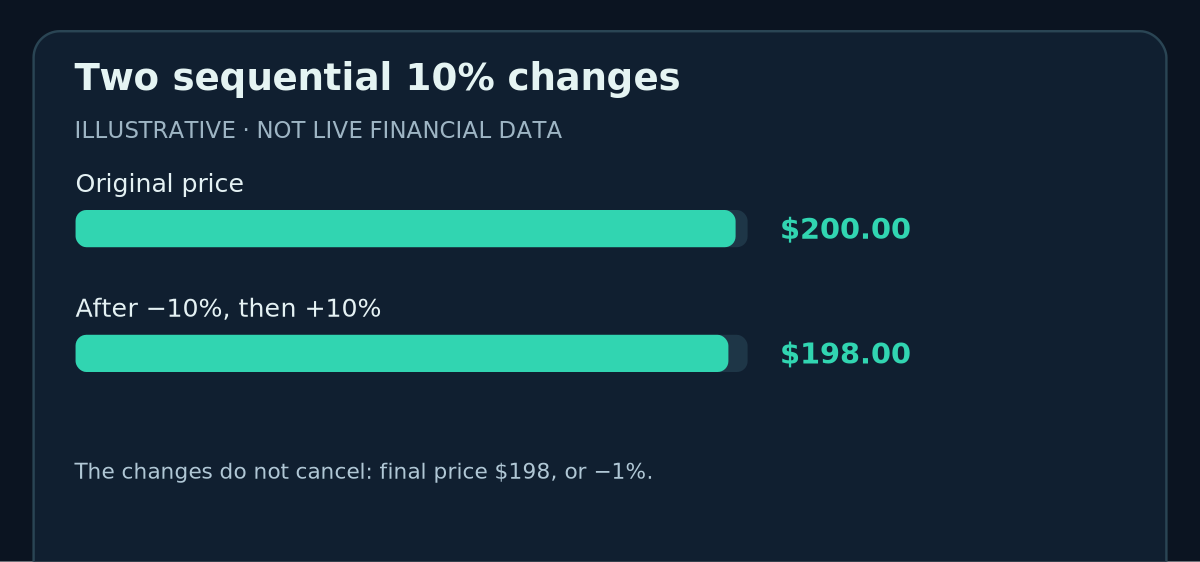
For successive changes, multiply factors rather than summing the rates. A 10% discount followed by a 10% rise gives an overall factor 0.90×1.10 = 0.99, a 1% net reduction versus the original price.
Step 7: Distinguish percent from percentage points
If a savings rate rises from 12% to 15%, that is a rise of 3 percentage points, which is a 25% relative increase in the savings rate itself. These are different statements; decide which you mean.
Step 8: Document exceptions
When the original is zero, write that the percentage change is undefined; report the absolute change instead. For a negative baseline, conventional business growth percentages can be ambiguous and may need a separate signed definition.
Formula and assumptions
Percentage change = ((new − old)/old) × 100%, old ≠ 0. New after increase = old × (1 + percent/100). New after decrease = old × (1 − percent/100).
Fully worked example
All dollar values are illustrative. A monthly charge goes from $80 to $100: (100−80)/80×100 = 25% increase. Dropping from $100 to $80 gives (80−100)/100×100 = −20%, a 20% decrease. Reversing a 25% increase requires a 20% decrease from the new base.
Second scenario and interpretation
A fictional $200 price discounted by 10% becomes $180. A subsequent 10% markup applies to $180, adding $18 and producing $198. The final $198 price is 1% below the original $200. The factors, not arithmetic addition of −10% and +10%, explain the answer.
Common mistakes and troubleshooting
Dividing by the new amount
For change relative to the original, the old amount belongs in the denominator.
Ignoring zero original values
A move from zero to twenty is a 20-unit increase, but ordinary percent change is undefined.
Adding consecutive percent changes
Changes compound against updated bases; multiply factors.
Confusing percentage points with relative percent
Going from 4% to 6% means 2 points or a 50% relative increase.
Alternatives and special cases
Percentage difference
When two values have no natural time or original reference, a symmetric percentage difference formula may be more suitable; label it explicitly.
Index data
With CPI use new and old index readings from the same series and interval.
A negative original amount
Specify a domain-appropriate convention and discuss the sign; an ordinary “growth” interpretation may fail.
Differences by country
United States
Use nominal dollars for ordinary price-change calculations; inflation-adjusted comparisons require a separate price index.
United Kingdom
The arithmetic is universal, but VAT-inclusive and VAT-exclusive prices must not be mixed.
Canada
Compare tax treatment and currency consistently when computing price changes.
Australia
For retail price comparisons, specify whether a quoted total includes GST before interpreting the percentage.
This how to calculate percentage increases and decreases procedure is general education. Confirm current official rules and product or employment details where relevant.
Frequently asked questions
Why does +20% followed by −20% lose money?
1.20×0.80 = 0.96, leaving 4% below the starting amount.
Can a percent change exceed 100%?
Yes. An increase from 50 to 150 is 200%.
What happens if the original is zero?
The standard denominator is zero, so the rate is undefined; report an absolute change.
How do I report change between percentages?
Use “percentage points” for a subtraction of two rate levels and “percent relative increase” for a ratio-based comparison.
Final checklist
-
[ ] Identify original and new clearly
-
[ ] Compare same units
-
[ ] Subtract old from new
-
[ ] Divide by nonzero original
-
[ ] Multiply by 100
-
[ ] Validate with reverse operation
-
[ ] Use compounded factors for repeated changes
Sources & Further Reading
-
US Bureau of Labor Statistics: Consumer Price Index: concepts — CPI interpretation and inflation limitations. Checked 27 October 2026.
-
US Bureau of Labor Statistics: Purchasing power and constant dollars — Price-index ratio and equivalent historical dollar values. Checked 27 October 2026.
Use the checklists as you go, and confirm the result before moving on to a more involved repair.