How to Calculate the Break-Even Point for a Purchase
Calculate purchase break-even months or uses, include net operating savings and test sensitivity to lifetime and maintenance.
Quick answer: For an optional purchase that saves money per use or month, calculate break-even use count = extra upfront cost ÷ net savings per use, provided net savings are positive. For a buy-versus-rent comparison, account for purchase, operating expenses, maintenance, resale value and the rental or alternative cost on the same time horizon.
What you will achieve: You will know how many actual uses or months it could take for the more expensive option to catch up financially. Break-even is not a recommendation by itself: liquidity, uncertainty, repairs, time value of money and nonfinancial value can change the decision.
Before you begin
Get two comparable options that solve the same problem; their up-front prices, expected number of uses, per-use costs, maintenance, consumables, financing, disposal, warranties and plausible resale values. Keep taxes and delivery charges either in both options or in neither. Do not assume a cash saving exists if it depends on hypothetical behavior.
A break-even estimate requires incremental upfront cost and realistic net saving per period. Repair costs, financing fees, lifespan and uncertain use can postpone or eliminate payback.
Step-by-step instructions
Step 1: Define the alternative you would otherwise choose
A premium appliance versus a basic one, a reusable filter versus disposable cartridges, or buying a tool versus renting it are different types of comparison. Clearly state the least costly feasible baseline; otherwise the savings are imaginary.
Step 2: Calculate incremental upfront spending
Subtract the cheaper option’s upfront cost from the dearer option’s upfront cost. If the premium option costs $600 and the basic option $240, incremental upfront spending is $360. Do not compare the total $600 with savings attributable only to the difference.
Step 3: Estimate net saving in the same units
Suppose the premium option costs $12 less to run every month compared with the feasible alternative. Verify this figure using expected usage, energy or replacement part consumption and current quotes. If costs are variable, create a low, middle and high case instead of one confident-looking number.
Step 4: Divide the incremental price by net recurring savings
For $360 extra cost and $12 saved each month, 360/12 = 30 months. If you need whole months or whole uses, round the break-even count UP, not down: a fraction of a use is not sufficient to pay back the extra cost.
Step 5: Allow for maintenance and replacement
A machine that requires a $90 service every year will have lower net savings than one with no maintenance. Estimate servicing when it is likely to happen, rather than spreading a lumpy cost invisibly across an unrealistic lifespan.
Step 6: Check the expected useful life
If the premium option is likely to be replaced after 24 months, a 30-month simple payback does not occur under the original assumptions. If uncertain, use a conservative shorter lifespan in your stress case.
Step 7: Review financing and resale
A financed purchase may have borrowing costs or a lost opportunity to use the cash elsewhere. Resale value is an estimate and only offsets the cost if a buyer actually pays it. If discounting future cash flows, call the answer a discounted break-even estimate, not the simple payback.
Step 8: Document a decision threshold
Write the projected break-even date, minimum monthly use or savings requirement, and the evidence that could invalidate the estimate. If net savings are zero or negative, no finite break-even point occurs from those savings alone.
Formula and assumptions
Basic payback months = incremental upfront cost ÷ net monthly savings (only when saving > 0). Net ownership cost = purchase + operating + maintenance + financing + disposal − realized resale proceeds. For nonuniform cash flows, break even when cumulative incremental cash-flow savings first equal the incremental cost.
Fully worked example
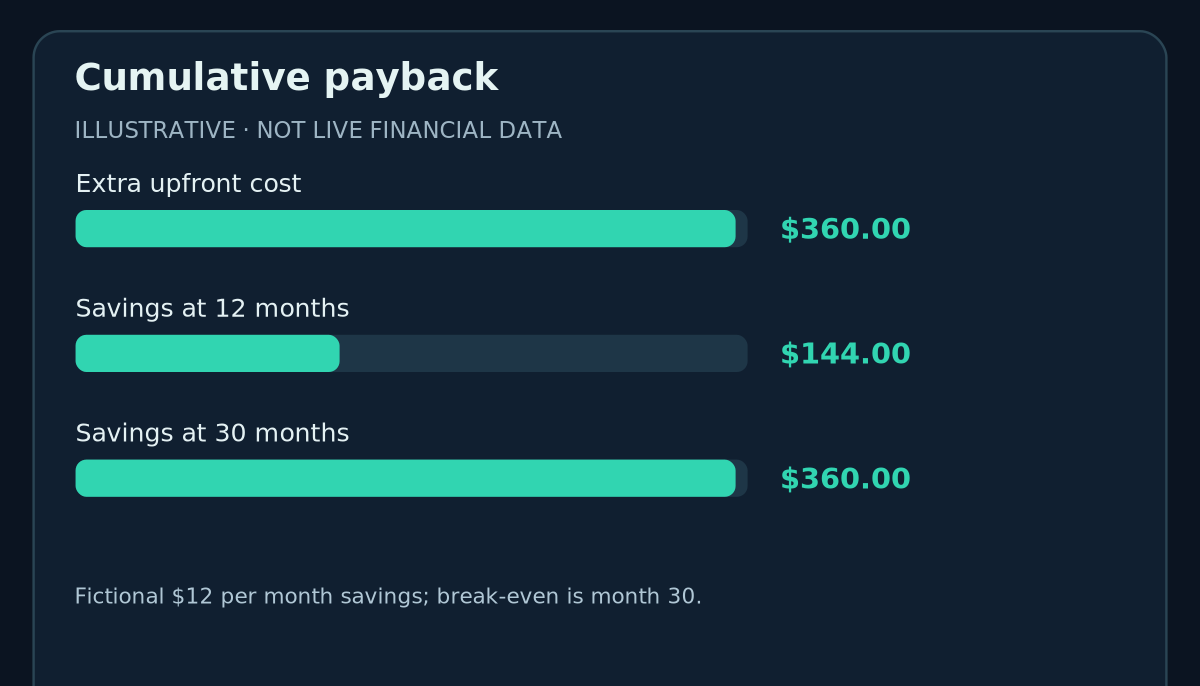
Illustrative appliance A costs $600; appliance B costs $240. Assume A saves exactly $12 of operating expense per month against B and that both last at least 30 months, without maintenance or borrowing costs. Incremental price = $360. Simple break-even = 30 months. By month 12, $144 savings leaves $216 unrecovered; at month 30 cumulative savings equal the incremental $360.
Second scenario and interpretation
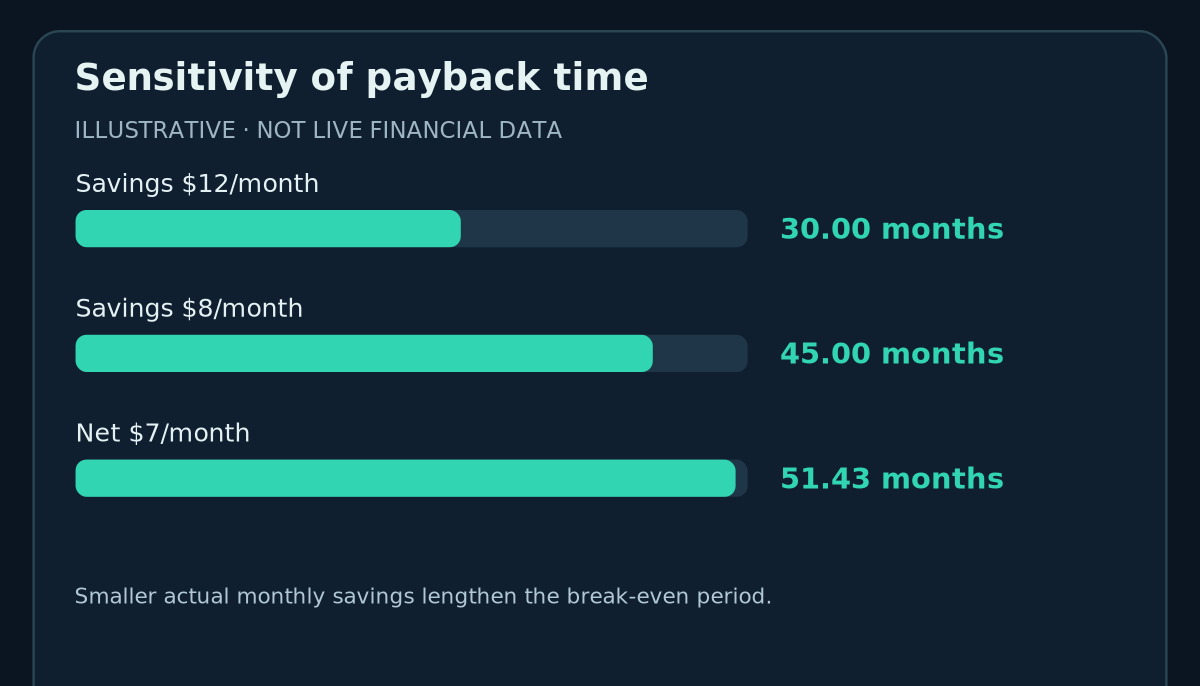
If the actual monthly saving is only $8, simple payback extends to 45 months. If annual maintenance for the expensive option costs $60 and is spread for a rough scenario as $5 per month, the modeled net monthly saving becomes $7 and the simple estimate is about 51.43 months, or 52 complete months. The true schedule can differ because maintenance is often paid at discrete dates.
Common mistakes and troubleshooting
Using gross instead of net savings
A device that saves $15 electricity but costs $5 more in consumables nets $10, not $15.
Ignoring equipment lifetime
A payback period beyond useful life may make the plan uneconomic.
Assuming savings from a purchase you would not otherwise make
Compare against a real feasible alternative, not an imagined expense.
Treating payback as a complete investment analysis
Opportunity cost, risk, nonfinancial benefits and timing also matter.
Alternatives and special cases
Buy versus rent
Compare cumulative rental fees against all ownership costs and plausible resale value at matching use counts.
Time value of money
For longer horizons, discount dated incremental cash flows rather than using simple division.
Uncertain energy or usage savings
Run best/base/worst cases and require a margin of safety before relying on the result.
Differences by country
United States
Price and warranty terms vary by product and state; nothing in the payback formula grants a right to a refund or advertised energy saving.
United Kingdom
Compare VAT-inclusive amounts where paid by a consumer; verify actual energy tariffs before modeling monthly savings.
Canada
Use Canadian-dollar and applicable-tax inclusive amounts for a personal purchase; check seasonal energy use.
Australia
Compare GST treatment and recurring costs consistently; do not assume advertised usage estimates will match your household.
This how to calculate the break-even point for a purchase procedure is general education. Confirm current official rules and product or employment details where relevant.
Frequently asked questions
What if recurring savings are negative?
There is no saving-driven finite break-even; the dearer option keeps increasing the cost gap.
Should I include the value of my time?
Only if you can state a defensible time valuation and actually gain the promised time.
Does resale always help?
No. It is uncertain and may be zero; use a conservative scenario.
Must every purchase break even?
No. Convenience, quality and safety may justify spending even when the financial payback never occurs.
Final checklist
-
[ ] Name a real cheaper alternative
-
[ ] Calculate incremental upfront cost
-
[ ] Estimate net savings per month or use
-
[ ] Divide and round the threshold appropriately
-
[ ] Check repair and replacement horizons
-
[ ] Stress test savings and useful life
-
[ ] Record uncertainties before buying
Sources & Further Reading
-
US Securities and Exchange Commission / Investor.gov: Figure Out Your Finances — Net worth = assets less liabilities, tracked over time. Checked 27 October 2026.
-
Australian Securities and Investments Commission / Moneysmart: Net worth calculator — Asset and debt snapshot; estimates not predictions. Checked 27 October 2026.
Use the checklists as you go, and confirm the result before moving on to a more involved repair.