How to Calculate the Purchasing Power of Money
Convert historical money into current purchasing power with CPI ratios and see why a 20% price rise differs from a 20% cash-value decline.
Quick answer: To calculate the purchasing power of money across two dates, multiply the original amount by the newer price index divided by the older price index. This finds the newer amount needed to buy approximately the same basket. To restate a current amount in earlier dollars, reverse that ratio. Always identify the location, index, and dates.
What you will achieve: You will be able to compare the buying power of an amount at two points in time without confusing the fall in purchasing power with the percentage rise in prices. This is a purchasing-power estimate for an index basket, not a promise that a particular household will face identical price changes.
Before you begin
Collect a monetary amount, a comparison year or month, and two observations from the same official price-index series for the same geography and basket. Record whether observations are annual averages or individual months and whether they are seasonally adjusted. Work in a single currency; exchange-rate movements are a separate issue.
Match the country, time span and index series before using CPI to compare purchasing power. A national average index may differ substantially from a household’s actual consumption basket.
Step-by-step instructions
Step 1: Define the question before choosing a formula
Decide whether you want the current equivalent of money you held in the past, or the historical buying power of today’s amount. The directions of these two calculations are opposite. Label both amounts with dates instead of calling either “today’s value” without a date.
Step 2: Select a suitable price index
For a broad United States comparison, a consistent CPI-U series may be suitable; other countries publish their own indexes. A consumer basket index does not directly measure the price of one house, a particular medical bill or an investment. Use a narrower index only if its intended basket actually fits your question.
Step 3: Read exact index observations
Write the older index beside its period and the newer index beside its period. They must be comparable within the same base series. An index value of 150 is not a $150 basket price, and the base year being 100 does not mean the price of every item was $100.
Step 4: Calculate the inflation multiplier
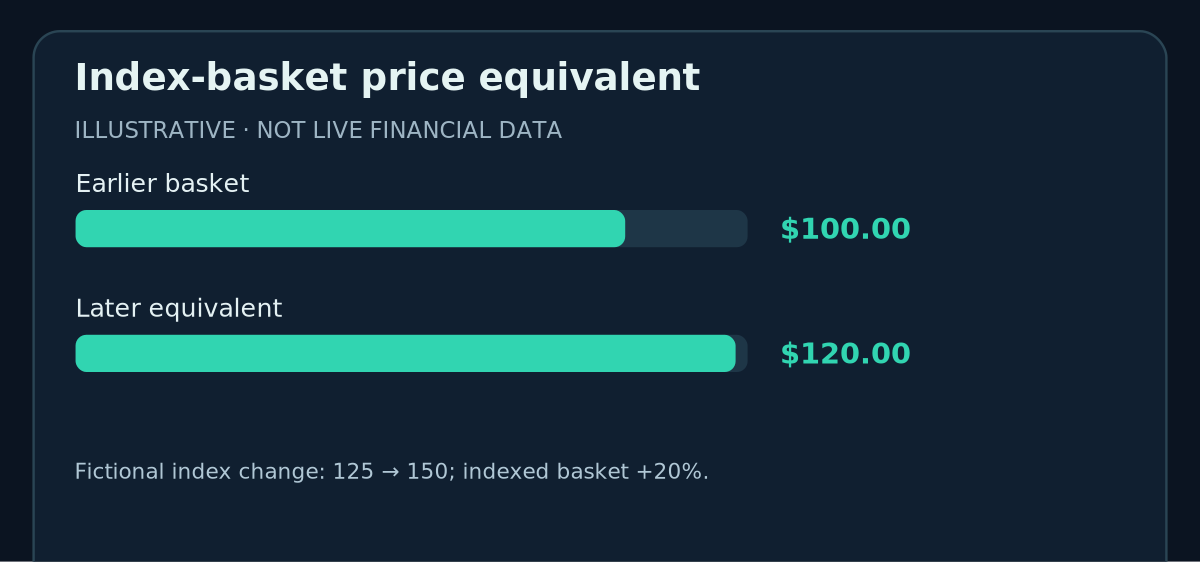
Divide newer index by older index. If the index rises from 125 to 150, the ratio is 1.20. It means the indexed basket is 20% more expensive over that span; do not substitute a single annual inflation headline for a multi-year ratio.
Step 5: Convert the monetary amount
For an earlier amount, multiply by the inflation multiplier to estimate an equivalent amount in the later period. For the purchasing power of a later amount in earlier dollars, multiply by the reciprocal. Note the chosen base-date units beside your answer.
Step 6: Distinguish price increase from purchasing-power decrease
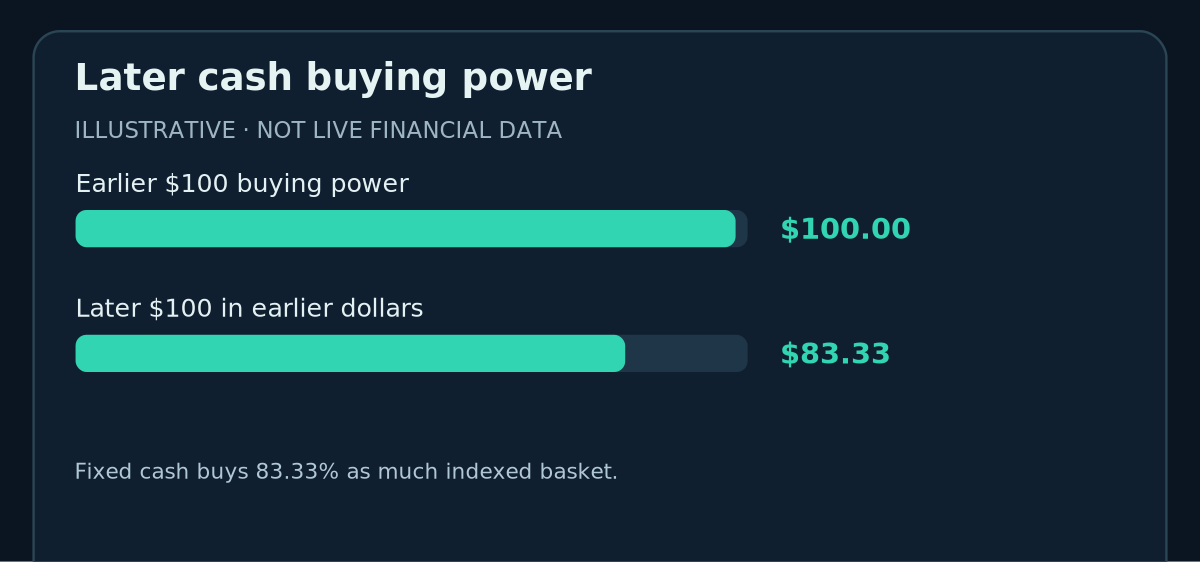
If prices rise 20%, the same fixed nominal cash buys 1/1.20 of the old basket, or about 83.33%; the loss in basket purchasing power is about 16.67%, not 20%. These denominators are different and should not be interchanged.
Step 7: Sanity-check and interpret
When an index has increased, the future equivalent of a fixed past amount must be larger; the older-dollar purchasing power of fixed current money must be smaller. Review rounding only at the end. Compare actual spending categories separately if your household consumption diverges from the official basket.
Formula and assumptions
Later-date equivalent = earlier amount × (later CPI ÷ earlier CPI). Earlier-date buying power = later amount × (earlier CPI ÷ later CPI). Percentage decline in cash buying power = [1 − (earlier CPI ÷ later CPI)] × 100.
Fully worked example
Illustrative figures, NOT official observed CPI: older index 125.0, newer index 150.0. A basket that cost $100.00 in the older period would cost $120.00 in the later period: $100 × 150/125. Conversely $100 held in the later period buys the older-period equivalent of $83.33: $100 × 125/150. The reduction in index-basket purchasing power is 16.67%, not 20%.
Second scenario and interpretation
An illustrative $2,500 earlier-month budget would need $3,000 in the later month for approximately equivalent basket coverage. If the relevant household spends unusually heavily on rent or energy, that household’s actual experience can differ from the national index. An illustrative CPI ratio is not an actual forecast or individual cost-of-living guarantee.
Common mistakes and troubleshooting
Using index points as percentages
An index change from 125 to 150 is 25 index points but 20% relative to the older index.
Reversing the ratio
Multiplying past money by old/new makes it shrink under inflation, producing the wrong direction for the later equivalent.
Mixing national and city indexes
Keep geography, underlying series and price-basket definition consistent.
Treating the result as a purchasing recommendation
The calculation describes indexed value, not which goods or investments you should buy.
Alternatives and special cases
Official calculator
For US historical periods, use the BLS inflation calculator and record its index method and measurement scope.
Household-specific comparison
Make a separate spreadsheet using actual recurring quantities and actual price quotes where basket-specific accuracy matters.
Cross-border purchases
Calculate each local currency’s inflation separately and then, if needed, analyze exchange rates as a distinct calculation.
Differences by country
United States
BLS CPI-U and its calculator cover US urban consumer expenditure patterns; the national CPI is not every household’s inflation rate.
United Kingdom
Use a consistent ONS CPI or CPIH series and identify which one you selected; they measure different scopes.
Canada
Statistics Canada CPI series are local to Canada, not interchangeable with US index values.
Australia
Use the Australian Bureau of Statistics CPI appropriate to your population/period; do not carry US dollar examples into Australian inflation data.
This how to calculate the purchasing power of money procedure is general education. Confirm current official rules and product or employment details where relevant.
Frequently asked questions
Does a 20% price increase mean cash loses 20% purchasing power?
No. A fixed cash balance buys 1/1.20 = 83.33% of its previous indexed basket, a 16.67% reduction.
Can I use an annual-average CPI with a monthly CPI?
Do not mix those for a clean point-to-point comparison; choose both monthly or both annual-average observations.
What if prices fall?
The ratio will be below one; later equivalent amounts may be smaller. Check that you did not reverse the periods.
Is this the same as investment returns?
No. CPI adjusts purchasing power; returns, taxes, risk and cash flows are separate.
Final checklist
-
[ ] Confirm past and present periods
-
[ ] Choose one matched price-index series
-
[ ] Record two accurate observations
-
[ ] Divide later index by earlier index
-
[ ] Apply ratio in the correct direction
-
[ ] Label money amounts with price-date units
-
[ ] Double-check the 20% versus 16.67% distinction
Sources & Further Reading
-
US Bureau of Labor Statistics: Purchasing power and constant dollars — Price-index ratio and equivalent historical dollar values. Checked 27 October 2026.
-
US Bureau of Labor Statistics: CPI Inflation Calculator — United States CPI-U inflation calculator methodology. Checked 27 October 2026.
-
US Bureau of Labor Statistics: Consumer Price Index: concepts — CPI interpretation and inflation limitations. Checked 27 October 2026.
Use the checklists as you go, and confirm the result before moving on to a more involved repair.