How to Choose Between Checking and Savings Accounts
Choose checking versus savings accounts based on bill payments, transaction fees, access needs and account protection with real calculation methods.
Quick answer: Use a checking account (called a current account in the UK or chequing/transaction account in other markets) for receiving income, card spending, bills and frequent payments. Use a savings account to separate money for future needs and, when available, earn deposit interest. Many people need both. Compare the total fees, withdrawal convenience, eligibility, actual interest earned and deposit protection rather than assuming one product is always superior.
Your result: A two-account money-flow plan: where incoming funds go, how much stays available for upcoming payments and how often to move the remainder to savings. The figures here are fictional budgeting assumptions, not representative bank fees, typical interest rates or current product recommendations.
The central difference
A checking/current/transaction account normally supports high-frequency payments—debit cards, direct deposit, bill pay, cash withdrawals and recurring debits. Savings accounts focus on holding money set aside, with differing interest, transfer, ATM and withdrawal arrangements. Some checking products pay interest and some savings accounts allow frequent transfers; the names alone do not determine every feature. Your bank’s actual terms do. A savings account is not automatically a safe substitute for an everyday payment account if bills could be missed or transfers delayed.
The best fit depends on the job the money must perform. Short-term rent or utility money must be available on the right day; an emergency fund must be accessible when needed; a future-expense fund might tolerate fewer withdrawals but still needs enough liquidity. Compare convenience with interest and charges, not just the highest yield.
Prepare a practical account inventory
Collect a typical monthly income figure and timing, the next four weeks of payment dates, usual card and ATM use, statement and ATM fees, account minimums, transaction allowances, online and branch access requirements, and savings goals. Ask each provider for its official account disclosure. Identify whether the provider is a deposit-taking bank/credit union or another kind of financial app; don’t assume all apps are directly covered by bank deposit insurance. List accessibility needs: cash deposits, a local branch, support for joint accounts, a debit card, accessible online banking and language assistance.
Do not enter your bank username/password into an untrusted comparison service. Confirm the actual account type and legal bank. Obtain terms through the bank’s verified site, branch or official contact number.
Step-by-step account decision
1. Map what you actually do with money
Make two columns: daily payments and money deliberately reserved. Daily payments include wages, rent, electricity, transport, groceries, subscriptions and bill debits. Reserved money includes emergencies, annual insurance, planned repairs and a medium-term purchase. If the majority of your transactions are everyday payments, a transaction account is the foundation. If money will remain untouched most weeks, a separate savings account may reduce accidental spending and may earn interest.
2. Work out the next month’s operating balance
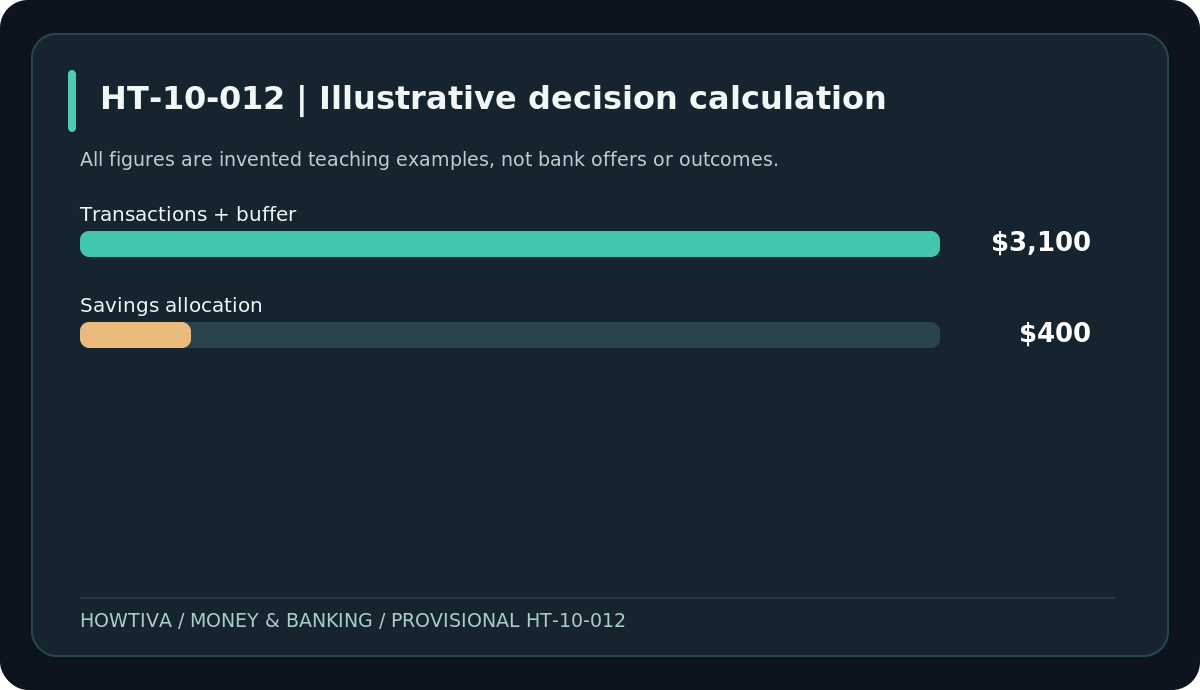
Assume take-home income of $3,500, next month’s scheduled essential bills of $2,200, expected groceries and transport of $700, a deliberately chosen short-term cash buffer of $200, and a proposed savings amount of $400. The arithmetic is $2,200 + $700 + $200 + $400 = $3,500. Keep $3,100 in the transaction account for these particular spending/buffer assumptions and transfer $400 into savings only once timing and available funds allow. If a large bill arrives before payday, revise the timing: a monthly total that balances on paper can still cause a negative balance midmonth.
3. Compare predictable transaction fees, not just account labels
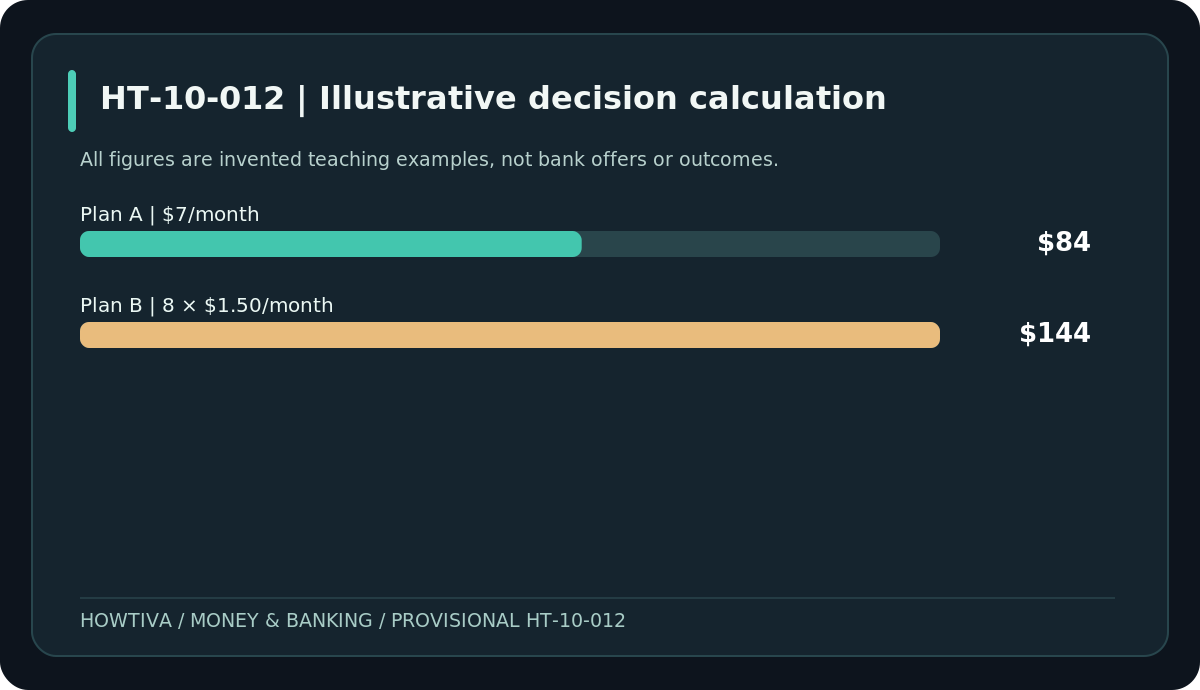
Imagine fictional Transaction Plan A has a $7 monthly fee and no relevant additional charges for this customer’s routine transactions. Its annual routine cost is $84. Fictional Plan B has a $0 monthly charge but charges $1.50 for each of eight chargeable transactions each month, or $144 per year. Given these invented usage assumptions, Plan A is $60 cheaper annually, even though Plan B advertises no monthly fee. If you instead make only two chargeable transactions a month, Plan B costs $36 and may be cheaper than Plan A. Never mistake this thought experiment for real bank pricing or assume every debit purchase attracts a charge.
4. Compare savings interest against access and fees
If a fictional savings product offers a steady 3.00% annual effective yield, holding $4,000 unchanged for a full year produces $120 gross interest before fees and tax. That may justify a separate account, but only if you are allowed to deposit that balance and retain the advertised yield. If the savings product charges more than the extra interest you could earn, or requires a costly linked account, include the costs. A savings rate may change or be conditional on monthly deposits and no withdrawals. For an emergency fund, penalised or blocked withdrawals are an important disadvantage even if a locked product advertises a higher rate.
5. Understand transaction restrictions correctly
In the US, the Federal Reserve removed the federal Regulation D limit of six convenient savings transfers per month from the regulatory definition in April 2020; the change did not obligate every bank to allow unlimited transfers at no cost. A bank’s own contractual withdrawal limits and charges can still exist. In Canada and Australia, product-level transaction fees or restrictions vary. In the UK, ‘easy-access’ and fixed-term savings products are different; some pay bonus rates only when withdrawal conditions are met. Never claim all savings accounts allow six transactions—or unlimited free transactions—without consulting actual terms.
6. Check protection, eligibility and services
For US deposits, an FDIC-insured bank’s checking and savings accounts are typically included in eligible insured deposit categories, with the standard $250,000 per depositor, per bank, per ownership category limit and aggregation across same-category accounts at the same bank. UK ordinary eligible deposits are generally protected through FSCS up to £120,000 per eligible person per authorised firm, as effective from 1 December 2025. Australian eligible deposits may be protected through APRA’s Financial Claims Scheme up to A$250,000 per account holder per ADI. Canadian coverage differs by CDIC membership and eligible account category. Always verify the actual institution’s membership and aggregation rules; placing two accounts in the same bank does not necessarily double your coverage.
7. Open or reorganise accounts safely
Before changing your main transaction account, list each incoming salary, standing instruction, cheque, card-linked payment and preauthorised debit. Move deposits and payments in stages, retain cash for pending items and monitor both accounts during the transition. A bank may verify your identity and eligibility. Avoid closing the old account until refunds, cheques, salary and automatic payments have been accounted for. After a savings transfer, verify the transaction posted before treating the reserved amount as inaccessible to spending. Do not spend funds that are subject to a hold.
8. Establish an operating rhythm
Check the transaction account weekly for upcoming scheduled charges. Reconcile the statement monthly. Move to savings on a date that leaves enough available for all essential debits, or use a scheduled transfer after payday if your pay is stable. If income is irregular, determine cash needed until the next reliable payment before saving. Review account conditions whenever fees, employment arrangements or savings goals change.
When a single account is reasonable
A single low-fee transaction account can be sensible at the beginning if you have no stable surplus or would incur extra fees for a linked savings account. Segregate future-bill money in your budget or sub-balances if the provider supports them. On the other hand, several savings pots might improve organisation; do not open multiple accounts without checking whether the underlying legal deposit institution is the same for deposit coverage purposes. Some people may need branch access, cash deposits or a basic bank account more than maximum interest.
Troubleshooting common problems
My savings account declined a bill payment: check whether direct debits or external third-party payments are supported; use a transaction account for recurring bills. I saved money and my checking went negative: check available funds, payment settlement times and pending cheques; restore essential liquidity and lower automatic transfers. My advertised interest didn’t arrive: examine minimum or maximum balance conditions, promotional expiry, monthly deposit and withdrawal requirements, and interest-credit dates. An online account claims to be ‘fee free’ but charged me: inspect ATM, international and over-limit fees separately. The new account won’t allow a transfer yet: onboarding, ownership verification, fraud checks or deposit holds may apply; ask the provider directly.
Alternatives and exceptions
A basic account may provide everyday payments without some overdraft features. A credit union account might have different eligibility and service arrangements. In Australia, some products are explicitly called transaction accounts. UK current accounts may allow an overdraft that is borrowing rather than an extension of your own funds. US money market deposit accounts are bank deposit products, not to be confused with money market mutual funds. High-interest checking accounts may require exact monthly activities and can underperform if you fail them. Tax-advantaged savings wrappers and fixed deposits must be compared under their own rules rather than treated like identical ordinary savings accounts.
Country notes — verified 27 October 2026
United States: use checking for daily transactions and compare savings APY/fees; do not repeat the obsolete federal six-withdrawal requirement as universal. United Kingdom: ‘current account’ is the everyday payment label; see MoneyHelper’s current and savings product descriptions and confirm FSCS protection for the authorised bank. Canada: FCAC distinguishes chequing and savings and notes that savings withdrawals/transfers can incur fees and rates may be tiered. Australia: Moneysmart explains that transaction accounts support everyday payments, whereas savings products often offer bonus interest with conditions and are frequently linked to transaction accounts.
Frequently asked questions
Should my salary go straight into savings? Generally direct it where regular payments can clear safely, then move available surplus into savings; product capabilities differ.
Can a checking account pay interest? Yes. Check rate qualifications and whether charges outweigh earnings.
Will both accounts at one bank double deposit insurance? Not automatically; ownership categories and aggregation rules control coverage.
Is cash in savings inaccessible? It depends on the account. Easy-access savings may be liquid; notice and fixed-term accounts can have restrictions.
What if I cannot afford to save this month? Prioritise essentials and avoiding harmful penalties. A small or temporarily zero transfer is better than borrowing to make an arbitrary savings target.
Final checklist
- I separated short-term payments from reserved goals.
- I modelled available money before bill dates, not just a month-end balance.
- I compared all relevant recurring and per-transaction charges.
- I checked the savings yield, transfer conditions and accessibility.
- I confirmed deposit insurance with the actual licensed provider.
- I made a safe transition plan for deposits and automatic payments.
Sources & Further Reading
- CFPB — Bank accounts and services.
- CFPB — Interest-bearing checking account considerations.
- Federal Reserve — Regulation D transfer rule change.
- FDIC — Deposit Insurance at a Glance.
- MoneyHelper — Current accounts.
- Bank of England — FSCS change to £120,000.
- FCAC — Chequing accounts.
- FCAC — Savings accounts.
- ASIC Moneysmart — Savings accounts.
Last researched: 27 October 2026. All financial examples are hypothetical, not financial product quotations.
Use the checklists as you go, and confirm the result before moving on to a more involved repair.