How to Compare Savings Accounts Using APY or AER
Compare savings accounts by APY or AER, account fees, bonuses, access restrictions and deposit protection with fully worked fictional examples.
Quick answer: Compare like-for-like annualised effective deposit rates—APY (annual percentage yield) in the United States and AER (annual equivalent rate) in the United Kingdom—then calculate the money you would actually receive after account fees, introductory periods, balance tiers and withdrawal conditions. A higher headline APY or AER does not automatically mean a better account for your particular deposit or access needs.
Your result: A reproducible comparison sheet showing each provider’s official date-checked terms, expected gross interest, possible fees, access limits and deposit protection. All rates and money amounts in the worked examples below are fictional teaching assumptions, not live bank offers, advertised yields or guaranteed returns.
What APY and AER do—and do not—measure
APY expresses the effective annual yield on a deposit, including compounding under the account’s stated conditions; the US Truth in Savings regulations prescribe how institutions calculate and advertise it. AER is the UK annual equivalent rate used to compare savings interest on a common annualised basis, including compounding. Both aim to put interest crediting frequencies on a broadly comparable yearly footing. They do not automatically deduct account fees or taxes, promise rates will stay unchanged, or show whether money can be withdrawn without penalty. Do not equate these figures with borrowing APR, which describes a different cost of credit. In Canada or Australia, the account may instead advertise an annual interest rate plus separate compounding or bonus rules; inspect the provider’s calculation method before treating those figures as directly equivalent to APY/AER.
A product can advertise variable interest, fixed-term interest, introductory bonuses, monthly deposit requirements, caps on interest-bearing balances and loss of bonus interest for withdrawals. One headline rate may apply only while every condition is met. The purpose of the comparison is to model what applies to your money, not just copy the largest percentage from a ranking.
What you need before comparing
Gather the official product factsheets and account agreements for at least two eligible providers, checked on the same date; the amount you plan to deposit; whether you will add or withdraw money; the length of time you need access; and your tax residence. Record the provider and underlying deposit-taker (which may differ from an app brand), interest type, standard rate, introductory rate and end date, minimum and maximum balances, qualifying transactions or deposits, interest crediting schedule, all fees, and permitted withdrawals. Verify deposit insurance with the responsible official agency before placing a balance that matters to you.
Use one currency for worked calculations unless you separately model foreign-exchange conversion, FX fees and currency risk. Don’t compare a 12-month locked product with an instant-access emergency-fund account without explicitly valuing the lost access. Avoid giving a comparison website your banking password; obtain terms directly from a regulated provider.
Step-by-step comparison
1. Compare the same deposit and holding period
Choose an opening balance, start date and end date. For the first illustration, use $10,000 held for one full year, no extra deposits, no withdrawals, no taxes, and rates held constant. These assumptions make the arithmetic easy to check; they are not forecasts. If the accounts pay a variable rate, your calculation is a conditional projection rather than promised interest.
2. Find the actual APY or AER—not an unrelated nominal rate
Read the official account disclosure. A US account showing APY is already giving an annualised yield that includes the product’s compounding assumptions. A UK account advertising AER provides a comparable annual equivalent; a separate gross rate can differ when interest is credited during the year. If only a nominal annual rate r with regular compounding frequency n is supplied, the simplified mathematical effective-rate formula is effective annual rate = (1 + r/n)^n − 1, where r is a decimal. This is an approximation of a simple product design, not a substitute for a regulatory disclosure when daily accrual, tiered rates, bonuses, dates or day-count rules are involved.
A purely hypothetical 4.00% nominal rate compounded monthly yields (1 + 0.04/12)^12 − 1 ≈ 4.0742%, so rounded effective annual yield is approximately 4.07%. A separately quoted 4.00% APY does not mean 4.00% nominal compounded monthly; do not compound an APY a second time.
3. Convert the annualised yield into illustrative gross interest
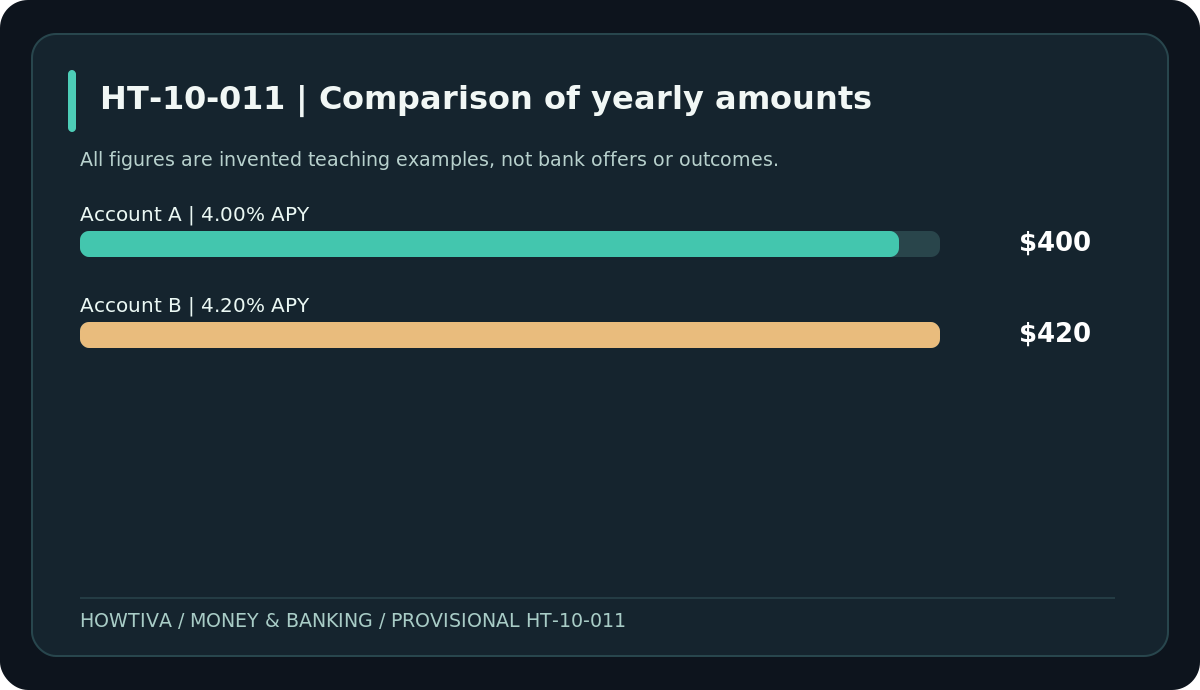
Suppose fictional Account A has 4.00% APY and fictional Account B has 4.20% APY, each constant for the year and accessible under identical conditions. With $10,000 left untouched, A earns $10,000 × 0.0400 = $400 and B earns $10,000 × 0.0420 = $420 before taxes and fees. The higher rate makes only $20 difference over that year for that balance. If your balance is $1,000 rather than $10,000, the same 0.20 percentage-point difference yields just $2, all else equal. This is not a current market-rate quotation.
4. Subtract fees and account-specific costs separately
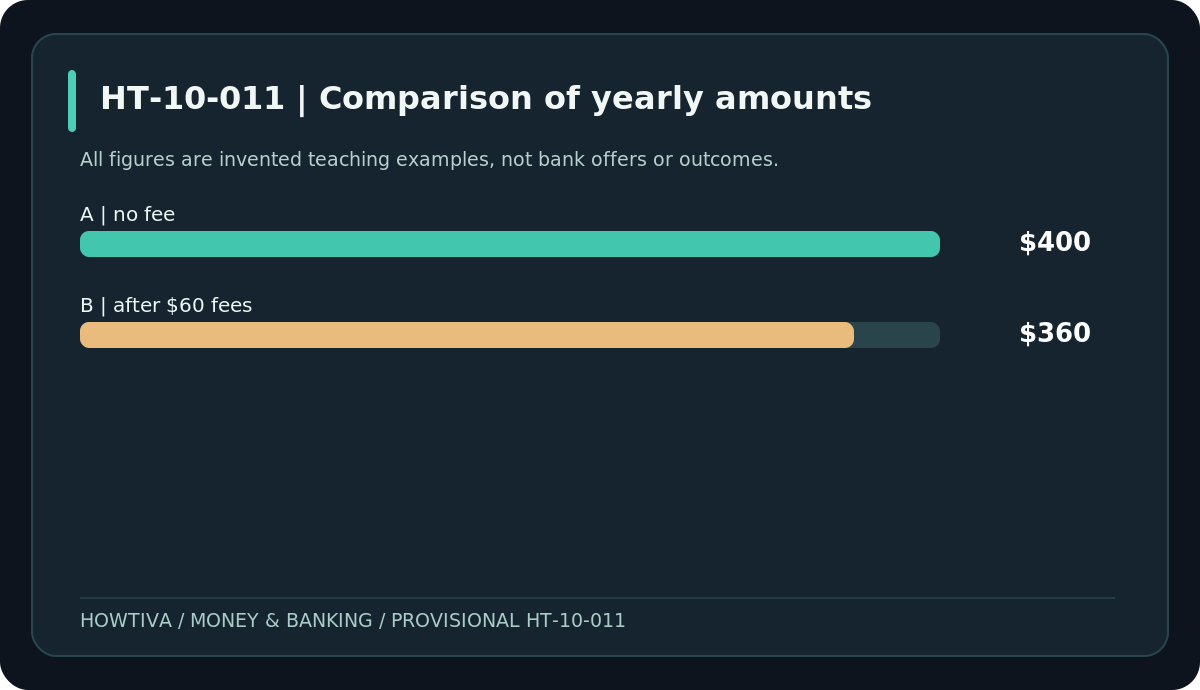
APY/AER does not directly tell you net-of-fee earnings. Imagine Account B also charges a fictional $5 per month, totaling $60 per year, but Account A has no fees under these assumed terms. B’s gross $420 minus $60 is $360; A’s gross $400 with no fees remains $400. B now trails by $40, despite advertising the higher yield. If fees are taken from the interest-bearing balance during the year, actual compounding will differ slightly; calculate cash-flow dates precisely for a real comparison. Consider minimum balance conditions, transfer charges, required linked accounts and the opportunity cost of leaving excess cash idle to qualify for a bonus.
5. Model promotions and tiers rather than extending them forever
A fictional promotion pays 5.00% annualised for the first three months, followed by 3.00% annualised for nine months. Using an expressly simplified, non-compounding time-weighted estimate for a constant $10,000 balance, gross interest is $10,000 × (0.05 × 3/12 + 0.03 × 9/12) = $350. The arithmetic does not mean its twelve-month APY/AER disclosure must be 3.50%; compounding, payment dates, timing and regulations can change the published figure. Use the bank’s legally required disclosures and actual day-count rules for a precise real-world model. If the advertised rate applies only above a threshold or only up to a cap, calculate each balance band separately. Never apply the top tier to your whole deposit without confirming the terms.
6. Test accessibility, risk and deposit protection
Ask whether you can withdraw any day, what notice or penalties apply, how long transfers take and whether a mandatory linked account creates extra charges. Check the legal deposit-taker and its insurance scheme, not just a brand’s logo. As checked on 27 October 2026, eligible US deposits at FDIC-insured banks have standard coverage of $250,000 per depositor, per insured bank, per ownership category; accounts in the same ownership category at the same institution are aggregated. The UK FSCS ordinary deposit protection limit has been £120,000 per eligible person, per authorised firm since 1 December 2025, with separate rules for temporary high balances. Australia’s APRA Financial Claims Scheme protects eligible deposits up to A$250,000 per account holder, per ADI. Canada uses distinct CDIC coverage rules, categories and eligibility; check the primary agency rather than transplanting the US number. These are legal protection regimes, not interest guarantees; eligibility and underlying licences matter.
7. Choose according to purpose and schedule your next check
For an emergency fund, safe, prompt access and reliable deposits may matter more than a small extra yield. For money set aside for a future known date, compare access restrictions and any early withdrawal penalty. Check the date your promotional term expires, set a reminder and recheck the rate and account terms regularly. Record why you chose the product so you can repeat the calculation when circumstances change.
Troubleshooting and common calculation errors
Your calculated interest is different from your statement: verify average daily balance, actual date range, leap year/day-count method, changes to variable rate, balance tiers, taxes withheld, when the interest was credited, and withdrawals. A 30-day month is not automatically one-twelfth of every bank’s annual accrual. Gross rate exceeds AER/APY or vice versa: check which number is nominal, whether interest is withdrawn, and whether a bonus is included. A promotion looks much better than its long-run cost: split the timeline and use different rates. An app claims deposit protection but has no obvious bank licence: identify the underlying regulated deposit institution and confirm coverage independently. AER/APY appears as a daily cash return: annualised percentages are not daily percentages.
Other methods and exceptions
For an account with changing deposits and withdrawals, use a dated cash-flow schedule, daily-balance calculations or the provider’s savings calculator rather than multiplying the ending balance by APY. For fixed-term products, compare early withdrawal rules, tax treatment and maturity date. UK ISAs have specific tax eligibility and rules; Australian bonus savers may require monthly deposits; Canadian high-interest accounts may pay tiered interest. Those are product-specific, not universal. Investments and money-market funds are not necessarily insured savings deposits; verify the product type. Never compare a deposit yield with a risky investment’s speculative return as if the risks were identical.
Country-specific guide — verified 27 October 2026
United States: compare disclosed APY under Regulation DD and separately audit fees. Confirm the bank is FDIC insured or, for credit unions, check the relevant share insurance; not every app balance is a traditional deposit. United Kingdom: compare AER with AER, check rate bonuses, tax status and eligible FSCS protection; if interest is paid away rather than reinvested, actual cash flow can differ from a compound-interest illustration. Canada: FCAC advises reviewing daily interest accrual, monthly credits, balance tiers, promotional periods and transaction fees. Australia: ASIC Moneysmart highlights bonus conditions, introductory rates, linked accounts and withdrawal restrictions; APRA coverage must be checked by the underlying ADI.
Frequently asked questions
Is APY the same as AER? Both describe effective annualised savings yield including compounding, but they operate within different disclosure conventions. Compare eligible products only after checking the exact terms and currency.
Does a 4% APY pay 4% every month? No. APY is annualised; a balance held only for part of a year earns interest according to its actual balance and the provider’s accrual rules.
Does APY include fees and tax? Usually not; calculate those separately and check tax rules locally.
Should I choose the highest displayed number? Not without checking eligibility, deposit protection, bonus conditions, access and total net benefit.
Can the bank change the APY tomorrow? Variable rates can change under product terms and applicable notice requirements; fixed-rate products have different conditions. Verify your own contract.
Final checklist
- I compared the same balance, currency and holding period.
- I used APY versus APY or AER versus AER, not APY versus nominal rate.
- I documented variable rates, tiers and promotion dates.
- I subtracted applicable fees separately and did not double-compound APY.
- I checked withdrawals, legal deposit-taker and insurance eligibility.
- I recorded the date of the offer and when to review it.
Sources & Further Reading
- CFPB — Regulation DD, Appendix A: APY calculation.
- MoneyHelper — AER versus APR.
- MoneyHelper — Comparing cash savings products.
- FDIC — Deposit Insurance at a Glance.
- Bank of England / PRA — FSCS limit from December 2025.
- FCAC — Savings accounts.
- ASIC Moneysmart — Savings accounts.
- APRA — Financial Claims Scheme.
Last researched: 27 October 2026. Illustrative numbers only. No specific account, interest rate or outcome is recommended or guaranteed.
Use the checklists as you go, and confirm the result before moving on to a more involved repair.