How to Compare Unit Prices and Save Money Shopping
Compare grocery unit prices per 100 g, kg or litre, work through a $3.60-versus-$4.40 example and avoid false bulk savings.
Quick answer: For comparable products, calculate unit price = selling price ÷ package quantity using the same unit for every option. Choose the lower comparable price only after checking actual usable amount, quality, fees and likely waste. A larger package is not automatically a better deal.
What you will finish: A shopping comparison you can do from a shelf label or online price, including a worked gram-to-kilogram calculation and an adjustment for products you cannot finish. All examples use fictional US-dollar prices for arithmetic illustration.
Why shelf price is not enough
A $3.60 pack can cost more per gram than a $4.40 pack if the first contains much less. Unit pricing places packs of different sizes on one denominator. The UK government, Australian ACCC and US FTC all explain unit pricing as a tool for comparing groceries; packaging shrinkage and multi-buy offers make it especially useful. But only compare similar things with equivalent functions: pure juice against pure juice, or usable food quantities against usable food quantities—not unlike products just because the labels show the same unit.
Before you begin
Write the total amount payable, the net quantity (excluding packaging), the unit (g, kg, mL, L, oz, lb, item, sheet), any store discount conditions, and the amount you need before spoilage. Bring a phone calculator or use shelf unit prices where they are clearly displayed. For variable-weight produce, price may be per kg/lb rather than per pack. If a promotion requires buying two items, include both purchases and their full cost, even if the second might go unused.
Remember that ‘per serving’ is not necessarily comparable across brands, because serving sizes may differ. Do not compare concentrated and ready-to-use liquids by bottle volume without adjusting for their dilution instructions and actual usable yield. For foods packed in liquid, verify whether the quantity is net weight or drained weight relevant to how you use it.
Step by step: compare two packs fairly
1. Select the common unit
For rice, use price per 100 g or per 1 kg. For milk or detergent, use per 1 litre. For batteries or identical rolls, per item may be reasonable; for toilet paper, sheets or area may be more informative if length and ply vary. UK and Australian shelf units can differ by product category. The mathematics does not depend on the country, but consistent units do.
2. Convert quantities before dividing
1 kg equals 1,000 g; 1 litre equals 1,000 mL. If one pack is 750 g and the other 1 kg, express both in grams or kilograms. Do not divide one price by grams and the other by kilograms and then compare the raw results. For imperial packs, convert carefully and do not treat fluid ounces (volume) as ounces (weight). If you lack a trustworthy conversion, compare using a common unit printed on both labels.
3. Run the full calculation
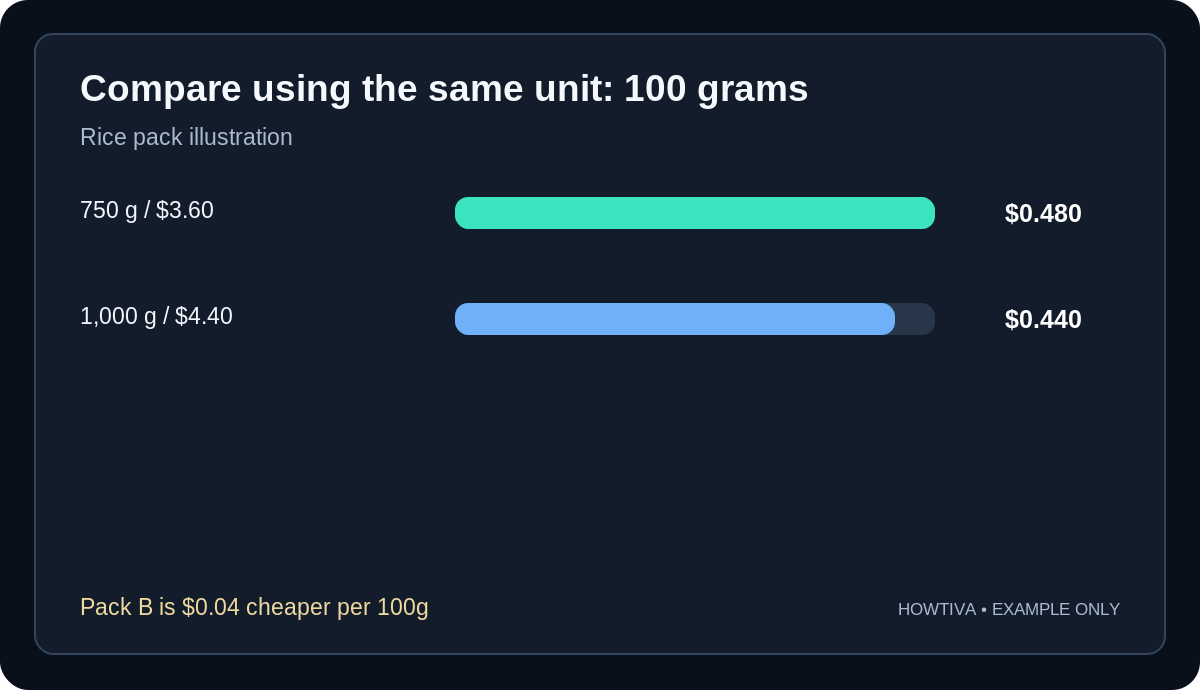
Assume pack A contains 750 g for $3.60. Price per 100 g = $3.60 ÷ 750 × 100 = $0.48. Assume pack B contains 1,000 g for $4.40. Price per 100 g = $4.40 ÷ 1,000 × 100 = $0.44. Pack B costs $0.04 less per 100 g, or $0.40 less per kg on this hypothetical price basis. If you need exactly 2 kg and can purchase two B packs for $8.80, versus a fractional equivalent of A priced at $9.60, the equal-quantity mathematical difference is $0.80; however, fractional packs may not be purchasable, so real checkout totals depend on pack combinations.
4. Account for multi-buy and coupons
A fictional ‘2 for $7’ offer on two 500 g packs makes 1 kg cost $7, or $0.70 per 100 g, if you actually buy both for $7. A single $4 pack of 500 g is $0.80 per 100 g. Do not assume the multi-buy discount applies when you purchase one. Include conditions such as loyalty enrollment, coupon expiry, tax treatment or minimum spending where they affect what you genuinely pay. For online shopping, delivery and service fees can change the overall cost of an order even when the displayed item price is attractive.
5. Check how much of it you will truly use
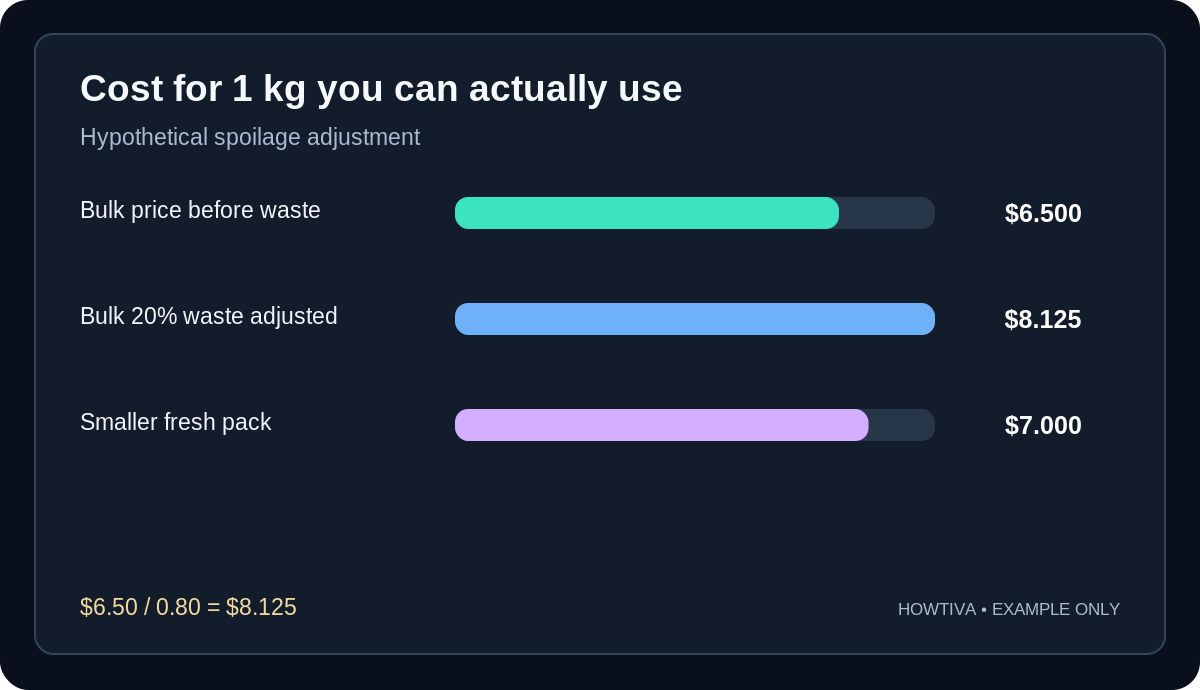
The least expensive shelf-unit price can waste more money if you throw a large portion away. Example: a fictional bulk perishable pack costs $6.50 per kg, but you expect 20% waste due to spoilage. Effective cost per usable kilogram = $6.50 ÷ 0.80 = $8.125, or about $8.13/kg. A smaller fresh pack priced at $7.00/kg, with negligible waste, is cheaper per usable kg in this specific scenario. Use a realistic waste estimate based on how you shop and store food, not a universal waste rate.
6. Include non-price constraints before choosing
Is the bulk purchase affordable this week? Is your storage space dry, cool and large enough? Will the product remain safe and usable? Does the alternative contain substantially different ingredients or concentration? Could the larger pack encourage additional use? Does transporting it cost extra? Unit price helps compare value; it does not override your dietary needs, product safety, or the total budget.
7. Save the method for repeat purchases
For a frequently bought product, note its usual price per unit and package size; a price change or package reduction will stand out. Use the same unit over time, and update the baseline when packaging or product concentration changes. Compare shop-by-shop only when delivery, travel costs and availability make the comparison practical.
Troubleshooting common price-label problems
Shelf label shows a different unit: convert one value; $0.44 per 100 g corresponds to $4.40 per kg. Pack has multiple pieces: divide total price by total comparable pieces, but account for differing sizes. Offer labels are unclear: calculate using the price you actually qualify for, ask staff or review checkout before assuming savings. Nutrition or concentration differs: switch to per-use or per-serving calculation only if dosage and yields can be compared sensibly. Online price differs from in-store: date-stamp prices, delivery fees and discount eligibility.
Rounding matters: retailers may display unit prices rounded to pennies. For close comparisons, recalculate from unrounded shelf prices and exact net quantities where possible. Do not claim a one-cent displayed difference implies a meaningful total saving without multiplying by the amount purchased.
Other useful approaches
For toilet paper, compare cost per 100 sheets or total area when sheet sizes differ and the data is available. For detergent, compare cost per recommended wash at the same soil level and machine conditions, but do not assume one brand’s doses equal another’s. For phone plans, compare the cost of meeting your actual monthly usage, not price per advertised unlimited unit. For household appliances, total cost of ownership may be more relevant than the retail price per unit.
Country notes — checked 27 October 2026
UK: official consumer material explains unit prices per standard weight or volume, often visible near the shelf price. Australia: the ACCC describes an industry Unit Pricing Code for covered grocery retailers, with product-specific standard units and exceptions. US: shelf unit pricing implementation varies by state and retailer; the FTC emphasizes reading net quantity and shelf unit prices as packages change size. Canada: store labels and units can vary; use the same conversion mathematics and check local consumer information. These differences should not be read as identical national mandates.
Frequently asked questions
Is the cheapest price per 100 g always best? No. Only if products are comparable and you will use the quantity without excessive waste or extra costs.
Should I buy a larger pack to save money? Only if the lower unit cost is real and your budget, storage and expected use justify it.
Can I compare solids and liquids directly? Not by confusing grams with millilitres. For a specific ingredient or concentrated product, use trustworthy density/yield information if necessary.
Why does my calculated unit price differ from the shelf? The display may be rounded, a promotion may apply only with conditions, or the net quantity may differ from what you entered.
How should I compare perishable foods? Estimate how much is likely to be edible or usable, and divide price by that amount as a separate practical calculation.
Final checklist
- Read the checkout price and correct net quantity.
- Choose one common unit for all options; convert first.
- Divide price by quantity, then multiply by the desired base unit.
- Adjust for promotions, loyalty eligibility, delivery fees and tax where relevant.
- Consider expected waste, product equivalence, shelf life and budget.
- Check that a larger pack really lowers cost for the amount you can use.
Sources & Further Reading
- UK Government — Unit pricing: information for consumers.
- Australian Competition and Consumer Commission — Unit prices for groceries.
- US Federal Trade Commission — The case of the shrinking packaging.
All prices and waste percentages are illustrative. Source review date: 27 October 2026.
Use the checklists as you go, and confirm the result before moving on to a more involved repair.