How to Organize Financial Records for Tax Season
Organize tax documents, reconcile income and receipts, and understand record retention differences across the US, UK, Canada and Australia.
Quick answer: Create one tax-year folder, gather income records and evidence for any deduction or credit you intend to claim, reconcile totals to your bank and payroll records, and keep a separate list of missing documents. Name every file with its tax year, issuer and document type. Keep the records securely for the period required in your own jurisdiction—do not assume the US, UK, Canadian and Australian rules are interchangeable.
What you will achieve: A usable annual tax-document checklist, a clear electronic or paper filing system, and a reconciliation worksheet you can hand to a tax preparer or use when preparing your own return. The system cannot decide whether an expense is legally deductible. All fictional amounts below are illustrative, not reported tax data.
Before you start: scope, supplies and safety
You need the tax year and country, a calendar of income sources, statements from banks or payment processors, employer or client tax forms where applicable, invoices and receipts, and access to a folder on a device you control. Use a password-protected device, a secure backup, and preferably multifactor authentication. A commercial tax app is optional; you do not need to upload identity documents to an unknown website. Keep original identity numbers and unredacted statements out of shared files.
Start with the year to which income or expense belongs, not the date you happen to download a statement. Some tax systems report business income on a cash basis, some on an accrual basis, and specific rules vary. When unsure, label the transaction clearly and verify its tax treatment rather than quietly shifting it into another year.
Step-by-step: build your tax-season records
Step 1 — Create one root folder for the correct tax year
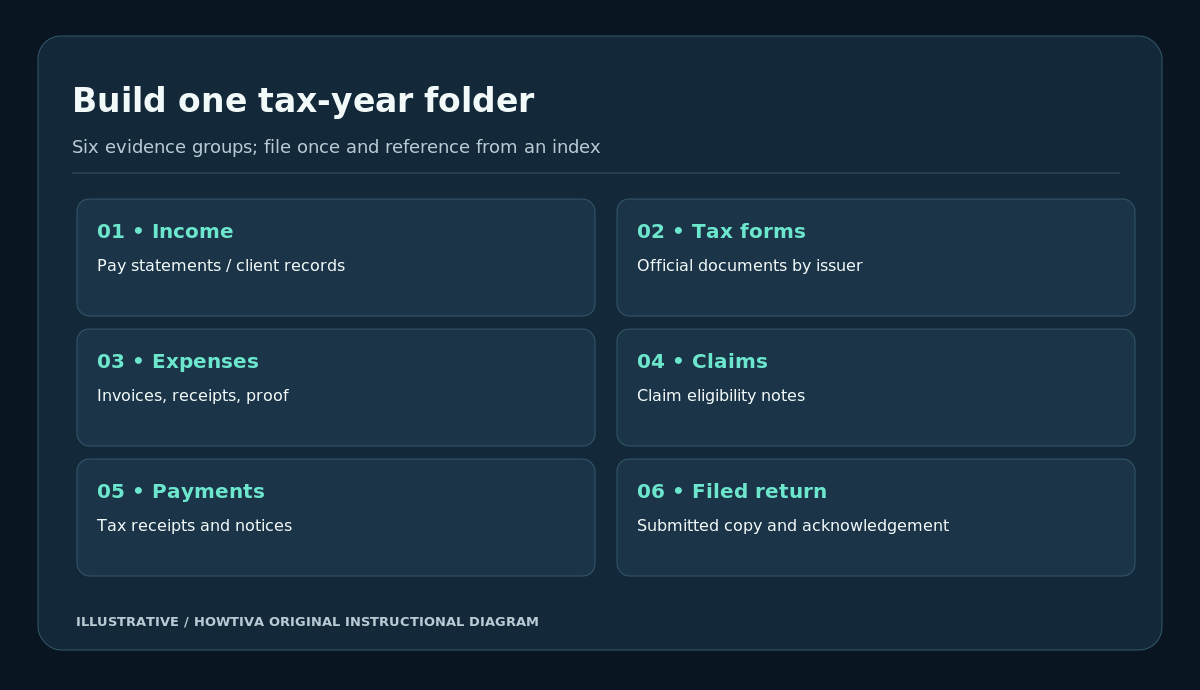
Use a predictable name such as Tax_2026_US or Tax_2025-26_UK. Within it create 01_Income, 02_Tax_Forms, 03_Expenses_and_Receipts, 04_Deductions_and_Credits, 05_Payments_and_Notices, and 06_Filed_Return_and_Workpapers. A joint household can add separate subfolders for each taxpayer, with appropriate access permission. The folder label is an organization method, not a legal filing-year determination.
Avoid a giant Misc folder. Put an item in the category that answers the question a preparer will ask: What does this prove? If a PDF supports both an expense and a credit, keep one source file and make a reference in your index rather than accidentally counting the same expense twice.
Step 2 — Collect income evidence before adding deductions
List all employers, contracting clients, freelance marketplaces, rental sources, bank interest accounts, dividend payers and other relevant sources. Obtain the forms normally issued in your country: for example, US W-2/1099 documents, UK P60/P45 or self-employment sales records, Canadian T4/T5 slips, and Australian income statements where applicable. These are examples, not a list that applies to every person. Compare each source to the year’s bank deposits and your own invoice ledger. A bank deposit may include loans, transfers or refunds; not every deposit is taxable income.
Keep a short missing-documents list with: issuer, expected document, contact details, requested date, and resolution. If a US W-2 or 1099 has not arrived, the IRS advises contacting the issuer for a copy or correction; available wage-and-income records can also be accessed through an IRS Individual Online Account. Do not treat an incomplete transcript as conclusive evidence that you had no income.
Step 3 — Build an evidence chain for each expense or credit
For every possible claim, record its date, payee, description, amount, currency, business or personal purpose, supporting file, and the tax position still to verify. Keep the detailed receipt, invoice or other evidence that establishes what was purchased, not just the account statement showing that money moved. A bank statement may prove payment without establishing deductibility. The tax agency or a qualified tax adviser determines whether the expense meets the rules.
Consider an illustrative self-employed person with three fictional records: $340 for work software, $115 for printer ink and $60 for a family streaming service. The documented business-spending subtotal would be $455, not $515; the third item is personal in this example. If the $340 software charge appears both on a bank statement and in an emailed invoice, it is still one expense. Whether the $455 is deductible depends on the relevant law and use.
Step 4 — Reconcile your income ledger against independent records
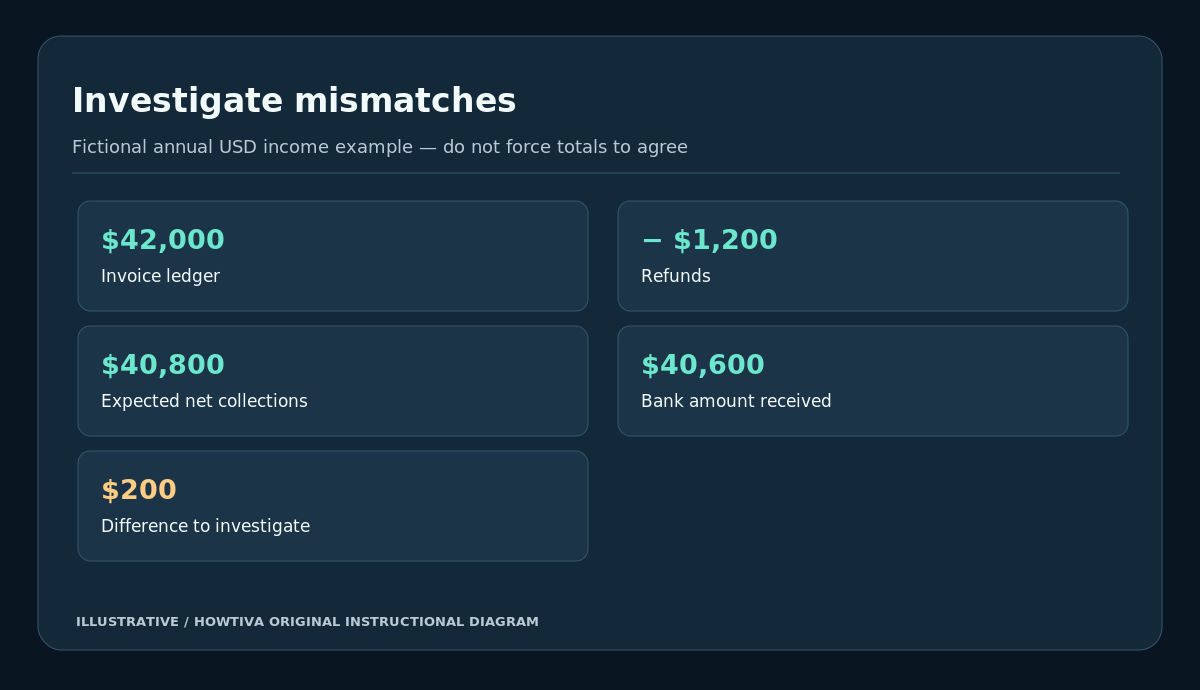
Build a spreadsheet with Date | Description | Gross Amount | Refund | Net Amount | Account | Supporting File | Notes. For a fictional annual ledger with $42,000 invoiced, $1,200 refunded and no other adjustments, net collections are $40,800. If the bank shows $40,600 received, investigate the $200 difference rather than forcing the two figures to agree. Payment processor charges, unsettled deposits, exchange conversions and calendar timing can cause mismatches. Record these as possible explanations, not automatic deductions.
Step 5 — Keep proof of taxes paid, notices and the return itself
Save withholding evidence, estimated payments, official receipts, and communications about adjustments. Record payment confirmation numbers without exposing login credentials. After filing, save the final submitted return, schedules, calculation workpapers and acknowledgement or notice. The filing confirmation is not the same as proof that every figure is accurate; leave a note for any later amendment or unresolved correspondence.
Use descriptive filenames: 2026-04-19_Supplier_Invoice_0341.pdf or 2026_EmployerA_W2.pdf (substitute your country’s document). Avoid filenames like scan3.pdf, which fail when you need the file years later. If downloading statements, prefer the original PDF or an accessible searchable format rather than an unreadable low-resolution screenshot.
Step 6 — Check for incomplete items without inventing figures
Read your missing list from top to bottom. Missing receipt? First ask the vendor for a duplicate, search the secure account portal, or ask the payer for a replacement statement. If an item remains unverified, leave it marked PENDING_VERIFICATION. Some tax authorities have procedures for reconstructed records, but they are not permission to fabricate expenses. Get jurisdiction-specific guidance before submitting an estimated or provisional figure.
Step 7 — Set the correct retention schedule and backup routine
Mark each folder with a review date, not an automatic deletion date. Retention depends on jurisdiction, filing date, late filings, asset basis, audits and other exceptional circumstances. Keep electronic copies readable and recoverable. Use a backup in a separate protected location; test that you can actually open a sample file from it. Do not store a spreadsheet of your full account numbers and passwords alongside your tax folders.
How long should you keep tax records in different countries?
United States — checked 27 October 2026: The IRS describes a general three-year assessment period for many returns, but the actual retention period varies. Some situations can involve six years or no time limit. Documents that establish an asset’s tax basis may need to be kept until after its disposition and the relevant limitations period. An IRS audit or pending claim can change the end date. Consult the IRS recordkeeping guidance for your case.
United Kingdom — checked 27 October 2026: For Self Assessment records involving self-employment, HMRC generally requires records for at least five years after the 31 January submission deadline for the relevant tax year. For other pay-and-tax records, the rule can instead be at least 22 months after the tax-year end for a timely return; late filings and enquiries change the analysis. Do not mix up the two rules.
Canada — checked 27 October 2026: The CRA instructs individuals to retain income-tax records for at least six years, with special circumstances potentially requiring longer. For most business records, the starting point is the end of the last tax year they relate to, not necessarily the day a document was created.
Australia — checked 27 October 2026: The ATO generally requires individuals to keep supporting records for five years from lodging the return; records associated with depreciating assets, disputes or other exceptions may need longer. Verify the current ATO rules for your type of claim. These periods are not a cross-country recommendation to destroy data when a timer expires.
Common mistakes and practical fixes
Missing a second income source: Revisit your full-year bank records, client invoices and all year-end tax forms; reconcile independently instead of relying on one employer’s document.
Treating gross receipts as taxable profit: Track revenue, refunds and business expenses separately. A net figure must be supported, not estimated from last year’s return.
Using a bank statement as a substitute for proof of what was bought: Attach receipts, invoices, mileage records or other evidence appropriate to the claim. Payment evidence alone does not establish business purpose.
Sharing the whole folder with a preparer via a public link: Give named people time-limited access through a secure method, verify the recipient, and revoke access after the work is complete.
Deleting after a universal three-year countdown: Different countries and special cases have different starting points and exceptions. Use a review flag and the actual applicable rule.
Alternatives and exceptions
A paper-only system works if documents are labelled, secured against fire or water and duplicated where appropriate. A spreadsheet works for most simple households; a bookkeeping application may suit larger contracting income. A tax-preparer portal may offer a controlled transfer process, but confirm its privacy settings and what happens to documents afterward. For estates, foreign accounts, trusts, business assets, litigation or past amended returns, consult the relevant authority or a qualified professional; this basic system does not cover every statutory obligation.
Frequently asked questions
Do I have to keep paper receipts if I scanned them?
Not universally. Some jurisdictions accept reliable electronic records under conditions, and certain originals matter for non-tax reasons. Verify your local requirements and ensure the scan is complete, readable, and retrievable before discarding an original.
Can I use a single spreadsheet for every country?
The columns can be similar, but tax years, currency, filing bases, required evidence and retention periods differ. Use separate year-and-country folders and do not assume the same tax treatment.
What if my tax form does not match my bank deposits?
Check gross versus net pay, timing, refunds, platform fees and transfers. Ask the issuer for a correction if an information form itself appears wrong; do not edit the form to make it match your worksheet.
Should I include every personal expense?
You may keep personal receipts for budgeting, but tax deductions and credits require specific qualifying rules. Keep private non-tax spending out of the preparer packet unless it is relevant to a legitimate claim.
When should I start organizing?
At the first income or expense of the tax year. A weekly five-minute filing habit reduces the scramble before a deadline, although a late start is still useful.
Final tax-record checklist
- [ ] The year, jurisdiction and taxpayer are identified on the root folder.
- [ ] Each income source has documentation, or an explicitly labelled missing item.
- [ ] Potential claims have dates, reasons, amounts and supporting evidence.
- [ ] Totals are reconciled; differences are investigated and not hidden.
- [ ] Payments, notices, filed returns and acknowledgements are saved.
- [ ] Access permissions and recoverable backups are checked.
- [ ] Retention review dates use the right country’s rules and special cases.
Sources & Further Reading
- IRS: Topic No. 305 — Recordkeeping
- IRS: How long should I keep records?
- IRS: Get your tax records and transcripts
- HMRC: Self-employed records — how long to keep
- HMRC: Keeping your pay and tax records
- CRA: How long should you keep your income tax records?
- ATO: Recordkeeping guidance for tax returns
Verification date: 27 October 2026. Educational explanation only; verify your actual situation and any legal deadlines with the relevant authority.
Use the checklists as you go, and confirm the result before moving on to a more involved repair.