How to Remove Ink Stains from Clothes
Check the care label, put clean absorbent paper towels behind a washable ink stain and test rubbing alcohol on a hidden seam before carefully dabbing from the back.
Quick answer: Check the care label, put clean absorbent paper towels behind a washable ink stain and test rubbing alcohol on a hidden seam before carefully dabbing from the back. Replace towels as ink transfers, rinse thoroughly, launder and air-dry to inspect. Some inks will not come out.
For some washable, colorfast fabrics affected by pen ink. Permanent marker, printers, gel inks and fabric dyes vary greatly. Rubbing alcohol can damage acetate, dyes, surface prints and adhesives; dry-clean-only pieces should go to a professional.
Before you begin: safety and materials
What you need:
- Clean white paper towels and a stable, protected worktop
- Garment label plus disposable gloves if required by product
- Small quantity of 70% isopropyl rubbing alcohol only if fiber/dye compatible
- Water for thorough rinsing
- Laundry detergent suitable for the garment
Step-by-step instructions
Step 1: Identify the ink and protect the work surface
Determine whether the stain is ballpoint, felt-tip, rollerball or an unknown printer ink if possible. Work on a protected surface away from heat and flames. An alcohol-based process is not suitable for every ink or fabric; an expensive printed garment may need professional help.
Step 2: Read the label and spot-test alcohol
Try a tiny amount of rubbing alcohol on an unseen seam, following ventilation and product safety warnings. Blot with white paper to check if garment dye transfers. If the seam changes color, stiffens or becomes tacky, do not treat the visible stain.
Step 3: Place fresh absorbent towels behind the mark
Turn the garment so the stain faces down against disposable white paper towels if construction permits. The backing must be clean and thick enough to stop ink reaching the table. Keep stained layers isolated from sleeves, linings or pockets.
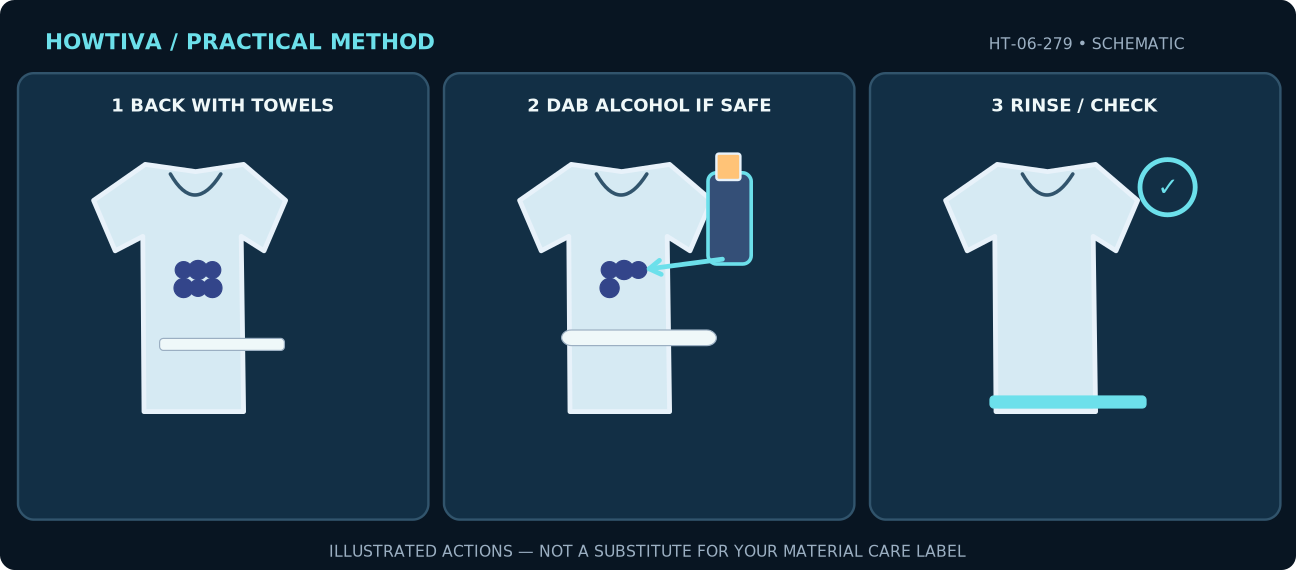
Step 4: Transfer ink gently from the reverse side
Using a barely wetted applicator, dab a compatible alcohol onto the back of the ink spot so ink moves into the absorbent towel. Replace towels often as they become stained. Do not soak the whole item or rub broad circles. Work away from flames and ventilate as labeled.
Step 5: Rinse thoroughly before normal laundering
Once the ink stops transferring, flush the treated area with clean water to remove residual alcohol and mobile ink, following the textile’s wet-care limits. Wash with appropriate detergent and the care label’s instructions. Do not add a second chemical to wet alcohol.
Step 6: Air dry and evaluate without heat
Inspect the fabric after washing. Dye transfer or faint shadows may be more visible on dry fabric. If residual ink remains, repeat only if both fabric and product continue to tolerate the treatment; otherwise stop rather than damaging the garment with many solvent passes.
Practical examples: when the procedure changes
Ballpoint ink on washable cotton
This is a plausible candidate for the tested alcohol-transfer technique. Work on a small section, renew paper towels frequently and wash after rinsing; do not promise a perfect result.
Ink line across a synthetic athletic shirt
Heat-set logos, print overlays and elastane blends may be sensitive to alcohol. Hidden-seam testing is essential, and a care specialist is safer if the ink crosses a large printed area.
Troubleshooting: what can go wrong
The stain spreads outward: Stop dabbing, replace soaked backing towels and confine treatment to a smaller section.
Garment dye transfers: Rinse as directed, abandon solvent treatment and seek professional textile advice.
Ink remains after one wash: Air dry, identify ink type and repeat cautiously only if compatible. Some inks cannot be removed.
The area feels stiff: Rinse thoroughly if safe, wash as directed and check for dissolved coatings or finish damage.
Alternatives, materials and model differences
For solvent-sensitive clothing, manufacturer-approved commercial ink removers may be available but must still be tested. Do not use acetone, hair spray or nail-polish remover as universal substitutes. Professional cleaning is often the only defensible option for structured or delicate pieces.
Stop conditions and when to request qualified help
Stop if fabric composition is unknown, dye bleeds, paint or print softens, skin or respiratory irritation occurs, or alcohol cannot be used safely. Never work near flames. Do not combine alcohol with bleach or other cleaners.
Frequently asked questions
Will rubbing alcohol remove permanent marker?
Not necessarily. Ink formulation and garment dye stability differ; some inks are effectively permanent.
Why use paper towels under the stain?
They collect dissolved ink and reduce the risk of redepositing it onto another garment layer.
Sources & further reading
-
American Cleaning Institute: Stain Removal Guide
-
American Cleaning Institute: Laundry Basics
Use the checklists as you go, and confirm the result before moving on to a more involved repair.